

Culture
FAF - a festival made by people dedicated to film
80 films are coming to the 32nd Original Film Festival, many of them with awards from the Cannes festival. It is organized by a citizens' association, without a dinar of state money

Why do they shoot films like "The Wedding" in Croatia and films like "The Gift" in Serbia, and why do audiences in both countries prefer "The Wedding". In ten days, nearly 380.000 viewers saw it
"With our colleagues from Croatia, we made a film that will be loved by the entire region, and we cannot do that in Serbia today," he said. Dragan Bjelogrlic regarding shooting Wedding in which he plays one of the main roles.
Wedding is a Croatian-Serbian co-production directed by Igor Sheregi, who is also the screenwriter of the film.
The wedding Both Serbs and Croats love it.i
It premiered in Serbia on January 28, at the Sava Center. The standing ovation lasted ten minutes. During only the first four days of screening in Serbia, more than 130.000 people saw it, which has not been recorded for decades.

Film Wedding has sold 378.007 tickets, including advance sales, from the Zagreb premiere on January 20 to February 1, announced Cinestar Cinemas, part of the Blitz group.
With that, he "achieved a historic result" and "a record income of 2.740.374 euros".
"This exceptional result was achieved in 29 Sinestar multiplex cinemas in Serbia, Bosnia and Herzegovina and Croatia, which have a total of 180 theaters and more than 26.000 seats. This is the highest result that a cinema exhibitor has ever achieved in the region in such a short period of time," the announcement stated.
Such a success of the film Wedding proves and shows many things, including that everything is okay between Serbs and Croats and that politics and politicians cannot do anything to them.
Previous films
As surely everyone already knows, Wedding is a love story that befell two families, one from Belgrade and one from Zagreb. Their children met far from home, fell in love, and had a baby. That's why now, together, we need to organize a wedding. Everything is going on nicely and as it should, with a lot of healthy laughter and joy - even though it is between Serbs and Croats.

Pre Wedding and after the last war, more films were made about the coexistence of Serbs and Croats, for example, Star, Constitution of the Republic of Croatia, On the other side, The last Serb in Croatia, The summer when I learned to fly.
They all talk about what makes us different and the same. And all those films were seen both in Croatia and Serbia, as well as in countries outside the region whose audiences have no idea that Serbs and Croats are officially considered enemies.
How do Croats do it?
The interesting thing about this story is that except Leta all the mentioned films come from Croatia.
It's not a coincidence. It's a decision.
While Croatian cinematography has nothing against stories that acknowledge the existence of the other in its own backyard, Serbia systematically produces films that reinforce the narrative of the eternal victim over whom the threat of the enemy constantly hangs. Among which Croatia is at the top of the list.
And how is it in Serbia?
The most obvious example of such a Serbian strategy is Dara from Jasenovac, a film that invokes the trauma of the NDH in order to use it to spread the image of Serbs as victims. Dara was used as a propaganda tool suggesting to the people not to go on vacation to the country on whose territory Jasenovac was once located, and to see in it only an enemy and nothing else.

In order for that message to reach everyone in Serbia, the film premiered on RTS, and in order for the world to see it, the film was sent to Hollywood as the country's representative for the Oscar award.
After the television premiere, the media announced for days that Daru was seen by 2.650.000 people, in Hollywood it did not reach the list of candidates for the Oscar, it was shown in America in 21 cinemas and, according to the Film Center of Serbia, it earned about 4000 dollars in the first weekend, which the local regime media interpreted as being the most watched in America, while they did not publish the data on the cinema audience.
Whether it's because of the corona or because of something in the film itself, just yet Dara did not stay in cinemas as long as the government expected.
Year is an exception
The summer when I learned to fly more than 200.000 people saw it only in cinemas, so without television viewers in Serbia and Croatia. Year the story of a twelve-year-old girl from Belgrade, Sofia, who spends the summer on Hvar on the Adriatic Sea with two grandmothers, the Croatian one of which she has never met. New family relationships, new society, new emotions and a new future for Us and Them, untainted by prejudices and imposed attitudes.

Year was recorded to spread love and not hate. He offered the audience what is close to him and what he needs, contrary to what the local cultural strategy offers him.
Who cares about hate?
The success of films dealing with Serbs and Croats persistently refutes the thesis about the deep, unsurpassed hatred between the peoples, which is proclaimed by politicians. They show that this hatred is a political project. Audiences respond to stories, not flags – and this is perhaps the most inconvenient truth for those who live by division.
Wedding is the latest evidence.
The only difference between Serbs and Croats that this film points to is the difference in production strategies.
And that's why: it's not true that blockers are watching this film because it comes from "there", as is of course commented on the networks, but because it talks about what people feel and love, and because it wishes them well.
80 films are coming to the 32nd Original Film Festival, many of them with awards from the Cannes festival. It is organized by a citizens' association, without a dinar of state money

Tomorrow "Zvezdara Theater" will celebrate the 400th performance of "The Book of Milutin" by Nenad Jezdić's monodrama. Plays that have been in the repertoire for more than a decade are currently being played in Belgrade. The musical "Some like it hot", even - three

More than 400 artists and cultural workers signed the request of the Initiative for Free Culture, which calls for the dismissal of all the leaders of cultural institutions in Pancevo.
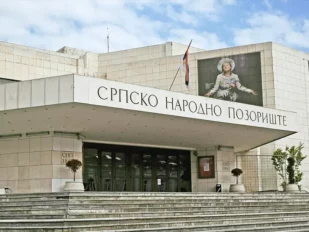
After the resignation of Dragana Milošević, the acting manager of the SNP, Željko Andrić was appointed the director of the Opera, even though the employees are demanding a change in the entire administration.

There is little information about the 61st October Salon. It is not known, for example, how the selected artists deserved to represent the current art world scene and how much it all costs

At the moment when the institutions of the Republic are destroyed, when Vučić's octopus is still alive, when people are disgusted by the injustice and the stench left behind by the Essenes regime, we have, as Machiavelli said, only civic virtue as the fuel with which we can return to the beginning

The four independent members of REM are an example of perseverance and civic responsibility. Rodoljub Šabić even, upon leaving the premises of REM, after the sentencing of the Informer, experienced that the Essenes insulted him, hit him with their hands and feet. But that too will soon be over

Vučić pardoned the batterers and Dijana Hrkalović. The election winners should abolish the sultan's power that allows one man to run afoul of the entire judicial system

Time explores: The construction of the St. Sava Temple
Did the money paid by the Government to SPC end up in Moscow through Alta Bank? subscribeThe archive of the weekly Vreme includes all our digital editions, since the very beginning of our work. All issues can be downloaded in PDF format, by purchasing the digital edition, or you can read all available texts from the selected issue.
See all



