Sixty years ago, the universe took a new direction on television. "Star Trek" was first broadcast on September 8, 1966, and the crew of the Enterprise embarked on a mission to explore the "last frontier," where, as the famous announcement read, no one had gone before.
It began as a television science fiction series, and soon became much more than that. The world of Kirk, Spock, Uhura and the rest of the crew became one of the most enduring representations of what it might look like. future of humanity.
Many have written about the phenomenon of Star Trek for "Time" over the years. About him, on the occasion of the 11th release of the film, he also wrote Mladen Kalpic, which emphasized the versatility and socio-political implications of film, which are as important as technical achievements such as the mobile phone, then appearing for the first time:
The 79-episode "Star Trek" television series created by former pilot and police sergeant Gene Roddenberry (1921-1991) under the working title "Carriage to the Stars", as an allegorically updated version of Swift's Gulliver's Travels, was the first to show a kiss on the TV screen between a white man and a black woman - crew members of this 23rd century ship - Captain James T. Kirk and Lieutenant Uhura.
Also, during the Cold War, he predicted a global thaw in Soviet-American relations when he included a Russian member - Chekhov - among the daring crew. During the escalation of the war in Vietnam, the highly respected Asian Sulu was on board the Enterprise.
Scientific significance
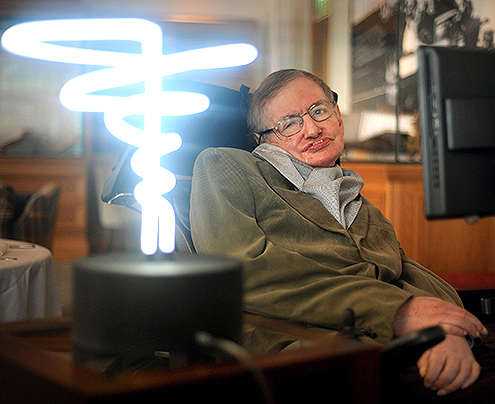
Given that Star Trek was conceived as science fiction, importance was also given to the scientists who participated in the series. Among them is the physicist Stephen Hawking, who is in the book The Cosmos in a Nutshell excerpt from "Time" published in 2002, wrote:
The key to the popularity of Star Trek is a safe and easy vision of the future. I'm a bit of a fan of the TV series myself, so it didn't take long to convince me to participate in an episode where I played poker with Newton, Einstein and Commander Data. I was the best, but, unfortunately, an alarm was declared, so I was left with no winnings.

Photo: APPoker player from Star Trek
Hawking also wrote about the world shown in the series and compared it to the science of that time.
The Star Trek vision of the future—where we have reached an evolved but fundamentally static level—can be realized in terms of our familiarity with the fundamental laws that govern the cosmos. There may be a definitive theory we'll come to in the not-too-distant future. That final theory, if indeed it exists, will determine whether the Star Trek dream of superluminal propulsion can come true.
As things stand now, we'll have to explore the Galaxy in a slow and laborious way, using slower-than-light spaceships, but since we don't yet have a fully unified theory, we can't completely rule out superluminal propulsion.
How Audiences Shaped the Franchise
The course of the series went in a different direction due to the demands of the audience:
The writers of the NBC television series were once taken aback when, in 1966, the newsroom began to be flooded with piles of fan letters marked "For Spock." The audience fought for this long-eared character to be equally represented as the Earth Captain, even though it was not originally intended at all. Nimoj remained privately imprisoned in this role, which despite all his attempts to engage in singing, photography and directing (most successfully with the hit Three Men and a Baby), he could not free himself, as the titles of his two autobiographies tell us: I Am Not Spock from 1977 and I Am Spock from 1995.
This was also understood by the producers of the latest film, who decided that Spock, played by the 78-year-old Nimoy, would magically appear in this prequel film, traveling through time to inform the young Tiberius Kirk of the phantom danger that is stalking him. So Nimoy remained in the role of space Sherlock Holmes for more than four decades.
Why Star Trek has been interesting for 60 years
Star Trek is a phenomenon that continues after 60 years. Kalpić wrote about how the phenomenon continues to live in the aforementioned text in 2009:
The appearance of this intergalactic monk today as one of the most persistent achievements of media culture in the past half century is interesting, while, opposite him, the pansexual "shameless" Catherine Tremmel, played by Sharon Stone, succumbed already after the second installment of Low Passions, losing the attention of the audience whose overexalted promiscuity it was supposed to symbolize.
In the age of info-aesthetics, when everyone communicates with everyone via the Internet and mobile phones as if from the command bridge of the Enterprise, it seems that we have all become Spocks more than ever. The hyperlogical Vulcan has become an adequate image of an epoch that first thinks and then only feels, because all the essential life juices have been poured out in the electronic labyrinth. Let's hope, therefore, that this man who replaced his scepter of passion with the golden key of logic must have his fairy Tinker Bell somewhere, as the final words from the sixth Star Trek movie suggest: "Which course shall we take, captain?" "Second star to the right and straight till morning," was the final command to the crew of the Enterprise's captain - a reference to the words of pointy-eyed Peter Pan.
The circle between the imaginary Nedoji plan and the volcanic plan is thus closed in our imagination very skillfully and, of course, we have no doubt that in the new film with Spock's otherworldly help, as in Peter Pan, everything will end happily. And everyone will live long and richly.
Real journalism costs money, and we will not be bought by tycoons and corporations. Support us with a one-time or monthly donation. The time for it is now!