

Culture
It was sad to be at the 69th Book Fair in Belgrade
The 69th Book Fair has ended, it lasted nine days, and it's as if it wasn't even there. The main publisher was Pošta Srbije, which is not a publisher
 Copyright © bpk – Bildagentur für kunst, kultur und geschichte
Three days after the capitulation of Yugoslavia, on April 20, 1941, Adolf Hitler celebrated his 52nd birthday. The ceremony was held in a special train that housed the "Führer's Main Headquarters Southeast" ("Führerhauptquartier Südost"), from which he monitored the attack on Yugoslavia and Greece, and which was stationed at the exit of the railway tunnel near Munichkirchen in Styria, about fifty kilometers from the Yugoslav border. Among the birthday guests, in addition to the military and party leadership of the German Reich, were Count Cano, Admiral Horti and Bulgarian King Boris "like vultures gathered around the corpse of Yugoslavia", and the celebration began with a concert held in front of the train. Then Hitler was presented with an appropriate birthday gift, the only war trophy from the dismembered Yugoslavia - a memorial plaque to Gavrilo Princip brought from occupied Sarajevo. The photo of the presentation of this gift was taken by his official photographer, Heinrich Hoffmann. Without taking into account this photo, which "Vreme" publishes for the first time, all polemics and analyzes about the beginning of the First World War, about the historical weight of the Sarajevo assassination, Young Bosnia and Gavrilo Princip, about the character of the Yugoslav idea, about the Second World War as a continuation of the unfinished First, can no longer be considered complete. The photo in itself has a wonderful and suggestive magic, but so does the story woven around it, which touches on the fates of Ivo Andrić and Kurt Waldheim, Eva Braun and Rodoljub Čolaković, the Spanish king Alfonso XIII and Murat Kusturica, Gavrilo Princip and Adolf Hitler... The photo speaks for itself: the Führer was happy that his army from a part of the world not worth the bones of a single Pomeranian grenadier managed to he brought as a gift the only thing from that murdered country that means something to him: the plaque with which Gavril Princip was honored in Sarajevo. The dead should be buried, Hitler thinks, and this plaque they erected in Sarajevo to celebrate their freedom and German humiliation is now a tombstone to their country and their dreams
The photo is, as usual, black and white. It was filmed on April 20, 1941 in a carriage of a special train America which at that time stood on the blind track of the Vienna-Graz railway, next to the entrance to the tunnel near the town of Menichkirchen. In the foreground of the photo, we see the profile of a neatly combed man and a board resting on the handles and back of an armchair. A man is standing with his arms crossed on his chest and is looking at the board with satisfaction. The man's name is Adolf Hitler. That day is his birthday, fifty-second. The record is a birthday present. On the plaque is an inscription in the Serbo-Croatian language, written in Cyrillic, in the Jekavian dialect. Hitler neither knows Serbo-Croatian nor reads Cyrillic. However, he suspects that the two words written in capital letters represent the name and surname of a young man who has been dead for almost a quarter of a century. He also understands that the number 28 indicates a date in the month of June. The last four characters on the board are four numbers: one, nine, one, four. He remembers that year well. He thinks: if only the penultimate and last digits were to switch places, if it read one, nine, four, one, it would indicate the current year, the year of his fifty-second birthday, the year of his triumph and revenge over the dead young man. He put things back in their place, he destroyed the country that the young man dreamed of, that was made of his dreams. Two congratulators, two uniformed officers from the background look at Hitler, see if the Führer, the man who has everything, who has the world and Europe at his feet, is looking forward to the gift. Unlike Hitler, they stand with their hands by their sides, in a calm attitude, as if on dead watch. The beginnings of a gentle smile can be sensed on all three faces. Hitler is smiling because he is happy because of the gift, the officers are happy because the leader is happy. In the frame is another armchair, the edge of the desk with a pile of papers and a lighted lamp. The photo is expertly framed. You can see the hand of the master.
1. PHOTOGRAPHER
The photograph was taken by Heinrich Hoffmann, Hitler's personal friend and official photographer. Richard Moorhouse1, an English historian of the younger generation (born in 1968), says that Hoffman is "one of the most important photographers of the twentieth century." Heinrich Hoffmann was born on September 1885, 1910, in Firth near Nuremberg. As a twelve-year-old, he became an apprentice in his father's photography shop in Regensburg. Hoffmann's father was the official court photographer of several aristocratic European ruling houses of the time, from the family of the King of Bavaria to the family of the Duke of Genoa. After his apprenticeship, he lived in London for a while, and after returning to Germany in 1914, he opened his own photography studio in Munich. A year later, he married Teresa Bauman, with whom he would have two children. On August 1920, 10, Hoffmann took the famous photograph in Munich of a crowd celebrating the start of the First World War. Years later, Hitler's figure was also recognized in the photo. Hoffmann and Hitler did not know each other then. They will meet only after the war, both as veterans. Hoffman joined the National Socialist Party as early as 1945. Hitler soon appointed him as his official photographer. In the next quarter of a century, Hoffmann took more than two million photographs of Hitler. However, their relationship was not only official. They were close, friends - in the truest sense of the word. Although he was personally ascetic, Hitler did not mind Hoffmann's penchant for tobacco, alcohol and other vices. Hoffman and his second wife Erna (Teresa died after World War I) introduced Hitler to Eva Braun, his lover and later wife. Hitler met her when she was seventeen, while she was working as an assistant in Hoffmann's studio. According to some sources, Hitler also met Theodore Morel, his personal physician, through Hoffmann, who would have a great influence on the body and spirit of his most famous patient. Morel, they say, treated Hoffmann for gonorrhea. During the war, Hoffman traveled with Hitler and took photographs tirelessly. The pictures he took show the Second World War from Hitler's point of view. The Americans arrested Hoffman on May 1950, 1955, the day after Germany unconditionally capitulated. He was sentenced to four years in prison. He was released from prison in XNUMX. He lived the rest of his life peacefully, in the countryside. In XNUMX, he published a memoir Hitler was my friend.. He died on December 1957, 2011. Today, some historians consider him a pioneer of photojournalism. More recently, Hoffman attracted the attention of the mass media at the end of XNUMX, after previously unknown photographs of Hitler taken during his rehearsals for public appearances were published. Two million times, Heinrich Hoffmann released the shutter of his camera with Adolf Hitler in the frame. However, let's not fall for the magic of big numbers. Like a needle in a haystack, like a tree in a thick forest, one out of two million photographs summarizes the spirit of the times. zeitgeist so to speak, and much more along the way.
2. BIRTHDAY PARTY
Since 1933, when the National Socialists came to power, the custom of solemnly celebrating Hitler's birthday has become established. On April 1933th of that year, the forty-fourth birthday of the "Fuhrer of the German People and Chancellor of the German Reich" was celebrated. From 1939 to 1939, however, those celebrations, although festive and public, were somewhat informal from a legal point of view. Nevertheless, on the seventeenth of April 20, just three days before Hitler's fiftieth birthday, April 17, the Fuehrer's birthday, was declared a national holiday. From April 20 to XNUMX, German newspapers write extensively about preparations for the celebration of the new holiday. This is the list of countries that sent a delegation to celebrate Hitler's fiftieth birthday: USA, USSR, France, Poland, Italy, Japan, Spain, Hungary, Belgium, Bolivia, Brazil, Bulgaria, Estonia, Finland, Greece, Great Britain, Yugoslavia2, Latvia, Lithuania, Netherlands, Norway, Portugal, Romania, Sweden, Siam, Slovakia and Turkey. On the night of April 45, Hitler and Albert Speer opened the East-West Axis, a seven-kilometer-long boulevard on which is the Brandenburg Gate. The next day, between eleven o'clock in the morning and half past four in the afternoon, a festive birthday military parade was held on the aforementioned boulevard. Six divisions participated in the 1500-kilometer march. 40.000 officers, 10.000 crews, and almost 1 military vehicles paraded. About one hundred and thirty days separated the world from the beginning of the Second World War. There are historians who consider Hitler's fiftieth birthday the peak of his life. Here is the suggestive assessment of one chronicler: "If Hitler had died that day, he would have gone down in history as the greatest German." Fate was not in his favor and he had to live another six full years, during which time he would lead the greatest war in the history of mankind." That war began on September 1939, 20, and before his fifty-first birthday, on April 1940 the following year, Hitler conquered Poland and conquered Denmark and Norway; shortly after his birthday, he conquered France, Belgium and the Netherlands. When he returned from occupied Paris in July XNUMX, his popularity among the German people was at its peak. All of Europe is practically his. And those parts that are not formally, they belong to him. On March 25, 1941, in Vienna's Belvedere Castle, one such ceremony took place belongings; Yugoslavia officially accedes to the Triple Pact. In the previous four months, before Yugoslavia, Hungary, Romania, Slovakia and Bulgaria joined the Triple Pact. The protocol was signed on one side by the representatives of Italy, Japan and Germany (Ribbentrop), and on the other by the representative of Yugoslavia (Cvetković). Ivo Andrić was also a member of the Yugoslav delegation. Two days later, when demonstrations break out in Belgrade (where the crowd shouts the assonantly rhyming slogans "Better war than pact" and "Better grave than slave") and the coup, Hitler at first will not believe that it really happened. When he believes it, he will be furious like never before in his life. He waved a telegram from Belgrade shouting that he had been betrayed in a humiliating way and that he was going to destroy Yugoslavia, regardless of what the new Yugoslav government might promise him. On March 27, Hitler had a scheduled meeting with Japanese Foreign Minister Yosuke Matsuoka. The meeting was postponed for several hours, and even Ribbentrop had to stop the already started talks with his Japanese counterpart. At one o'clock in the afternoon, in front of a group of officers from the army and air force and in front of his closest collaborators, Hitler orders that Yugoslavia be attacked militarily and destroyed as a country, to be erased from the world map, and urgently, as soon as possible. He expects the support of the Croats, and in return he will give them autonomy. He also expects the support of the Italians, Hungarians and Bulgarians, so he will also reward them territorially. Due to the attack on Yugoslavia, the attack on the USSR will be postponed, but not longer than four weeks. The army and air force are to deliver tactical plans for the attack to the Führer that same evening. There was no discussion. The start of the attack was set for April XNUMX, at five past twenty in the morning. The atmosphere in the Ministry of Propaganda was heated. Goebbels proposed, and Hitler accepted, that the official radio fanfare that will accompany the attack on Yugoslavia be the tones from the beginning of the Strauss March. Prince Eugene. At one o'clock in the morning, on the night between April 1914th and XNUMXth, Hitler and Goebbels discussed how long it would take them to conquer Yugoslavia. Hitler thought two months, while Goebbels thought not even that long. Hitler ordered that there should be no mercy in the bombing of Belgrade and the attack on Yugoslavia. While waiting for five twenty in the morning and the start of the attack, Hitler and Goebbels drank tea. They did not only deal with military topics. Hitler had an obsession to make his native Linz a cultural metropolis more important than Vienna. Goebbels proposed that the film industry of the Reich should be located in Linz to begin with, that there should be a German Hollywood there, so to speak. At five twenty, when the attack began, Hitler went to sleep, and Goebbels went to the radio to read the proclamation dictated to him by the Führer himself. The bombing of Belgrade and the attack on Yugoslavia are declared in that proclamation as retaliation against the "Serbian criminal clique" which, like in XNUMX, once again caused war in the Balkans. On the evening of April XNUMX, Hitler left for his advanced command post, on a special train America, stationed at the tunnel entrance near Munichkirchen. The night before, the British had bombed Berlin, the most thoroughly up to that point, even managing to hit the buildings of the State Opera, the University and the National Library on Unter den Linden Street. Hitler was angry with Goering because the German Air Force failed to stop them. On the train America Hitler celebrated his fifty-second birthday. Yugoslavia capitulated three days earlier3. Among the congratulators in Munich were the Bulgarian King Boris, the Hungarian regent, Admiral Horty, and Count Ćano - "like vultures gathered around the corpse of Yugoslavia", as noted by the famous Hitler biographer whose chronology we follow. A concert was played in front of the train, and Goering gave a speech in which he admired Hitler's military genius. Hitler was not interested in the territory of Yugoslavia. In his mind, he had long been concerned only with attacking the Russians. And he was happy that his army from that part of the world that is not worth even the bones of a single Pomeranian grenadier managed to bring him a gift that cheered him up, probably the only thing from that murdered country that means something to him: the plaque with which they honored him in Sarajevo Gavril Princip. The dead should be buried, Hitler thinks, and this plaque they erected to celebrate their freedom and German humiliation is now a tombstone to their country and their dreams.
3. A GIFT
Contrary to popular belief, the memorial plaque to Gavrilo Princip at the site of the Sarajevo assassination was not discovered in 1924 or 1934, that is, on the tenth or twentieth anniversary of this famous act. This is not the only information regarding the discovery of this monument that contradicts common prejudices. Namely, the plaque was not discovered at all on Vidovdan. The date was February 2, 1930, and the occasion was tomorrow's fifteenth anniversary of the execution of Danilo Ilić, Miško Jovanović and Veljko Čubrilović. According to the commentator of the Sarajevo newspaper Evening Post the date is quite arbitrarily determined. The same commentator announced on January 31, two days before the unveiling, that the event "will be modest and without special festivities." And so it was; not only that not a single, even the lowest, official of the government nor His Highness' representative attended the unveiling. V. Kralja, but the ceremonial academy that was planned at the National University after the unveiling of the memorial plaque was suddenly cancelled. According to the correspondent of the London "Times", the Yugoslav authorities in their internal diplomatic communication with the Western powers insisted on the information that the plaque was not raised by the state, or even by the National Defense, but only by individuals: friends of the assassins and members of their families. The reason for this is probably the economic depression and the increasing dependence of the country on money from abroad. The "Deutsche Algemeine Zeitung" of the same February, however, writes that the installation of the plaque is "a monstrous provocation that must not be tolerated", and writes off the non-attendance of representatives of the authorities at the ceremony as mere triviality. On the front page of "Politics" from February 3, 1930, under the title Unveiling the memorial plates to Gavrilo Princip, the Sarajevo correspondent of this newspaper describes the very act of unveiling as follows: "The mother of the late assassin Ilic took her place on the stand that was decorated with greenery and palm trees, as a symbol of peace." Next to her was Jovanka Čubrilović, the wife of the late assassin Čubrilović. Then Trifka's sister, Milena Grabež, Miško Jovanović's sister Mara. At eleven o'clock Mr. Vasilj Grđić, Milan Božić, Savo Ljubibratić, Hamdija Nikšić and Borivoje Leontić. As soon as Vasilj Grđić got on the stand, he turned to the gathered people and in an unusually firm voice directed the following words to the gathered people: 'People, we have gathered to pay our respects to the greatest of us. Today, today, the most dignified tribute to the post office is silence.' Sam Mr. Vasilj Grđić bowed his head and stayed like that for two minutes, then he raised his head high again and loudly shouted: 'Glory to the hero Gavril Princip!' The people accepted, and at this historic place they roared three times: 'Glory, glory, glory!' At the same time, the young nationalist Hamdija Nikšić, who was imprisoned as a high traitor during the war, lifted the white cloth from the memorial plaque. Then on Mr. Mr. Vasilja Grđić Borivoje Leontić, representative of the Dalmatian youth, sent the following words: 'I attach this wreath to the monument to the hero as a humble sign of recognition of young Dalmatia to the great hero.' After his words, they chanted again three times: 'Glory to him!' Receiving the silver laurel wreath, Mr. Vasilj Grđić: 'Thank you always to patriotic Dalmatia.' This is the end of this ceremony. The following words are carved in golden letters on the black marble plaque: At this historical place, Gavrilo Princip announced freedom on Vidovdan 15/28 1914. years. Before the crowd dispersed, he tore the greenery from the stands to keep as a memory of today's day, and then everyone dispersed in peace."4 (By the way, while the ceremonial unveiling of the memorial plaque to Gavril Princip is taking place in Sarajevo, King Alexander is preparing for a festive lunch with the students who were awarded the King's Prize by the University Council. The lunch began at noon on the second of February, and those present were the rector, vice-rector and secretary of the University of Belgrade, the Minister of Education, all faculty deans and awarded students.) Not forgetting, of course, Ilić's mother, Čubrilović's widow, Grabež's sister and Jovanović's sister, nor Milan Božić and Sava Ljubibratić, let's focus here on the main protagonists of the ceremonial unveiling of the memorial plaque: Vasilj Grđić, Hamdija Nikšić and Borivoj Leontić, as well as on the one who described this event to us, "Politika's" Sarajevo correspondent signed with the initials AK The first is delivered a speech, another unveiled the plaque, the third first decorated it with a wreath, and the latter told us the whole story. The memorial plaque itself was erected in 1928, but was officially unveiled only two years later. Vasilj Grđić, who spoke at the unveiling, is actually the author of the text engraved on the plaque. He was born in Gack in 1875, completed primary school in his hometown and Mostar, high school in Sarajevo, Faculty of Philosophy in Graz and Vienna. In 1910, he was elected a member of the Bosnian Parliament. He was the first defendant in the Banja Luka high treason trial (1915-1916), where one hundred and fifty-six people were tried. He was one of the 16 who were sentenced to death. However, through the efforts of the Spanish King Alfonso XIII, these convicts were pardoned. (Out of gratitude to this Spanish king, a street in the center of Banja Luka is still named after him today.) After the First World War, he was elected to the parliament of the Kingdom of SHS. He died three and a half years after the ceremony of unveiling the memorial plaque to Gavril Princip; October 26, 1934 in Belgrade. Hamdija Nikšić was also sued and convicted by Austria-Hungary during the First World War. He was one of the accused in the Travnica trial against members of the "Serbo-Croatian youth". The indictment accused them of advocating for the cultural and political unification of South Slavs into one state. Hamdija Nikšić was sentenced to two years in prison. The name of Hamdija Nikšić is also found in the book Sarajevo in revolution (with subtitle The Communist Party of Yugoslavia in the preparation and organization of the uprising) where, in the introductory part, a distinction is made between the part of the Muslim population that was loyal to the Nazis and the NDH and those who "carried by sincere patriotic aspirations" are attached to the partisan movement and the People's Front. Among the latter, some of the most prominent were "Dr. Zaim Šarac, Professor Husein Brkić, Sulejman Filipović, Hasan Ljubunčić, Hamdija Nikšić, the Karahasanović family and others." Borivoj Leontić's name can be found on the list of Yugoslav fighters in the Spanish Civil War. (We are not sure if a certain Boro Leontić, a colonel of the Yugoslav secret service in the second half of the 1947s and the short-lived head of the Belgrade Military Museum, is the same person, but it is tempting to think that he is. Namely, after they became aware in Yugoslavia in 1948 that is a high-ranking and silent associate of the Austrian Foreign Minister Gruber, who participated in diplomatic talks with the Yugoslav delegations in London and Moscow, in fact Kurt Waldheim, who is suspected of war crimes in Yugoslavia, In early 1972, representatives of the USSR secret services told Leontić that they had recruited Waldheim to work for them and that the Yugoslavs should not interfere in the case . until the end of 1981. In 1986, he was elected president of Austria. his the Nazi past becomes common knowledge. Alan Levy, an author who dealt with this problem, reports that the attempt to locate Leontić in 1986 was unsuccessful. It is known that the Spanish fighter Leontić died in Belgrade in 1980. If it's the same person, it's clear why he couldn't be found six years later.) As in some stereotypical story about Sarajevo, Bosnia and Yugoslavia, we have three people who are of the same gender, but by origin belong to three different religions. The only thing missing is a Jew, a cynic would probably say. However, there is also a Jew. Behind the initials AK Sarajevo correspondent political hiding the name of Abraham Cohen called Abo. We do not dare to go deeper into the family-Cohanite connections of this Abraham Cohen with other Cohens, but we will tell a summary of his fate. After Hitler's army entered Sarajevo and after they removed the plaque from the wall, the unveiling of which he wrote in Politicians, Abo Cohen and his family managed to avoid death or deportation to one of the concentration camps thanks to Cohen's fellow journalist named Rudy Rother. Roter was a native of the village of Potomje on the Pelješac peninsula. Leaving Sarajevo for his homeland, Roter convinces Cohen to go down south with him together with his family. For some time, the Cohens hide in Potomje near Rother, and later move to Trpanj and finally, after the Italian capitulation, join the partisans. In accordance with his journalistic profession, Abo Cohen starts working for the information sector of ZAVNOH (National Anti-Fascist Council of the People's Liberation of Croatia), as technical editor of "Vjesnik". According to the memories of his colleague, "known partisan journalist" Mahmud Konjhodžić, Cohen was "already an elderly man and weakly mobile" at that time. In May 1944, when the Chetniks attacked the Partisan hospital in the village of Krečani in Lika, they also slaughtered Abraham Abu Cohen, who escaped death at the hands of the Nazis and Ustasha only to end up at the hands of the Chetniks. In 2004, Rudi Rotter was named "Righteous Among the Nations" by the Yad Vashem Memorial Center in Jerusalem.
The Nazi army entered Sarajevo on April 17, 1941. The moment of removing the memorial plaque to Gavrilo Princip from the wall was recorded by a camera and included in a film journal (available at http: //www.youtube .on/watch?v=QhLeaqhPXVU). The shots of the Nazi tanks entering Sarajevo, the crowd cheering them and the raising of the German flag are obviously less important, because the longest part of this newsreel follows a group of men who carefully remove the plaque with the help of a ladder and hand it over to the Wehrmacht soldiers who pose theatrically with it. All this is accompanied by the voice of the announcer who speaks a few sentences in German. In translation, they read as follows: "Invasion of a Bosnian city." The German war flag is raised. In Sarajevo; here, on June 28, 1914, the Austrian heir to the throne became the victim of a cowardly assassination attempt by a Serbian student. Those shots gave the signal for the world war. The Germans remove the marble tablet and hand it over to the Wehrmacht. The board reads: Gavrilo Princip fought for the freedom of Serbia at this historical place. The Führer handed the board over to the Berlin Zeughaus5. "

The author of the quoted text obviously had a reliable translator from Serbo-Croatian. The inscription on the board actually begins with a phrase In this historic place which was literally translated into German in the film magazine (An dieser historischen Stätte). However, neither Serbia nor Serbia is mentioned anywhere on the board. From this lapidary interpretations of an anonymous German film worker, numerous journalistic and stage works will be developed, even in our time visions Princip's act. On April 21, the Associated Press agency reported from Berlin that the Nazi headquarters in the Balkans received information that the memorial plaque commemorating the Sarajevo assassination was handed over to Hitler yesterday by one of the first German soldiers who entered that Yugoslav city. . It was also announced that the plate will be publicly displayed in the museum as "proof of Serbian criminal blood guilt for the World War". On the first of July of the same year, on the occasion of the presentation of a memorial plaque to Adolf Hitler, the commentator of the NDH's "Sarajevo Novy List" triumphantly writes: "Sarajevo has washed away the stain of Vidovdan." (The form Sarajevo here is not a typographical error. In the first months of the Ustasha occupation, the name of the city was formally changed to Sarajevo, but the name Sarajevo was soon returned.) Less than four years later, on April 1945, XNUMX, the partisans liberated Sarajevo. Already on the seventh of May, even before the capitulation of the Greater German Reich, a new memorial plaque to Gavril Princip was unveiled. The ceremony is followed by a "big demonstration meeting" attended by the "President of the National Assembly of Bosnia and Herzegovina, Dr. Vojislav Kecmanović, members of the National Government of Bosnia and Herzegovina headed by its president Rodoljub Čolaković, members of the National Assembly, representatives of the National and local USAOBiH, youth delegates from the provinces ,and delegates of the youth of Greece and fraternal Bulgaria". Reporter Releases he further writes: "The rally was opened by Comrade Braco Kosovac and gave the floor to Comrade Dragoslav Ljubibratić, one of Princip's collaborators and a member of the revolutionary organization Young Bosnia and underlined the important role of the Bosnian-Herzegovinian youth - Princip's youth, inspired by the ideas of brotherhood and unity of all the peoples of Bosnia and Herzegovina, all the peoples of Yugoslavia, and emphasized their struggle against the reactionary politicians of the time, who advocated a compromise with Vienna. He ended his speech with the words: 'According to his ideas, Gavrilo Princip belongs to today's young generation, which finally and completely realized the aspirations that Gavrilo Princip started in those days.' After Comrade Ljubibratić, Comrade Cvijetin Mijatović spoke, then Croatian youth Mile Čačić and Muslim youth Nađa Biser." The memorial plaque itself was discovered by Borko Vukobrat, a "young man from Bosanski Grahov". The plaque read in golden letters: As a sign of eternal gratitude to Gavril Princip and his fellow fighters against the German invaders, the youth of Bosnia and Herzegovina dedicates this plaque Sarajevo 7. pestle 1945. years. There were no words on this plaque, which had been standing on the wall for, in all likelihood, ten years freedom. When the one who records this story, in the 1980s, was at the scene of the Sarajevo assassination for the first time, freedom was once again invoked on the new memorial plaque.6. But neither that plaque, nor the old one made of black marble, nor freedom, is anymore.
1 While still a student, Moorhouse worked as a researcher for Norman Davies, one of the most celebrated historians of our time. His first independent book Kill Hitler (with subtitle The Third Reich and conspiracies against the Führer) deals with all known attempts to assassinate Hitler, from the most famous (such as Kanaris' and von Straufenberg's) to some much more marginal ones. The conclusion of his book, however, is a consideration of the question of the meaning of tyrannicide. When in September 2011, CNN cameramen entered the office of Sadi Gaddafi, the Colonel's third son, they recorded, among other things, the aforementioned Moorehouse book on his desk. It is assumed that he read it just before his escape.
2 Yugoslavia was represented by the new royal Yugoslav deputy in Berlin, doctor Ivo Andrić. It is interesting that doctor Andrić handed over the letter of credit to Hitler in the building of the New Chancellery only a day before, i.e. April 19, 1939. The procedure was faster than usual precisely because of the need for the Yugoslav representative to attend the solemn celebration of the Führer's birthday. On the same day, the letter of credence was also handed over to the Reich Chancellor by the Slovak MP Matus Černak.
3 With the capitulation of Yugoslavia, the Germans had 344 Yugoslav prisoners of war under their control. Total German losses during the invasion of Yugoslavia were: 000 dead, 151 wounded and 392 missing soldiers and officers. It is interesting to compare the simultaneous German attacks on Yugoslavia and Greece. The aim of the attack on Yugoslavia was revenge, while the aim of the attack on Greece was strategic assistance to the Italians. Hitler expressly ordered that Belgrade be razed to the ground and that there should be no mercy for the Serbs, while he equally expressly ordered that Athens not be bombed at all, regretting, as he admitted to Goebbels, that he had to go to war against Greece at all. When he returned to Berlin eight days after his 15nd birthday, it was the last truly victorious return to the capital of the Reich. When it comes to the thesis that the postponement of the attack on the USSR due to the unplanned attack on Yugoslavia played a key role in Germany's failure to subdue the Russians before winter, opinions differ on its validity. On the one hand, Hitler himself believed in it. On the other hand, meteorological reports show that due to the wet, bad and cold spring of 52, the invasion of the USSR could hardly have started much earlier than June 1941, even if there had been no attack on Yugoslavia. There is, however, another detail concerning the impact of the "Balkan invasion" on Operation Barbarossa, which is not related to timing. Namely, during the attack on the USSR, German tanks had unusually frequent mechanical failures. According to one of the more convincing interpretations, the reason for this was "wear and tear" due to recent long drives on bad Balkan roads.
4 Truth be told, in Politika's article, the inscription on the plaque was not quite correctly conveyed; first, the name of the month of June was omitted, the dates according to the old and new calendars are separated by a slash, while there is a parenthesis on the plate, the word "year" was added at the end, which is not on the plate, the word Vidovdan is written on the plate as a semi-compound (Vidov-dan) , while the text says Vidovdan, and also the phrase "At this historical place" which is written on the plaque in Ijekavian, is quoted in Ijekavian in the text. (A modern commentator prone to unnecessary irony in this sense might find continuity in the language policy of this paper, but that is not the place here.) Let us quote the inscription from the memorial plaque here verbatim: At this historical place, Gavrilo Princip announced the freedom of Vidov and 15system. (28.) June 1914.
5 Zeughaus (old Arsenal) is the oldest building in Berlin's Unter den Linden street. It was built at the beginning of the eighteenth century, and since 1875 it has housed a military museum. In 1943, Rudolf von Gersdorf unsuccessfully tried to kill Hitler in this building. At the end of World War II, the building was heavily damaged in bombings. The later fate of the specific exhibit, the memorial plaque to Gavril Princip, a birthday gift to Adolf Hitler, is unknown to us. With the division of Berlin, the Zeughaus found itself in the GDR. In 1952, he was placed in this building Museum of German History, which interpreted modern German history from a communist perspective with its setting. The institution located there today, after the unification of the two Germanys, has a different but similar name: German Historical Museum.
6 On the plaque that stood at the site of the assassination until 1992, it was written (in Cyrillic): From this place 28. June 1914. Gavrilo Princip shot with his gun to express the popular protest against tyranny and the age-old aspiration of our people for freedom. It is reasonable to assume that it was installed on June 28, 1953, when the then mayor of Sarajevo, Dane Olbina, opened the Museum of Young Bosnia in the same place. Western journalists who came to Sarajevo during socialist Yugoslavia were usually unpleasantly surprised by this kind of tribute to Gavril Princip. The analysis of those writings deserves a more serious research. It is interesting that in the issue of June 28, 1964, on the fiftieth anniversary of the assassination, the New York Times published as many as three articles on the occasion. One of those texts is a report from the scene written by Joseph Berry. In the subtitle of his text, it is pointed out that an intending traveler in Sarajevo will discover that "the young madman from 1914 is remembered as a nationalist hero". It is worth at least briefly noting here a significant detail from his text. One of Berry's Sarajevo interlocutors, the man who told him about the connection between the Sarajevo assassins and the Partisan revolutionaries from the Second World War, was a "communist secretary for information, a friendly thirty-seven-year-old, former captain of the Partisan army" named Murat Kusturica. From 1992, when the plaque that shocked the New York Times journalist was removed, until 2004, there was no mention of that historical event at the Sarajevo assassination site; In 2004, the Sarajevo city authorities placed a plaque there with the (Latin) inscription: From this place 28. June 1914. Gavrilo Princip assassinated the Austro-Hungarian heir to the throne Franz Ferdinand and his wife Sofia. Below is the English translation.
 TWO PHOTOGRAPHS BY HEINRICH HOFFMANN: Munich, August 2, 1914, Hitler in a crowd celebrating the start of the war...
 Hitler rehearses for a performance in 1929.
 AESTHETICS OF NAZISM: Hitler on parade in Berlin on June 6, 1939.
 FIUHER'S BIRTHDAY: Goering, Keitel, Himmler and Hitler in front of a train in Munich, April 20, 1941.

 CULTURE OF MEMORY: Three memorial plaques to Gavril Princip in the Kingdom of Yugoslavia,...
 …SFRY…
 …and BiH
The 69th Book Fair has ended, it lasted nine days, and it's as if it wasn't even there. The main publisher was Pošta Srbije, which is not a publisher

From the first day after the victory of the Student List until today, 12 requests have been submitted for the removal of leading people in cultural institutions, all of whom were appointed by the previous government
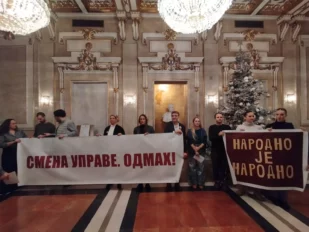
From Monday until today, the first week after the fall of Vučić, several requests for the removal of leading people in cultural and scientific institutions are published every day.

The authorities of Niš have chosen that the first International Film Festival of their city, apart from the Cultural Center, will also be organized by an entrepreneurial shop from Trstenik. The price of her service is not specified in the contract. And what does Željko Mitrović have to do with it

Most of the employees of Atelier 212 went on a warning strike, demanding the immediate resignation of acting director Ljubiša Ristić. That is why tonight's performances have been moved to 21 p.m

My honor is called loyalty, it was written on the metal buckles on the belts of the SS, which emphasized their loyalty to Adolf Hitler. Batina detachments of the Essenes wore phantoms on their heads instead of party insignia. Their loyalty was expressed in euros.

A lot was done in the first three days after the victory of the Student List. If you don't have that impression, you're just not used to normalcy yet

Why do we suddenly have no place to find out what Vučić thinks and who the "blockaders-Ustasha" are planning to kill? Why these pathetic attempts to fly over?

The archive of the weekly Vreme includes all our digital editions, since the very beginning of our work. All issues can be downloaded in PDF format, by purchasing the digital edition, or you can read all available texts from the selected issue.
See all




