
PR
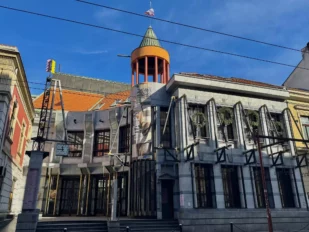
The repertoire of Atelier 212 for December
See the complete repertoire of the theater Atelje 212 for December. Find out the exact dates of performances on the "Mira Trailović" Stage and the "Petar Kralj" Stage
 photo: promo
Just a gawly girl
Just a bogus boy
Trape the fields of pheasant
To a chammer of not sleeping
Go home now, love
Leave your wanderings
(PJ Harvey, A Noiseless Noise)
Okay, so James Joyce set up his shop Ulysses in one single day. Polly Jean Harvey took another year to raise her heroine Ira-Abel Rawls from the stage of a nine-year-old girl to a woman. Whatever you think, nature, girlhood and language on the new album I Inside the Old Year Dying are the main heroes. PJ Harvey definitely knows why.
These days, PJ Harvey looks more like an enlightened heroine of British history in the Romantic era - something like Mary Shelley or Elizabeth Barrett Browning - than a erstwhile alt-rock femme fatale. After thirty-odd years of practicing the honorable profession of musician and composer, she has recently been recognized as a poet and author of theater, film and TV series music. There has been much speculation as to what Harvey has been up to in the seven years since her previous work The Hope Six Demolition Project, but with the release of the new record - things have become at least somewhat clearer. Or, on the contrary, not really.

DEDICATION TO GIRL'S INDEPENDENCE
If you look at the reactions after the release I Inside the Old Year Dying Harvey's - now for the independent Brooklyn label Partisan, after three decades of collaboration with the respected label Iceland - critics are mostly charmed and...confused. Listeners, too. It is enchanting to have a glimpse of the world of fairy-tale mystery, the feeling that a new legendary story is being born in front of you, such as England was full of in the past, but practically everything else is confusing. The poetic foundation of this album is found in her voluminous poem Orlam and develops through allegorical verses that seem to mysteriously connect apocalyptic biblical scenes with folk beliefs in ghosts and miracles, the most intoxicating versions of Shakespeare, John Keats and Bob Dylan, as if by some female stream of consciousness, as well as some imagined Elvis Presley who is not really that. But, above all else, there is a lot of feminine daring here from the English folk singer-songwriter Anne Briggs as well, and a sumptuous demonstration of the legacy of the divine voice of one Sandy Denny, from the same milieu of the 1960s and 1970s.
That is why it can be said that it is a plate I Inside the Old Year Dying a stunning tribute to British Isle maiden independence, awakening, boiling and causing magical events with her untamed sensuality. This is PJ Harvey's dedication to herself and to everything that she originally brought to the scene under her name at the very beginning of the 1990s.
Field sounds, whose original origins are distorted almost beyond comprehension, strange electronics, guitars, piano, unexpected wind instruments and above all the thinly curved voice of Polly Jean - which seems to belong to some mythological creature that calls out from leaves, trees, cracks in the ground, grass - all of this together fascinates us to the point of complete surrender and instantly seizes our attention, demanding an almost forgotten, ancient mechanism of perception, completely different from the one in which today transformed our sensory system for receiving and decoding data from the environment. This record seems to be crying out for that old-fashioned long-lasting and repeated "listening", which we used to indulge in!
PJ Harvey on his new album I Inside the Old Year Dying sincerely regrets that man separated himself from nature as his first habitat and carelessly discarded all those sensitive tools for receiving the truly important messages that were given to him at birth. This whole enchanting story of growing up, overnight, as it were, is a kind of mourning for the naivety that adorned our becoming human long ago. The unforgivable sin of hastily ripening in the present - fruits, vegetables, flowers, animals, human beings in the end - seems to her to be the crime from which everything else arose.
But alongside that sensitive exploration of the question of man's lost innocence, almost bordering on the dreams of William Blake, PJ Harvey - in the wise maturity of his own life - sings on the record I Inside the Old Year Dying longing for the breath of that inexplicable summer, after which the girls return to school changed, reddened by the heat of the sun and the touch of the intoxicating scents everywhere in the air, and their hearing sharpened by the capricious hum of insects that, in a ritual wedding dance, offer their fragile existence as a sacrifice to the awakening of their youth.
In this way, every creature, large and small, in nature serves to turn the eternal wheel of existence, being born, growing, decaying. But Polly Jean reminds us that there is also memory, a vocabulary of emotions, primal blessings and fairy tales. In the unstoppable flow of life, everyone is, at least for a moment, "me, personally".
THE MYSTERIOUS FORCE OF EROS
The language that PJ Harvey uses in his songs is a special story. Reaching into the almost extinct richness of the local Dorset dialect within which she was born, Polly Jean tells us that the language feels and, through the heart, he can quite easily understand. With this record, she forces us to strain ourselves so that we can really heard what is needed, teaches us to discard everything previously adopted and plunge into the sweet enterprise of pre-understanding where everyone is equal and eager to communicate with each other without remainder. Hence, unknown words are not really like that. If we just surrender to them with trust, she informs us, their meanings will come to us spontaneously and become an intimate part of our authentic experience.
Plate I Inside the Old Year Dying so is the kind of hallucinatory correspondence, pagan rite, psychotherapy in which our couch is - all of nature.
Entering the world of Polly Jean Harvey on this occasion happens instantly, without any preparation. The whine of some turbine in the distance and the haunting chirping of the intro Prayer at the Gate with the first appearance of the ghostly soldier-ghost ("As childhood died the old year/Made The Soldier reappear/The ash embowered night and day") flows into Autumn Term with a dreamlike howl doubled by the voice of a child and a woman, a woman and a man, beasts in the landscape, creating a soundscape of strange images from the inner life, ending with the children's cries: "I ascend three steps to hell/The school bus heaves up the hill".
And that is not the end of her efforts to touch the core of the first excitement across the chasm of time. U Lonesome Tonight. When she utters the words: "Are you Elvis?/Are you God?/Jesus sent to win my trust?/Love Me Tender are his words/As I have loved you, so you must", she directs these questions to that dreamy lover in to herself who is at the same time the strengthener of her own faith. Here, the pastoral Joan of Arc hears the words of her personal Christ through a rock and roll song.
As we have already said, Polly Jean dives into the sound of old heroines of English folk - in Seem an I with her vintage sound and rapturous rhymes ("Seem an I a childhood/of quartere'il and wormwood/of not-friends running nowhere/of vog a-veiling elsewhere") and the following The Nether edge - she seems to touch the world of the never-recorded songbook of Sandi Denny and Led Zeppelin, with her voice on serious challenges of rhythm like riding through fantastic landscapes from Alice from the other side of the mirror: "Now it looks it almost zounds/Wordle circles wider/With the silence upside down/Horse atop the rider".
Home I Inside the Old Year Dying perhaps most reminiscent of that old Polly Jean, so ghostly and irresistible, full of gloom that blazes, while All Souls - with its unusual brass sounds, mostly in the spirit of its older colleague Björk - conjures up a gloomy procession of wizards and wandering maiden souls that invoke a mysterious force of eros called Wyman-Elvis all the while: "A carnival, a flesh farewell/Hiessens rising from the, from the dead/'Wyman-Elvis', calls our girl/And counts the ash to where, to where he bled".
And all that further evokes the original tenderness of love, embodied in the significant verse: "Love me tender". Both songs dedicated to August on the album prophesy the end of childhood and the awakening of desire, cut by a feverish trance I Inside the Old I Dying, to A Child's Question, July started with a seemingly unusual style for this record, only to develop into a real one in the meantime The Battle of Evermore new age with actor Colin Morgan in a duo.
And finally, A Noiseless Noise marks the return of former PJ: "Absence, absence, absence/Cold moon comes down curdling, curdling/Through reddening leaves that are falling/Falling, falling, reddening", to end everything with a sweet melody and words like a dislocated prayer. When Harvey sends her love home at the very end of the song, advising her to stop her wanderings, it is like Anne Briggs blessing her lover to go his own way in the famous number Go Your Way. And that final buzz? Is it perhaps the soul of that fly from Titus Andronicus? Revenge of an indestructible nature? Polly Jean knows best.
Certainly one of the most poetically enigmatic and at the same time the most emotionally direct works with her signature, which will surely be explored in the years to come.
See the complete repertoire of the theater Atelje 212 for December. Find out the exact dates of performances on the "Mira Trailović" Stage and the "Petar Kralj" Stage

The director of the Šabac Theater announced that she was leaving because of, as she stated, continuous persecution and threats. Sabac students assessed that the resignation represents taking responsibility for the crisis in the theater, but does not release the director from responsibility for earlier actions

Nikola Selaković spoke at the hearing about the General Staff. The defense and the prosecution presented opposing views on the legality of the procedure by which the General Staff's status as a cultural asset was revoked

The portal "Vremena" wrote about the national pensions of artists and the annual awards of the National Theater. We are publishing a review of choreographer and professor Aleksandar Ilić on these topics

An exhibition about the Cyrillic alphabet is starting in the Graphic Collective Gallery, which is the right way to interest the public in the national alphabet - with beauty, not with pressure and punishments, as was done by the previous government

The former head of the BIA, Aleksandar Đorđević, was Vučić's staff. Now the BBC has published a strange interview with him in which Đorđević seems to be trying to wash himself, but somehow lukewarm

Why did an unusual group of people led by Aleksandar Vučić, at the constitutive session of the Assembly of Serbia, go berserk because of yogurt spilled on the head of a member of parliament, a "reputable artist" and, of course, a woman?

How Aleksandar Vučić convinced the public that progressives are not worthy of the position of vice-president of the National Assembly and how its president - Aleksandar Čupić - explained to him theoretically and practically what parliamentarism is in front of everyone

Change of power in the National Assembly
Majority, minority and high expectations subscribeThe archive of the weekly Vreme includes all our digital editions, since the very beginning of our work. All issues can be downloaded in PDF format, by purchasing the digital edition, or you can read all available texts from the selected issue.
See all



