"The most significant document I found in Tito's archive was the draft of his message to the United Nations announcing the Yugoslav attack on Zone A of the Free Territory of Trieste. This tells us that Yugoslavia would have reacted militarily if Italy had occupied Trieste in the fall of 1953 with the consent of London and Washington. So, in those days of great tension, there really was the possibility of an armed conflict between Yugoslavia and Italy," Federico Tenca Montini tells us. historian, graduated sociologist, who wrote his doctoral dissertation on the Trieste issue, and then, based on the thesis, published a book We do not give Trieste. Yugoslavia and the Trieste Question 1945–1954, which saw several editions in Italy, two in Croatia and two in Slovenia. Now the book is also published in Serbia, the publisher is "Akademska knjiga" from Novi Sad. Our interlocutor will emphasize that this is an important topic, which has not been researched and written about in this way. We talked with him about the most important moments in those nine years of the Trieste crisis from 1945 to 1954.
RIOTS IN BELGRADE
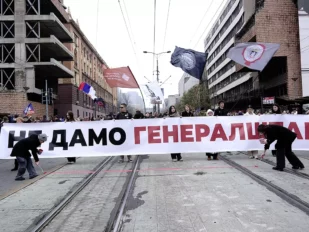
The Trieste issue was one of the main issues of Yugoslav post-war politics and left a deep mark in the memory of older generations. In the case of Serbia, the episode of unrest in Belgrade in October 1953 is particularly memorable, when the English and Americans announced the news that Trieste would be handed over to Italy. This caused several days of riots during which the buildings of Western embassies were destroyed. "The incidents in Belgrade left a strong impression on the people of that time and were spectacular: diplomatic buildings were pelted with stones, and an effigy of the then Italian prime minister was burned in the city center. For several days, important Yugoslav politicians, including Milovan Đilas and Moša Pijade, addressed the masses with various arguments, which included a vulgar joke addressed to Clare Boothe Luce, the American ambassador in Rome, who really played a significant role in protecting Italian interests in Washington. After the protests, the British and American cultural centers were moved to the peripheral parts of the city and lost some of their cultural influence," says Montini. However, it will remind you of the historian Darko Bekić in his classic work Yugoslavia and the Cold War noticed that, unlike the riots in Trieste a month later, no one was killed in Belgrade. "In any case," continues Montini, "those riots, probably spontaneous in the initial phase, were intelligently used by the Yugoslav government. They were an expression of the resentment of a country that could not accept not being at the negotiating table, but they were also a useful instrument to soften too much rapprochement with the West at a time when, after Stalin's death, the dance with the Eastern Bloc was starting again. If the trend of rapprochement with the West continued, perhaps at some point the very survival of the regime would be called into question. Crisis in relations with the West, caused by the surrender of Trieste to Italy, was therefore described in diplomatic correspondence as a 'second call to Bucharest', i.e. a shock comparable to the Informburo crisis, after which relations could not return to the state they were in before."
FORTY DAYS OF TRIESTE
It all started on May 1, 1945, when Yugoslav units entered Trieste, clashing with German forces. Post-war research, says our interlocutor, suggests that the Yugoslav troops in the final phase of the war numbered a total of about one hundred thousand men, most of which came from the Fourth Army, and the remaining part, at most a fifth, from the Ninth Slavic Corps. But, of course, not all of them stayed in Trieste; after liberation, part of the troops continued towards other cities, such as Gorica and Monfalcone. "Just in the final phase of the 'race for Trieste', from March 1, 1945 until the end of the operations, the Yugoslavs had about 2000 dead and wounded. The amount of weapons is also impressive: 366 cannons, 622 mortars, 80 tanks, howitzers and armored vehicles, and 4184 machine guns and machine guns. The Fourth Army was commanded by General Peko Dapčević, and among the soldiers there were also those who would later achieve important careers, such as Milka Planinc and Večeslav Holjevac", says our interlocutor. Regarding the behavior of Yugoslav units when entering Trieste, whether there was retaliation and terror, he will say that this is a topic that has attracted a lot of attention in Italy in recent decades and fits into the European trend of questioning the dark aspects of the Second World War and the behavior of the victors. "Yugoslavian troops and the political detachments that accompanied them", says Montini, "really carried out numerous arrests of people accused of various crimes, above all of collaboration with the Nazis. Several hundred of these people died in different camps. I think it is not much different from what happened in Yugoslav cities at the time of liberation. However, the fact that Trieste did not belong to Yugoslavia before the war and that it had a majority Italian population made these events a subject of international discussion. It is paradoxical, on the other hand, that it is almost as if we stopped being interested in the crimes committed by the defeated".
Yugoslavian control of Trieste lasted 40 days, at the end of May, the Americans and the British began to put strong pressure on Yugoslavia to leave Trieste and Gorica, and on June 12, Yugoslav troops retreated eastward, across the Morgan Line. "It can be said that their pressures, aimed at curbing the spread of communism - because no one harbored illusions about the character of the regime that was formed in Yugoslavia - were a sort of announcement of the Cold War. At one point, the situation even came close to an open conflict between Anglo-American and Yugoslav troops. In such a situation, on May 8, Tito withdrew Yugoslav forces to the east of the Morgan Line, which was a temporary border proposed and presented in Belgrade by British General William Duty Morgan (William Duthie Morgan). Thus, Trieste and Gorica were left to the Anglo-American military administration, and Yugoslavia, as an ally, maintained a symbolic military presence in Zone A, the area west of the Morgan Line," explains Montini.
DIPLOMATIC BATTLE
The Trieste issue is part of the wider picture of the Cold War. In the summer of 1946, the great powers, the USA, Great Britain, the USSR and France, could not agree on the affiliation of Trieste. That is why the possibility of creating an independent state began to be considered - the Free Territory of Trieste (STT), which, regardless of the opposition of the Soviets and Yugoslavs and, for other reasons, the Italians, was finally approved by the Paris Peace Agreements signed on February 10, 1947. "The Italians, the Soviets, and the Yugoslavs opposed the Free Territory of Trieste for various reasons. For the Italians, it was a maneuver to delay the return of the city to the motherland, a solution that would tie them to American and British politics in the long term. It was clear to the Soviets and Yugoslavs that the Anglo-Americans would certainly not give Trieste to Belgrade in the end. That is why Yugoslav diplomacy, especially in 1946, engaged in direct negotiations with the Italian communists, who were part of the Italian government at the time. Yugoslavia tried to get Gorica in exchange for the handover of Trieste to Italy, but Italian politics, except for the communists, rejected such a solution, because, among other things, the Yugoslavs occasionally supported STT, counting on some kind of joint management with Italy. But that didn't work either," adds Montini.
We are also talking about how much Josip Broz insisted on the area of Trieste. Did he use it as leverage in negotiations, and did he really hope that Yugoslavia would get a larger part of that area. Montini will emphasize that there are generally no traces of the intimate expectations of individuals in the archive material, but that while researching the documents and archives, he got the impression that Tito did "hope" for territorial expansion for Yugoslavia in the area of Trieste, but that he did not rely too much on it. "In the dynamic situation of the Cold War," continues Montini, "there was always the possibility of some 'pleasant surprise' happening. Yugoslavia masterfully used the Trieste issue in international negotiations. At one point, when, after the Informburo crisis, Belgrade's survival depended on the West, the 'unresolved Trieste issue' often served as an excuse to avoid excessive rapprochement with Western powers on the political and military front."
INTERNATIONAL RELATIONS AND NATIONAL ARCHIVES
This international structure is a good basis for another important topic - the position of Yugoslavia in the eyes of the international community, which varied depending on the period. In the first post-war years, the country quickly squandered the prestige gained in the partisan war, positioning itself as a communist dictatorship, in some respects even more aggressive than the Soviet Union. "After the conflict with the Informburo, resistance to Moscow brought Yugoslavia a certain amount of sympathy in the world, as well as significant economic and military aid from the West. The status of a socialist country independent of Moscow gave results very quickly, and Belgrade had an original role in international relations, a role that, after Stalin's death, was recognized even by many socialist countries, looking at Yugoslavia with a touch of envy. At the beginning of the fifties, Belgrade's special closeness to the West earned the country a title that Tvrtko Jakovina gave to one of its first books - American communist ally. At that time certain political concessions were made to the West, as well as the creation of a cultural climate very favorable to Western music, literature and film. "Also, in the field of military cooperation, through the Balkan Pact with Greece and Turkey, a sort of indirect connection with NATO has been reached," says Montini.
While writing his doctorate, which served as the basis for the book, Federico Tenka Montini researched the diplomatic archive of the Ministry of Foreign Affairs in Belgrade, Tito's personal archive, and the fund of Vladimir Bakarić and the Demarcation Commission, as well as the Military Archive and the Archive of the Republic of Slovenia in Ljubljana, as well as the writings of Edvard Kardelj, Minister of Foreign Affairs from 1948 to 1953, whose archive is scattered in Serbia, while there is a copy in Ljubljana. Regarding the availability of archival material that served him to write the book, our interlocutor will say that "Tito's archive" is available in the Archive of Yugoslavia without special restrictions, and the same applies to diplomatic materials in DAMSP. "I assume that military personnel in the Military Archives are under a stricter regime, but I wouldn't say that the documentation on the eastern coast of the Adriatic is less accessible than in Italy, on the contrary, I would say that it is the opposite. Moreover, even though I am a foreigner, I have always encountered the help and kindness of the staff in all the archives. I remember a colleague from Belgrade who, at the beginning of the research, asked me if I ever felt that the archives were 'cleaned'. I answered him that the fact that we were not finding what we expect does not mean that someone stole it. In the end, we concluded: 'Paranoia is a serious and incurable disease,'" says Montoni with a smile. "As a historian", continues our interlocutor, "I would also add that the selective removal of materials without leaving obvious gaps would require highly specialized personnel and countless working hours".
Tito's fist over Trieste
On the cover of the Serbian, Croatian and Slovenian editions there is a portrait of Josip Broz holding a map with his fist, and under his fist is Trieste. The picture was painted in 1947 by the portraitist Pavle Jovanović and was in Josip Broz's Cabinet for several years. However, due to dissatisfaction with the territorial solution, in 1954 it was transferred to the National Museum in Belgrade, where it is still today, with a ban on public display.

Famous slogans
How important the Trieste issue was in Yugoslavia is also shown by the slogans that even the younger ones will remember to this day, such as "Zone A and Zone B, they will both be ours", "The army is strong, we will not give Trieste" or "I give my husband, I don't give Trieste". Also, at the protest in Belgrade in 1953, the masses chanted: "If there are bombers - Silvana will be ours too", referring to Silvana Mangano, one of the most important and provocative actresses of Italian neorealism, who was apparently also known to the Yugoslav audience in those years.
Key events and dates of the Trieste Question 1945–1954
Liberation of Trieste on May 1, 1945.
Yugoslav troops withdraw eastward, across the Morgan Line, June 12, 1945.
The visit of the International Commission, which still failed to come up with a unified proposal for the border, spring 1946.
The peace treaty created on paper by the Free Territory of Trieste on February 10, 1947.
The entry into force of the peace treaty, which caused great tension, September 1947.
Tripartite declaration of the USA, Great Britain and France, recommending the surrender of the entire STT to Italy, March 20, 1948.
Resolution of the Informburo, June 28, 1948.
The decision by which the USA and Great Britain divided the STT, giving Trieste to Italy and Koper to Yugoslavia, October 8, 1953.
Signing of the London Memorandum. by which the Free Territory of Trieste (STT) ceased to exist. Zone A was handed over to Italy, and Zone B to Yugoslavia, and the allied forces withdrew on October 5, 1954.
(the author is a journalist from Rijeka)