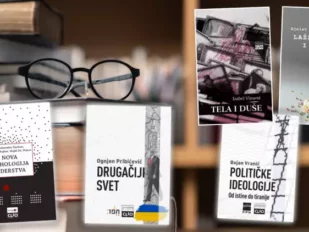
Giuliano da Empoli: Wizard from the Kremlin Booka, Belgrade, 2024; translation from French by Novak Golubović
The main characters of Giuliano da Empoli's The Wizard of the Kremlin are Vladimir Putin, Boris Berezovsky and Vadim Alekseevich Baranov, who may or may not be a real character. However, the fact that Baranov (perhaps) never existed other than as a character in a novel does not mean that what he says and does is any less true than what Putin (a real character, alive and at large) says and does, or what was spoken and acted by Berezovsky (also a real character, but dead). It doesn't matter if it's Vadim Baranov really was Putin's loyal companion in the creation of monsters, a machinist from the Kremlin to whom the door of the most important office was (almost) always open, a man whom Khazyayin entrusted with demanding and subtle tasks (and he carried them out without question) and who was always on the defense of the fatherland, in place and at a time when difficult decisions were made: in a helicopter, for example, which Putin, Putin's personal secretary Sechin (probably a real character, because such a thing is impossible to invent), he takes Baranov himself and several generals to the front in Chechnya, where the Russians are not doing very well; in Sochi, in the state villa, where together with Putin he watches and listens to the media, which, not at all favorably towards the Tsar (that's how Baranov addresses Putin), comment on the sinking of Russian nuclear submarines (Putin will no longer allow himself such recklessness as to leave a free media in Russia, and precisely Baranov will be the broom that will neatly clean and balance it all); at the court itself, the team realizes that the virus of patriotism should be injected into the voting body of Russia, and for the sake of the Tsar's survival in power. It is not important here whether Baranov was made according to a model, according to a real person, because of course the courts of tyrants are full of some kind of Machiavellian and characters devoid of any scruples, and not even a little stupid - let's add, the master is as afraid of them as the people , or enemies who do not have access to the court (Navaljni, for example) - it is important to what extent that character is a successful function in the fabric of the novel. After all, from the novel's perspective, even real characters are nothing but functions. Or, as Baranov himself says when talking about power (which also applies to literature): "There are no limits to the creative capacity of power that is ready to act with the necessary determination, provided that it respects the basic rules of any narrative construction." The boundary is not constituted by respect for truth, but by respect for fiction” (p. 130). This is why Baranov, even as fictional, is as real as Putin, Boris Yeltsin (died), Mikhail Khodorkovsky (arrested, robbed and expelled), Angela Merkel (retired), Yevgeny Prigozhin (murdered), or Eduard Limonov (was alive until he died), because they too they become real only as fictions made of linguistic (and not real) substance.
And now we will leave philosophy alone.
......
STRUCTURE
The structure of the novel is more than simple, so simple that it can cause a certain discomfort. A French intellectual receives a scholarship to stay in Moscow, and by chance he meets Baranov, about whom, as Putin's advisor and one of the Tsar's inner circle, he has heard stories that are not easy to believe, but which are even harder to refute. Baranov invites him to an estate outside Moscow and tells him his life story all night long, focusing on the twenty years he spent in the Tsar's closest proximity. He talks about how, at the end of the Yeltsin era - perhaps the freest period in the history of Russia - Berezovsky, he and some others pulled the promising head of the secret service from his chair in Ljubyanka and brought him to power, and how Putin is slowly becoming isolated and falling into the rule madness. After the first few pages, everything becomes Baranov's monologue, in which, here and there, a dialogue slips in, mostly with Putin. And that, when it comes to structure, is literally everything. Except that the book cannot be dropped from the hand. Because already in the descriptions of Baranov's childhood and student years, a tension is created that does not respect the laws of writing, according to which the intensity of the narration would have to slacken from time to time in order for the reader to catch his breath: in this text, there is no resting place for the reader, nor is it necessary. From the moment you pick up the 230-page book until the last sentence, there is no respite. And how did Da Empoli achieve it? Well, if we knew that there would be many more good writers than there are. At one time, Thomas Bernhard managed to enchant us with his unstoppable monologues, but Da Empoli is nothing like Bernhard. He shares humor with Berhard, the rest is his own expression. His sentence is calm and one-line, there are no postpals, language prostheses or syncopation, but at the same time everything is so stripped of excess and loaded with meaning that there is no unoccupied space. The rare dialogues are sharp and deliberate, like blades, because no one in this novel talks for the sake of talking, but to convey a message (except when Baranov himself, trying to convince the motorcycle gang to support Putin, engages in rhetoric, but his maneuver at robust gang leader does not pass).
MACHIAVELLI AND MACHIAVELISM
Putin is, of course, a Machiavellian, that is, an unscrupulous technologist of self-serving government. That, of course, is also Baranov. But Baranov possesses, in addition to undoubted intelligence and unrestrained boldness, another, completely valuable quality for the work he does: indifference. It was necessary for Baranov to tell us a story about his past - and in that story the relationship with Ksenia, the mother of his child, is not unimportant at all - in order to understand why Baranov is not really interested in money or power. He is a curious intellectual who simply wanted to see how things work from the inside, and to see that he had to become part of the machine himself. Therefore, he does nothing out of conviction, without morality, humanism and the Renaissance bothering him in the least. He's not even afraid of the Emperor, which the Emperor doesn't really like. In addition, the Tsar does not trust intellectuals, and because of this, says Baranov, they never became close, because Putin was only able to establish a true closeness, a deep understanding, with his peers. It doesn't matter that Baranov also mastered the language of power relations, it doesn't matter that he perfectly learned to play the silent games of submission and domination, that he learned how to behave in the Emperor's presence, and how far he can go in addressing his master - everyone is lying, including Khazyajina, but everyone knows that everyone is lying, so it seems to him that they are telling the truth - so it doesn't matter that Baranov complied with the master: both he, Baranov, and the master, know that he essentially does not belong to the court. And this is precisely why Baranov is so efficient and relentless, why he executes tasks with executioner's precision: he wants to see if he is able to do such a thing. There are few literary texts that describe to that extent, with such precision, how, and why, the machine of tyranny works so well. It is for this reason that Da Empoli's text can be compared to one of the most important European books - the only book, after all, which has lived an uninterruptedly intense life for 500 years - with The ruler Niccolò Machiavelli. It's not Ruler a masterpiece only because of its content, because the "ruler's mirror" genre, in which various sycophants write what the ruler wants to hear about himself, and in that text, as in a mirror, he sees himself as more beautiful and better and braver than he is, that the genre was, therefore, widespread in the Renaissance and Machiavelli's book would have been lost in the sea of similar works if the Florentine Secretary had not been a superb writer who, according to the words of Francesco Di Sanktisa, everyone knew, and most of them practiced them - he was able to turn them into top-quality reading in a way that no one else was able to. Finally, it should be taken into account that Machiavelli knew the mechanism of government very well from the inside, both because of his professional involvement and because of his association with various bloodthirsty men like Cesare Borgia. As, after all, Giuliano da Empoli spent most of his life in politics.
And something else. Every now and then we come across sentences that impressively summarize the experience of the will to power, just like in Machiavelli's To the ruler. "Any serious player, says Baranov while describing the intrigues at the court, knows that the Kremlin does not make you happy, but makes it impossible to be happy anywhere else." So he continues: "I can't deny it, I fit into the new regime naturally, like someone who has at least three centuries of worship in his blood" (p. 133). Or: "Power does not necessarily corrupt, it can make a man better, provided he is able to cope with it." All leaders demand loyalty above all else, but they make many mistakes in seeking it among the mediocre and the weak. Serious mistake, they always betray first. The weak cannot afford the luxury of honesty. Nor loyalty” (p. 140).
ATMOSPHERE
Da Empoli achieves an exceptional atmosphere in his text. The tone of that atmosphere - unpleasant by definition - is, of course, set by Putin, and the servants are there to interpret the master's signs. But perhaps the most important element in building the atmosphere are precisely the sentences, or even passages, spoken by the Emperor himself. While consolidating power, faced with Yeltsin's chaotic Russia, with an economy that does not exist, with powerful nouveau riche who have entire private armies and with the Russian army that has disintegrated, and with the war in Chechnya, at that stage, therefore, Putin demands strictness from his associates, self-sacrifice and enormous work to which he himself is inclined. But, in fact, Putin would have passed, like most of the previous (Yeltsin's) prime ministers, but in the moments when he needed to find the right words, he found them. The action came later, as a consequence of Putin's words. Things, then, continue to develop according to the logic of almost any dictatorship with a dictator capable enough to consolidate his power. The arrest and removal of the richest Russian, Mikhail Khodorkovsky, as a sign that the master is fighting against those who allegedly robbed Russia (any similarity with Vučić's attack on Mišković here is intentional) - it is hardly necessary to say that Putin's closest entourage became so fed up that the previous team of rich people seems like a small entrepreneurial layer - it is a masterpiece of dictatorial insight, and in the literary sense, that episode is undoubtedly one of the highlights Yes of Empoli's narration. Namely, the master knows that Baranov had a certain relationship with Khodorkovsky in his youth, so he plans the whole operation without his advisor. When he is invited to the office, he does not welcome him sitting in the usual place - relaxed on a two-seater - but sits at the table, which immediately establishes distance and once again (and again and again) sends a clear signal (so that there is no confusion) who is in charge, and that he does not discuss the already made decision. The whole not-too-long scene exudes a unique atmosphere in which, despite Baranov's amazement, the only thing missing is the fear that anyone else in Baranov's place would feel. But this absence of fear also contributes to the whole set and instills confidence in the fact that Baranov is a reliable storyteller, that he does not lie and embellish things. After all, Baranov is not as cruel to Putin as he is to himself.
And something else. When the power is already consolidated - and that, says Machiavelli, is the easy part - now it needs to be maintained. Putin, of course, is doing everything in his power: closing the public space in which only he now exists (although it seems that this is the end of political life because there is no free public space, politics, Baranov notes, is now transferred to the court, where it becomes even more cruel), it kills if it has to, arrests, persecutes, manipulates, but, despite everything, it is not enough if there is no big story behind it all. That's why Putin's brain trust invents patriotism, then Orthodoxy, then finds an enemy in Ukraine and bites off a part of Ukrainian territory, then something else, but for that to work, Putin himself needs to maintain a big story. And then, in front of our eyes and in Da Empli's novel, we see how he falls into the madness of the ruler because, suddenly, the Emperor begins to believe in what he says. For Putin, stories about a great Russia cease to be part of the mere technology of government and become his beliefs (that's why the man, in an interview with Tucker Carlson, lost so much in amateur historical guesses), and the rhetoric about how the West is working on his head, how Russia she has to become big and independent again, how she has to fight back, becomes part of his private dreams. When Baranov realizes this, he will begin to slowly retreat. "I left first, that's all. I didn't let the familiarity fool me. The trust of a prince is not a privilege, but a judgment (p. 220).”
What is happening in the country and the world, what is in the newspapers and how to pass the time?
Every Wednesday at noon In between arrives by email. It's a pretty solid newsletter, so sign up!
More than 20 festivals were not held last year and this year, the FCS has not announced competitions for two years, the Ministry of Culture rejects projects of art associations, the removal of successful directors and the appointment of people who do not promise... all this is evidence that we are living a culture of destruction, according to the research of the Center for Cultural Studies
In the Viennese auction house Doroteum, a painting by the Croatian author Vlaho Bukovac was sold for half a million euros, it will soon be exhibited in Zagreb, and the public there does not know the name of the buyer
The play "Professional" is performed for the 50th time. "It is incredible that in forty years - since writing about the then government and communism, little has changed," says its author, Dušan Kovačević.
The world-famous "Aesthetics of Film", memoirs by Srećko Džamonja, books by Aleksandar Dimitrijević, award-winning novels and other new Clio publications that will not be at the Book Fair
The performance of "Balkan Spy" was canceled last night just before the meeting of the Student List at Slavija - due to the indisposition of the actors. "I am not indisposed," says the director of the play, Tatjana Mandić Rigonat
There is, literally, no difference between the one who claims it is day in the middle of the night, or the one who claims to be a giraffe, from the claims we read on billboards: that Vučić is working to unify Serbs and that Serbia is doing better and better day by day.
The pre-election arrests due to the alleged "overthrow of the state" testify to the regime's panic. The bad news for them is - they can't arrest the whole people who decided to defend themselves from progressive beatings and election theft
The ring that tightens around Ćaciland Student list is getting narrower. Because there are more and more spoiled people who see the false prophet for what he is: a street obscener who is fighting Serbia
The archive of the weekly Vreme includes all our digital editions, since the very beginning of our work. All issues can be downloaded in PDF format, by purchasing the digital edition, or you can read all available texts from the selected issue.