

Recommendation
What would you ask Hendrix, Tarkovsky, Tesla and the like
Goran Kosanović, the author of the novel "Inside the Eternal Present" talks to those who have left a mark on culture, connects their times with ours, and it is very inspiring
 photo: promo
This is a film edited from a series, without the slightest prospect of a breakthrough in the world (and even in the region), the realization of very modest artistic achievements that the cinema distribution got hold of "by muscle"
Editing of television series into cinema films, more and more common in our country during the last few years, has become a serious problem. No one questions that it is not at all easy to collect the money needed to shoot a series or a movie, and that various negotiations are necessary in order for any realization to occur at all, but the "patch" that usually arises when five, eight or ten episodes of a series forcibly edited into a cinema film is something that should be avoided at all costs and should never become the standard or norm. Successful projects involving the simultaneous filming of a series and a film are possible, with the fact that then it is necessary to invest a lot of effort and finesse in order for the story to make sense in both versions. Our authors sometimes manage to do that, as in this case Impure blood Milutin Petrović and Really Nedeljko Kovačić, let's think of two more recent examples of good practice, but this decision mostly leads to the film being a mere byproduct created during the filming of the series.

The case of the film What are my thoughts struggling with is both an example of the state of contemporary Serbian film and a valid illustration of the problem presented in the previous paragraph of this text. Announced as a "historical and political thriller", Milorad Milinković's new film tells the story of the assassination of Prince Mihail Obrenović, which took place in 1868. In addition, it is also a love story centered on the prince and his fiancee (and cousin) Katarina Konstantinović. The film, which is currently being shown in our cinemas with rather modest success, based on the script by Milinković and Dragoljub Stojković, was edited from the mini-series Prince Mihailo (the broadcast of which is still expected), which, of course, meant extensive shortening and compression. This is not done too skillfully here, so the plot is difficult to follow because there is not enough space in the film to introduce all the characters in an adequate way, develop them and round them off.
Instead of focusing on one narrative line, the film What My Thoughts Are Fighting has the ambition to show the story of the assassination from different angles: on the one hand, there is the prince, his love life and inevitable bloody death during a walk in Košutnjak; then - in parallel - the preparation of the assassination and the whole confusion that follows the conspirators' agreements and, which is certainly a pure excess, a rather extensive narrative arm that deals with the life and connections of a fictional character in the interpretation of Luka Grbić, a young unstable man who mistakenly believes that the prince is guilty of suicide his father and because of that he wants to take revenge on him.
The role of prince Mihailo Obrenović, nominally the main character in the film, was entrusted to Dragan Mićanović, an experienced actor who made an effort here to give the character of the ruler and poet the necessary believability, to show his strength and vulnerability. Miloš Timotijević and Nebojša Dugalić also have major roles, just like the aforementioned Luka Grbić, and all of them are quite good within the given framework, with the fact that they definitely lack the space to give the characters they play the necessary three-dimensionality. Nataša Ninković and Tamara Krcunović had an even bigger problem, who get even fewer opportunities to show what they know, while, for example, Zoran Cvijanović and Gordana Đurđević were reduced to extras with a task.
Jana Ivanović, a young actress who caught the attention of viewers with a juicy role in the second season, also found herself in a very unenviable situation. Wetlands and for whom the role of Katarina Konstantinović was supposed to be a stepping stone in her further career - but her character, as presented in the film, remains sketchy and unclear. Did Katarina really love the prince with all her heart or was this relationship imposed on her? I guess we will find out in the series. There was no space in the film to develop and show that relationship in more detail, although Milinković made sure to, just in case, expose his main actress in a scene that does not contribute to the development of the story/character and whose exploitative fervor is unnecessary, and I will have before all in view of the theme of the film, could have bypassed it.
Milorad Milinković is known to all those who follow Serbian film for his "folk" comedies, which were often of a very problematic scope - both artistically and commercially. Of them, probably the best and most popular is the first one - Dead 'the barn (2002) - while his later directors, with the possible exception of the usable Obituary for Escobar (2008), are best forgotten as soon as possible (which, after all, happened, since I don't think there are many who still remember The search for Happiness, Blower, The fifth butterfly i Dwarf from the front pages). Why are my thoughts struggling? is the seventh cinema Milinković's film made from 2002 to the present day, and at the same time a rather radical change of genre and tone. Instead of contemporary themes and comedy, we now have a costume drama centered on an important event from Serbian history.
Paradoxically, What My Thoughts Are Fighting is one of the best films in Milinković's oeuvre, which again does not mean that it is a good movie. The confusing, "crumpled" narrative overshadowed those few aces up its sleeve - Mićanović's inspired acting creation, Ana Krstajić's excellent music, and Dalibor Tonković's photography, which has a television direction and reach (which is to be expected, bearing in mind that the film is created by cutting and re-cutting the television series), but undeniably has a very interesting palette in which brown and yellow tones predominate and which fits nicely retro-mood to be aspired to.
Of course, that's not all. The entire story of Milinković's film is additionally colored by the fact that, in a truly surprising turn of events, this very work was chosen to be this year's Serbian proposal for the Oscar award. How this happened remains unclear, especially since the year 2023 brought several films by Serbian authors that stood out in the world and had their premieres at prestigious world festivals - Have you seen this woman?? Dušan Zorić and Matija Gluščević in Venice, Lost Country Vladimir Perišić in Cannes and Dragan Bjelogrlić's Formula Guardians in Locarno. If it is added to that sequence, What is the struggle of my thoughts certainly loses in comparison - and convincingly so. Unlike the others, it is a film edited from a series, without even the slightest prospect of a breakthrough in the world (and even in the region), the realization of very modest artistic achievements that the cinema distribution got hold of "by muscle", without any pretensions other than to se, by the time the series reaches the small screens, earn some extra dinars from cinema tickets.
Does Milinković have any chance in the Oscar race? None at all. Admittedly, if we're being honest, it's very difficult to win a nomination (even now, when the number of nominees in the Best International Film category has increased from five to ten). The big question is whether they would succeed in that Have you seen this woman??, Lost Country or The Guardians of the Formula - probably not - but that does not change the fact that each of those three films would be a more logical and therefore a better and more dignified choice, as was Golubović's Trap (2007), which was shortlisted and thus came closest to the Oscar of all Serbian films in this century.
With all of the above, and if we look back at the box office report, the viewership of the film Ote se bore misli moje did not increase noticeably after the news that the film was the Serbian proposal for the Oscar, and everything indicates that by the end of the distribution it will most likely be seen by just over 20.000 viewers (after the first three weeks of screening, the film was seen by 17.639 viewers in Serbia, Montenegro and Bosnia and Herzegovina - which, let's not be fooled, is a rather modest result), so this shock nomination is not helped even "at home and in the neighborhood", and when we talk about cinema visits in the home and neighboring markets.
When the series appears Prince Mihailo, we will see if it brings an improvement compared to the film, for which there is a possibility (do not forget that in addition to Milinković, the writer Dragoljub Stojković worked on the screenplay, whose novel The last sin: The case of Mrs. Markovicka a very successful novel version of the circumstances under which the assassination of King Milan Obrenović was attempted in 1883), but even if it were so - that does not absolve the film Što se bore misli moje, which will be remembered in the history of Serbian cinema for only one thing: truly senseless and to the extremely counterproductive decision to make this "cabbage" our proposal for an Oscar candidate.
Goran Kosanović, the author of the novel "Inside the Eternal Present" talks to those who have left a mark on culture, connects their times with ours, and it is very inspiring
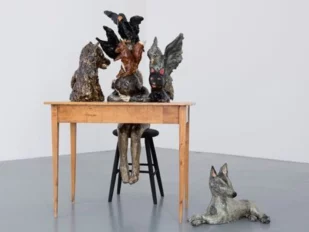
In Belgrade, someone wrote graffiti on the window of the Salon of the City Museum, where the exhibition of the October Salon is held. The graffiti was removed by the end of business hours. The perpetrator should have been captured by security cameras

I hope that the new generations, with a very clear attitude towards the past, not agreeing to revisionism and indoctrination and respecting the decisions of international courts, will break away from nationalist ideologies and start building a different society

“Fontaines DC” Dopamine Chamber (XL) and “Arab Strap” Half-Told Tales (Rock Action)

Here I am no more and the world exists, directed by Stevan Bodroža, Puls theater Lazarevac in co-production with the Institute for Play

At the moment when the institutions of the Republic are destroyed, when Vučić's octopus is still alive, when people are disgusted by the injustice and the stench left behind by the Essenes regime, we have, as Machiavelli said, only civic virtue as the fuel with which we can return to the beginning

The four independent members of REM are an example of perseverance and civic responsibility. Rodoljub Šabić even, upon leaving the premises of REM, after the sentencing of the Informer, experienced that the Essenes insulted him, hit him with their hands and feet. But that too will soon be over

Vučić pardoned the batterers and Dijana Hrkalović. The election winners should abolish the sultan's power that allows one man to run afoul of the entire judicial system

Interview: Branko Stamenković, public prosecutor of the Supreme Public Prosecutor's Office
A black picture and the breakdown of the rule of law subscribeThe archive of the weekly Vreme includes all our digital editions, since the very beginning of our work. All issues can be downloaded in PDF format, by purchasing the digital edition, or you can read all available texts from the selected issue.
See all



