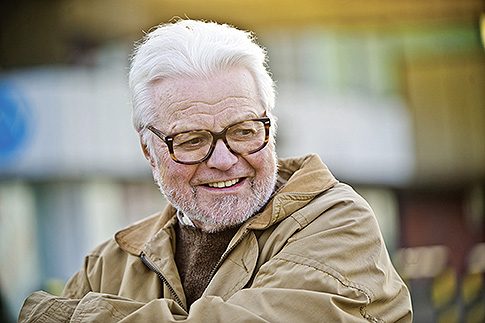
Recently, a gathering dedicated to the latest books by Ljubomir Simović was held at the Serbian Academy of Sciences and Arts. They are a collection of interviews, narrations and records "Titanik" in the aquarium which was published last November by Matica srpska, and the poetry collection Planet Danube in the "Belgrade Book" and Smederevo Poetry Autumn, published last May on the occasion of the awarding of the "Golden Key of Smederevo" award to Ljubomir Simović. In December, Ljubomir Simović was awarded the Serbian Literary Lifetime Achievement Award, and this spring, after a quarter of a century, his play was staged in the National Theater of Simović's hometown, in Užice. Miracle in Šargan. These are only the most current data from the biography of this classic of Serbian literature, which again draw attention to his entire work.
"WEATHER": Book "Titanik" in the aquarium is another chronicle of our age and, as you mentioned in the note, belongs to a series of books that "are filled with the most diverse forms: conversations, essays, articles, letters, diary entries, obituaries, sermons, speeches at demonstrations and protest rallies, records and comments" the series that make up Forge on Čakovina, Gallop on snails, A new gallop on snails, Geese in the fog i The Promised Land. One of the most important topics in these books is Kosovo. Observed in the light of the current negotiations on Kosovo, do you expect this topic in the book that will follow on "Titanik" in the aquarium?
LJUBOMIR SIMOVIĆ: Although after publishing "Titanic" in the aquarium already given several interviews dominated by political and social topics, I would not like to add another one to the series of books you mentioned. Another one of its kind. Those six books cover the period from 1981 to May 2013, they cover the decades in which Yugoslavia fell apart, all those wars, the bombing of Serbia, resistance to the Milosevic regime, the struggle for democratic changes. I'm afraid that after all that we have entered a period of great mortification. And I think that in those books I have said everything I have about everything that happened.
At this moment, I am supplementing the book with a series of new essays about our painters Reading images.
Otherwise, we will certainly not see the end of the negotiations regarding the fate of Kosovo soon. Many visible and invisible fingers and interests are involved in this problem, and as soon as an agreement is reached, and as soon as a solution to a problem is hinted at, a bunch of new, more difficult and complicated problems suddenly arise, which threaten to bring the business back to its original state. the beginning.
Assuming you're writing a play now Battle in Kosovo, What would you write about??
There is no reason to entertain such assumptions. I finished that work in 2002, when I finished the second version of the drama Battle in Kosovo. When I wrote that second version, Jagoš Marković told me that it was not another version but another drama. I think it can be looked at that way. Working on that second version, or on that other drama, I deleted more old text than I wrote new ones. But I emphasized some accents that I cared about from the very beginning. Some personalities, for example, such as Prince Lazar or Obilić, have been defined in our consciousness for a long time, and in both versions of this play they say roughly what is expected of them. In order to introduce new accents, new views and attitudes into the old story, I introduced a number of new characters into the drama. Instead of the "heavenly people", I introduced people from the market of Novi Brda: Pralja, Piljarica, Ribarica, a leather merchant and his wife, the barber Bogoja from Prizren, who is also a visionary, surgeon and doctor. He has a very important and very specific role in this drama, but no one paid attention to him. That Bogoje and his role did not escape Dusan Makavejev alone.
Battle in Kosovo appeared in an extremely unfavorable political context, in which meanings that are not in it were written into the text. It is enough to look only at the two songs that soldiers sing when they go into battle from which they will not return. They are two sad, elegiac songs, in which there is nothing warlike. And their text was literally altered and falsified on some occasions.
In order to emphasize the importance of those people from the people, in the list of people at the beginning of the play, I put their names before the names of the main protagonists, Serbian and Turkish rulers, nobles and knights. I emphasized their role at the end. While the first version ends with the prayer of the despot Stefan, which contains a state program, and a scene with the monks Makari and Theofan, the second ends at the Novi Brda market, with a discussion and argument between Pralja, Piljarica, Ribarica and Velislava, the wife of a leather merchant.
I probably wrote about the problems of today's Kosovo in all these six books, more openly and directly than could be written about in a dramatic text. Especially not in a dramatic text whose subject is a battle from the fourteenth century.
Do the positions of academics and classics of our literature allow you to say publicly what an academic would not dare to say, and the poet would?
I never asked myself that question. I only know that it would be normal for everyone, regardless of their position in society, to have the right to express their opinion on everything publicly, and without consequences. Expressing a position must not be a privilege, but a natural and inviolable right of every citizen.
You are first and foremost a poet and playwright. And yet, among journalistic questions in interviews published in "Titanic" in the aquarium political topics dominate. How do you interpret that?? Is it perhaps the hope of the public that politics looks more beautiful when seen through the eyes of writers?
And were you able to draw the conclusion from my answers that politics looks "prettier" in those books of mine? Journalists asked me political questions because they expected my answers to be different from politicians' answers. And I would say that in those texts and answers of mine, politics looks much "worse", which is to say more true, than in what politicians and party officials say.
In a collection of poems Planet Danube are your three poetry books: Eggshell, Point and collection after which the trilogy is titled. What emotion made them whole?
It is not just, as you say, "emotion", but an idea and a concept. In that concept, perhaps everything I wrote in earlier poetry books was summed up. Climbing the Danube for me was like climbing a peak from which the view not only extends far into space but also far into centuries and times. The Danube as a symbol, the Danube as a metaphor, helped me to see some events, concepts and problems in the greatest possible continuity and range, from the Neolithic to our days.
It is recognized both in your songs and in your plays our spirit. Describing him with sympathy, you criticize him.
When showing Miracles in Šargan at the Theater of Nations in Paris, 1977, the French critics pointed out, among other things, that I portray those people from the bottom, from the periphery, all those unfortunate Our Lady, Iconia, Jagoda, Cmilje, Stavra, that Beggar and Wanderer, that thief Angelka, with understanding and love. I don't accuse them, I don't mock them, I defend and represent them. Some critics in their time stated that the self in the poem Saturday in Šargan I deal with the "periphery" and the "ground floor". I replied that it may be a periphery in relation to Therazia, but it is not a periphery in relation to the stars. For me, it is not a "ground floor", but a plane, a level where perhaps the largest number of people live. I believed that a person can be projected upwards even from that plane. To believe that human fulfillment is possible only at the so-called "highest level", and at the same time to think that the "highest level" is only where there is the most money and power, would mean writing off millions of people and millions of life opportunities. The realization of a person's identity, and if you will also of a person's happiness, must be possible at all levels. Even on those that we consider the lowest. That's why for me that unfortunate Lady is as important as Antigone or Medea.
After the breakup of Yugoslavia, some nations defined, organized and stabilized their states. We are among those who did not do it. Serbia has turned into a country that imports beans and garlic and exports decorations. In the 1960s, the tavern "Šargan" was an island of outcasts on the outskirts of Belgrade, and today the whole of Serbia has become a tavern "Šargan". A tavern full of humiliated people without perspective and hope. Only that peripheral political activist Mile, in the meantime, probably became a minister, if not something bigger than that.
Last year's staging of your play at the Užice Theater Miracle in Šargan, written forty years ago, she showed and indicated the topicality of her story. What makes a literary text current?
I don't think anyone has a ready-made recipe for that. The most I can say is that it depends on talent and creative intuition.
You can read Ivo Milosevic's explanation on the Užice Theater website, directors of the latest version Miracles in Šargan, that she wanted to emphasize with the play "that unpleasant but true mirror of our society at this moment" which she recognized in your piece, as well as our need "enjoyment of suffering and the understanding of suffering as an unavoidable factor of our identity". Do you agree with her reading? Sargana?
I am not in the habit of commenting on what is written or said about my texts. I didn't have the impression that Iva Milosevic understood that exactly. Or it is about some of her statements that I have not seen. However, I would say that personalities from Sargana they understand their suffering or they don't, to learn something from their suffering or not, but I am sure that they are not so masochistic that they enjoy their suffering.
U Shargan are two soldiers of the First World War, dead, who are still seeking justice. How do you view the current issue of guilt for the First World War and the commemoration of the centenary of its beginning?
The memory of the First World War is preserved in our nation with a kind of pious reverence, as if it were a holy war. Holy in the most beautiful, purest and noblest sense of the word. There is no family in Serbia that does not have its dead and fallen in that war. My paternal grandfather, whose name I bear, died in the prison camp in Doboj in 1916. My maternal grandfather, Giorgio, lost his arm in the war, and then, in 1918, in Bitola, he died of the Spanish fever. I wrote several songs about that war: Battle of Cer, Report, Migration of Serbia... I dedicated a special chapter in the novel-chronicle to that war Ropes with crows. In that war, our people were exposed to the greatest suffering, in battles, in epidemics and reprisals, in that terrible retreat through Albania. Serbia, proportionally - better to say: disproportionately - to its forces, made a great contribution to the victory of the allies. And now those who caused the war, who planned it, who saw the war as an opportunity for their own expansion, are trying to shift their guilt and responsibility onto the backs of their victims.
It's hard to be a small nation. And it is difficult for a small nation to defend its truths. Besides, there is always someone who would like to turn it into someone's gubernia or into someone's banana republic.
And everything we got, and everything we didn't get, we paid very dearly.
Literary historians believe that the language of your works is one of the most beautiful and accurate in our literature. How to restore and establish a beautiful word in everyday life?
Instead of an answer, I'll read you something I jotted down one evening when I stumbled upon the final sequences of a movie Mad Max 3. I didn't manage to record the whole sentences, nor the name of the translator, but I transcribed the following pearls from the screen: "we remember" instead of "we remember", "we know" instead of "we know", "in order to remember" instead of "in order to remember". On TV screens, and often in our newspapers, it is written the way no one speaks in our country. One evening, wandering through the TV channels again, without the hope of finding anything valuable or interesting, I came across a movie, or a series, where the word SUPERVISOR appears in the translation of some dialogue. That word was obviously transferred from the Latin NAZORNICA. What literary genius turned Latin DZ, as if DŽ, into Cyrillic Dž?
Our language is rapidly decaying, despite many grammars and spellings. Everyone, everywhere, writes and says "resting" instead of "resting". Some words, which I have just mentioned, take on incredible and monstrous forms. Language develops and enriches itself through literature, and in our country books are read less and less, and literature is pushed to the very margin, and I would not be surprised if it is banished from the margin as well. Eliot's sentence that says "a nation that no longer cares about its literary heritage becomes barbaric" seems terrifying. Looking at what is happening to our language, and to whom its fate is left - and bearing in mind the increasing number of faculties, which are not engaged in spreading knowledge but in selling diplomas and doctoral degrees - it will not be difficult for us to conclude which path we have taken.
In one of the recent interviews, you spoke about the National Museum, you compared his current life with the life in the time of socialism. How is it possible that we all think that the National Museum is closed?, and that doesn't help anything?
Both the National Museum and the Museum of Contemporary Art in Usce have been closed for more than ten years, due to renovations. However, the state does not have the money for that renovation, and the money is not there probably because those who hold the key to the state coffers have never entered, nor do they need to enter, any museum in the world. Our political elite is not very interested in that kind of problem.
When it comes to the political elite, what academician Vladimir Kostić said on one occasion - that our biggest problem is not corruption but incompetence - is confirmed every day, at every opportunity and at every step. However, along with incompetence, we notice some other traits in our politicians: for example, lust for power, for example, vanity, for example, the absence of an elementary sense of reality.
Serbia, as we know, has the most neglected roads and the worst railways in Europe, and one of its ministers sees in his vision nothing more than to dig a canal from the Danube to the Aegean Sea, through other countries, through Macedonia and Greece!
While all the heads of state went to the Vatican for the inauguration of the new pope, our president declared that he was going to his beatification!
We recently had the opportunity to witness the filming of a dramatic scene in Feketić, in which the first deputy prime minister, running through a blizzard, saves a child, transferring him from a snow-covered bus to a helicopter. And we had the opportunity, then, to see how that savior, dissatisfied with satirical comments in which his act is recognized as part of the election campaign, turns into a powerful censor.
These days, the performance of another member of the political elite is very noticeable, who, after being too vocal at the session of the Main Committee of his party, was hurt in his vanity, dealt his party the hardest blow, and practically dismissed it, forgetting that it had elevated him in its time. to the very top of the state. From the top of his vanity, he said to his party with that blow: "The state, that's me!"
New parliamentary elections await us on March 16th. As the choices go by, our options are getting smaller and smaller.
Do you, and in what way, The Serbian Academy of Sciences and Arts influences the current life of the nation?
Instead of answering your question, I'll offer you a few lines from the book Leaders of the French Revolution Slobodan Jovanović, who was the president of the Academy from 1928 to 1931. Perhaps these lines, which were published in 1920, and whose actuality cannot be disputed even today, could have some influence on the life of the nation.
"The Girondins were not exaggerating when they claimed," writes Slobodan Jovanović, "that Robespierre's popularity was a public danger." It was not in the general interest for people to lose all power of criticism towards a political man, and follow him as if they were in love and bewitched. Idols in politics, as in anything else, are dangerous because they suspend the reasoning process of their fans.''