

Recommendation
What would you ask Hendrix, Tarkovsky, Tesla and the like
Goran Kosanović, the author of the novel "Inside the Eternal Present" talks to those who have left a mark on culture, connects their times with ours, and it is very inspiring

If on March 15 we follow the broadcast of that dazzling film festival in Los Angeles, we must not lose sight of the fact that the art of the international short animated film is still preserved where it has always germinated: on the historical coordinates of the festivals in Zagreb and Annecy, as well as on the maps of small, extremely selective festivals throughout Europe. In those places, the authentic antithesis to the American cliché is nurtured
Analyzing the winners in the short animated feature category is to enter the dichotomy between superior craft and polished narrative. As a rule, the taste of members of the American Academy (AMPAS) remains immune to the more radical quality offered by European production for decades, where animation is not treated as children's entertainment, but as a space, why not, of philosophical research and visual experiment. The selection process is rigorous but internally contradictory. The first, shortened list of fifteen titles is chosen by the members of the Short Film Branch, people from the profession. However, when the list is reduced to five nominees, the general membership is included in the vote: voters often choose based on recognition or a topic that seems socially acceptable. So, for example, masterpieces of recent European production fell out of the final list: The doll and the whale (The puppet and the whale, 2024) by the Italian director Roberto Cattani, a film-rebellion against the globalized modern society dressed in the garb of the story of Pinocchio who does not want to become a human being, or oneiric and gentle Night boots (The Boots of the Night) of the self-effacing Frenchman Pierre-Luc Granyon, made in the painstaking technique of the needle screen, which recently has a lot of admirers.
Russian director Konstantin Bronzit, already twice nominated for an Oscar, entered the finals with his film this year Three sisters (2025). However, the film was registered at the festivals under the name of Timur Kognov's relative, with a fictitious biography and under the "camouflage" of the Cypriot production of the Rymanco studio. Bronzit wanted to test whether the film could pave the way through a myriad of shorts art house films exclusively of their own quality, without the burden of a famous name and without a political context. In a world where Russian authors are often boycotted, Bronzit decided to become a "nobody". Many festivals rejected it because they saw the film as the work of an anonymous person, while the Academy, whose system mandates viewing without information about the author, recognized its value. "I am an idealist in the manner of Dostoevsky",
says Bronzit, defending a film's right to be evaluated independently of its passport and proving that rejections are often not a sign of a bad film, but of system inertia. An interesting digression in connection with the case of Bronzite is plasticine stop motion film Three sisters (2019) by experienced Russian director Svetlana Andrianova, who has been living and working in Montenegro for a long time. She based the film on the motifs of a Montenegrin story about triplet sisters who lived in a stone palace in Prčnje and waited their whole lives for a sailor to return from their journey. The similarity in the narrative with Bronzit's film is incredible, the fact that the two directors have known each other for years, although they made their films in two different cities, Andrianova in Moscow, and Bronzit in St. Petersburg, is even more interesting.
Using the technique of oil paints, painting directly on canvas and glass, the French author Florence Miall realized the pure poetry of matter - film Butterfly (Butterfly, 2024). She found inspiration in the fate of Alfred Nakasch, a swimming champion who survived Auschwitz. The film uses the fluidity of color to show Nakash at different ages – underwater, he transforms from an old man to a young man. The visual style is rich in texture, with a "blue palette" of colors: sky blue for childhood, sea blue for youth, and murky green tones for camp pools. Mial recalls the shameful deprivation of citizenship of Algerian Jews under the Vichy regime. Her film is an ode to endurance: a man who weighed 40 kilograms in 1945 already competed in the Olympic Games in 1948.
In the same rank is The girl who cried pearls (The Girl Who Cried Pearls). This dark tale of greed, set in early 20th century Montreal, was born out of an incident on the set of the film Madame Tuttle Putli (2007), when the doll's necklace broke. Authors Casey Lavis and Macek Šerbovski deliberately avoided digital tricks. The faces of their dolls are static, similar to wooden church idols. The memory scenes in the film are deliberately deprived lip sync because we are talking about impressions, not recordings - we remember words, but not lip movements from the past.
The technological antipode is Forever green (Forevergreen, 2025, directed by Nathan Engelhart and Jeremy Spears). This 3D project, on which 200 artists worked on a volunteer basis, uses special visual effects to imitate the texture of carved wood. Through a complex system of creating wood textures, the authors achieved the effect stop motion in a digital environment. Their allegorical story of hope and forgiveness uses nature as a universal language, merging craft with cutting-edge software engineering.

Finally, there's John Kelly with a movie Retirement plan (Retirement Plan, 2025). Kelly stated that the film was born out of a panic attack after a lost prize and a harrowing plane ride Ryanair. It is the story of Ray, a man who projects the future using lists of things he will do "when he finally gets out of the money race". The film balances between hope and melancholy: we all want free time to read all those books, organize photo files on the computer, enroll in a dance course, learn to play an instrument perfectly. Originally set in America for the sake of "universality", the film became true only when Kelly brought it back to his native Dublin, bringing his own fear of transience, as well as the voice of Donal Gleeson and the meditative music of John Carroll Kirby.
If on March 15 we follow the broadcast of that dazzling film festival in Los Angeles, we must not lose sight of the fact that the art of the international short animated film is still preserved where it has always germinated: on the historical coordinates of the festivals in Zagreb and Annecy, as well as on the maps of small, extremely selective festivals throughout Europe. In those places, the authentic antithesis to the American cliché is nurtured. Or, to avoid the trap of Eurocentric arrogance - on them is chiseled that truly good taste that we desperately need today precisely because, fortunately, it is constantly "falling out of joint" in relation to the dictates of the mainstream.
Four of the five nominated films are available online.
Goran Kosanović, the author of the novel "Inside the Eternal Present" talks to those who have left a mark on culture, connects their times with ours, and it is very inspiring
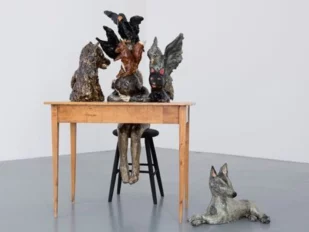
In Belgrade, someone wrote graffiti on the window of the Salon of the City Museum, where the exhibition of the October Salon is held. The graffiti was removed by the end of business hours. The perpetrator should have been captured by security cameras

I hope that the new generations, with a very clear attitude towards the past, not agreeing to revisionism and indoctrination and respecting the decisions of international courts, will break away from nationalist ideologies and start building a different society

“Fontaines DC” Dopamine Chamber (XL) and “Arab Strap” Half-Told Tales (Rock Action)

Here I am no more and the world exists, directed by Stevan Bodroža, Puls theater Lazarevac in co-production with the Institute for Play

At the moment when the institutions of the Republic are destroyed, when Vučić's octopus is still alive, when people are disgusted by the injustice and the stench left behind by the Essenes regime, we have, as Machiavelli said, only civic virtue as the fuel with which we can return to the beginning

The four independent members of REM are an example of perseverance and civic responsibility. Rodoljub Šabić even, upon leaving the premises of REM, after the sentencing of the Informer, experienced that the Essenes insulted him, hit him with their hands and feet. But that too will soon be over

Vučić pardoned the batterers and Dijana Hrkalović. The election winners should abolish the sultan's power that allows one man to run afoul of the entire judicial system

Interview: Branko Stamenković, public prosecutor of the Supreme Public Prosecutor's Office
A black picture and the breakdown of the rule of law subscribeThe archive of the weekly Vreme includes all our digital editions, since the very beginning of our work. All issues can be downloaded in PDF format, by purchasing the digital edition, or you can read all available texts from the selected issue.
See all



