

Culture
FAF - a festival made by people dedicated to film
80 films are coming to the 32nd Original Film Festival, many of them with awards from the Cannes festival. It is organized by a citizens' association, without a dinar of state money

Too Much, directed by Lena Dunham (Netflix)
Somewhere at the beginning of the essay entitled "Phenomenological and Feminist Approach to the Feminine View", in the study under the title A woman's view Revolution on screen, the author Iris Bre highlights and clarifies the following: "It is common for viewers to cinema hall we see as separate from the canvas they are looking at. They are thinking subjects capable of analyzing the film object from a certain distance. Phenomenology shooting, however, views this experience as an ongoing dialogue between the observer and the observed. The viewer establishes contact with the film, he or she does not watch the film as something known in advance or as something he has an idea about, but immerses himself in the materiality of the film. Spectators are not simply present in the cinema hall to attend the projection, they themselves become actors of the experience on the screen. The performance happens in the Hall as much as on the screen."

We can test the correctness of Iris Bre's thesis on the example of the series that has been the most talked about in the planetary sense in the last few weeks, which is the series Too Much by Lina Dunham, author of the hit series Girls (current in the period 2012–2017), made for Netflix. Already with that decision, things become noticeably more complicated, because we necessarily have to introduce at least two apparently side-splitting but essentially extremely important things into the story: firstly, with every, even more superficial analysis of the series Too Much one inevitably reaches a slippery distinction between the author's "manuscript" and mannerism; secondly, although it is not a metafilmic plot, Too Much it also rests on the obsession with British romantic comedies (rom-coms), which makes this serial work unusual in terms of meaning. First about the second one. The main hook of the first season Too Much reads: a young American woman, after a painful breakup of a long relationship, agrees to go to London (and England) for a mostly painless work assignment. In this way, he gets the opportunity to give vent to his own enduring fascination with British rom-coms (especially those created under the auspices of the [real] film company "Working Title" - for example Notting Hill, Actually love, Four weddings and a funeral...), and then, perhaps, in reality, he lives his own dreams of a magnificent love, after which everything changes radically. It is a fine and wise flywheel for a series story that moves undisguisedly within the boundaries of the same subgenre, and Lina Dunham, overall, satisfactorily uses and elaborates the story, with the (perhaps a very personal) impression that this motive is lost in an attempt to make the series as universal as possible. However, in that aspect, one should not be sloppy, because it is evident that a convincing balance has been established between the original author's intentions on the one hand, and necessary creative concessions on the other.
In addition, Too Much it does not run away from the British socio-geographical context, and from British rom-coms it unabashedly takes over the well-known meritocratic weft that that film genre caught in the old days, previously taken from the works of Jane Austen, in which we are clearly taught that happiness is only possible if and when we overcome our own failures. And precisely those falinka, here, centuries ago - both in literary, film and serial processing - perhaps represent the key driving fuel in stories of this type and such views on the world. All this is harmoniously grafted with the sub-motive of the clash of cultures (culture clash), which does not stop at the already minor lexical differences between the US and Britain. In a globalized and networked world, the dominant social movements have largely neutralized cultural differences, and the two main characters don't have to worry about those worries anymore: a romantic and very anxious American woman and her quick-witted love of her whole life, an English hipster who is on the edge of his thirties and lives from today to tomorrow, waiting for fame by playing in an unknown indie-rock band.
However, what is present in British (and other) rom-coms on a sympathetically minimal scale, in Too Much it arrives in abundance. The actors of British rom-coms are mostly civilians who are moderately confused and hindered by their own prejudices, who only need a little incentive from the lottery of fate to move forward and realize their own potential for full and true love. U Too Much on the other hand, bearing in mind the previous work of Lina Dunham (present here both as a screenwriter and producer, but also in the character of an older, very depressed sister), a lot of it gravitates around the motif of never-overcome anxiety and perhaps invincible narcissism. That was the case in the mentioned series of hers, and that is also the case in this partially British work. Lina Dunham managed to position herself as a generational sign/spirit of the times, as a dare and inevitable trap of millennials, and she transferred that to the ventures made for the year 2025. Truth be told, said narcissism is more or less equally distributed to the other characters, and the climax comes in the episode in which Andrew Scott appears in the role of a chaotic cinematographer in an attempt to become the new Ken Loach. Nevertheless, even such a mildly disguised insistence on narcissism, even as something that is simply taken for granted in this world, remains the reason why every now and then the impression arises that in the case Too Much, despite all the changes "on the fabric" of the basic and very striking formula, we are looking at a skillfully tailored "remix" Girl, where the author does not even try to hide the traces of her relaxed auto-recycling.
Of course, all of this can be subsumed under the always convenient and ambiguous self-referentiality, and this is a shortcut here to return somewhere to the beginning of this presentation. In the case of authors with much more articulate expressions and clear, candid and obsessive themes, it is difficult to distinguish mannerism - which deserves at least a name-call and the occasional question mark - from the author's self-awareness and the recognition of the author's "manuscript". With this work, Lina Dunham got even closer to an older and more experienced film poet obsessed with depictions of the (economically) not tense lives of (mostly) New Yorkers, and their search for happiness: we are talking about Woody Allen, also the confirmed king of anxiety and autofiction. And what about the series itself Too Much concerns, it is one of the highest quality and most well-rounded serial works in these six-seven months of the current year, with the necessary fence: overall measured, the film Tiny furniture (Tiny Furniture, 2010) still remains Lina Dunham's highest reach in her multi-pronged career (including forays into the world of prose).
80 films are coming to the 32nd Original Film Festival, many of them with awards from the Cannes festival. It is organized by a citizens' association, without a dinar of state money

Tomorrow "Zvezdara Theater" will celebrate the 400th performance of "The Book of Milutin" by Nenad Jezdić's monodrama. Plays that have been in the repertoire for more than a decade are currently being played in Belgrade. The musical "Some like it hot", even - three

More than 400 artists and cultural workers signed the request of the Initiative for Free Culture, which calls for the dismissal of all the leaders of cultural institutions in Pancevo.
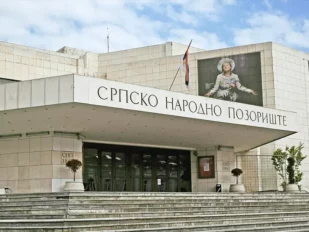
After the resignation of Dragana Milošević, the acting manager of the SNP, Željko Andrić was appointed the director of the Opera, even though the employees are demanding a change in the entire administration.

There is little information about the 61st October Salon. It is not known, for example, how the selected artists deserved to represent the current art world scene and how much it all costs

At the moment when the institutions of the Republic are destroyed, when Vučić's octopus is still alive, when people are disgusted by the injustice and the stench left behind by the Essenes regime, we have, as Machiavelli said, only civic virtue as the fuel with which we can return to the beginning

The four independent members of REM are an example of perseverance and civic responsibility. Rodoljub Šabić even, upon leaving the premises of REM, after the sentencing of the Informer, experienced that the Essenes insulted him, hit him with their hands and feet. But that too will soon be over

Vučić pardoned the batterers and Dijana Hrkalović. The election winners should abolish the sultan's power that allows one man to run afoul of the entire judicial system

Time explores: The construction of the St. Sava Temple
Did the money paid by the Government to SPC end up in Moscow through Alta Bank? subscribeThe archive of the weekly Vreme includes all our digital editions, since the very beginning of our work. All issues can be downloaded in PDF format, by purchasing the digital edition, or you can read all available texts from the selected issue.
See all



