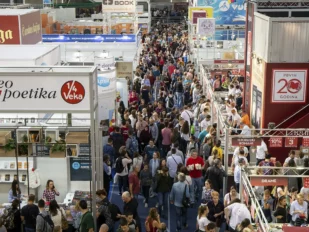
We didn't choose the circumstances, but we chose what we would do and how we would work in those circumstances - says Gojko Božović, whose publishing house "Archipelag" turns 18
Just before he will turn 15 on May 18, news arrived that the Archipelago publishing house received an award for its contribution to the improvement of publishing and cultural exchange in the region, at the International Book Fair in Podgorica. And that's good news.
In Serbia, the length of time a publisher has lasted this long is considered a great success, and above all it speaks of the books he published and because of which he survived in the local circumstances during those 18 years. And how those years were and what they are still like, "Archipelag's" slogan "Not everything is bad, books are good" speaks very eloquently.
Gojko Božović, editor-in-chief and founder of Archipelago, says that the slogan is "a little younger", and that he remembers how it came about:
Slogan from Saint Petersburg
"At the airport in St. Petersburg, between two flights, in a friendly discussion, I said that sentence. It was more than ten years ago. Discussions are best if they are friendly. We didn't change that slogan afterwards because the message was persistently shown to be correct. I would prefer that we had a reason to change it. But it's not a question of what I would like, but of how it is. On different occasions, we joined this slogan with some others. For example: "Every book is an island, together they form Archipelago Each reader is an island, together they form The archipelago." Or: "We publish books without compromise, and we have discounts only for readers." Slogans are, of course, important, some of them are memorable. But the most important thing is that what you do and say, you stand behind those messages addressed to the readers. Good books are needed at all times, even in times when nothing else is as good. I believe that both readers and books deserve better circumstances and better times."
"Archipelago" is coming of age in a year when culture is punished by budget cuts, and publishers who print books in Latin are excluded from the only competition that stimulates their work.
"It turned out that way, but we work all the time in the circumstances of crises: local and global, social and political, technological and media, health and security, economic and cultural-political, populist and authoritarian. As soon as you look out the window, you are already in the midst of some events. We did not choose the circumstances, but we chose what we would do and how we would do in those circumstances. So this is a difficult time for the publishing business, but we learned vitality through trials," comments Gojko Božović.
He notes that "Archipelag" is a market publisher, working on "the basis of readers' trust and support, and nothing has changed there for eighteen years. We will continue to do so in the future. But everything we do is not only market-oriented. If you publish poetry books, as well as other literary genres or certain genres of the humanities, it is certainly not a market decision and no publisher can come to it if he only takes into account economic reasons. We also take into account the interests of our readers and their right to reasons choice."
High culture and the market
He explains that "Archipelago" starts from "an assumption that was once taken for granted, but is no longer taken for granted for a long time, now it is a matter of conscious and not so frequent choice: publishing is a business that connects high culture and the market. Both are important to us. We check and base our values in the principles of high culture. In the principles of the market, even if it is poor, and if it is 'shallow', and if it is beset by various crises and insecurities, we test the resilience of our ideas and the attractiveness of the values we espouse, but we also test models with the help of those ideas and values."
Archipelago is recognized as a publisher of Serbian and world literature, but also books in the field of humanities - from historiography to political theory, from social studies to economics. "The books we publish promote cultural, poetic and social pluralism. In the field of literature, we publish books that are a sign of the best imagination. In the field of humanities, books that are a sign of reliable knowledge," says Božović.
And, at a time when the book is marginalized, an unfortunately unavoidable question: who is to blame, the government or the book that failed to impose itself?
Reasons for the crisis
"The book is marginalized and it is one of the most dangerous global problems with serious local consequences. There are several reasons. The book is facing a technological crisis: we are all digital today, and the book looks analog to many people of the civilization of moving images. The book is facing a crisis of attention: attention is today the rarest resource, and without it in daily doses of at least one or two hours of time there is no reading. The book is facing a crisis of critical thinking: if critical thinking is suppressed, then the need for a book is Undoubtedly less.The book faces a crisis of social relevance in a consumer society: where everything has a numerical value, where everything is expressed in the "pay and carry" formula, the book does not and cannot have the influence it had in the epochs when it was a formative force of society. The book faces a crisis of culture: the populist era rests on the Bengal fires of glamor and spectacle, on popularity rather than creativity, on promotion rather than creation. These are not book-friendly times, but they can't even overcome without a book."
Everything was learned in 18 years. Gojko Božović highlights the following:
"In this business, solid and long-term plans are needed. In these irregular times, when every day there is more information than events and more events than it is possible to cognitively and emotionally process, long-term plans seem a bit pretentious, not to say irresponsible. Behind some books there is more than a year of publishing work. In one circumstance we are preparing books, in completely different circumstances they will be in front of readers. Both we and society need responsibility, peace, commitment, the values of freedom and democracy."
What is happening in the country and the world, what is in the newspapers and how to pass the time?
Every Wednesday at noon In between arrives by email. It's a pretty solid newsletter, so sign up!
Holding the Book Fair in its traditional place, reforming the book support system - these are some of the goals of the Initiative 3 platform launched by the publishers Bajac, Hamović and Božović
Three days ago, an artistic painting was reported missing from the Provincial Government building in Novi Sad, and it seems that it disappeared back in August.
The Association of Literary Translators of Serbia and the PEN Center gave the most votes to Ljubinka Milinčić in the proposal for a national pension. After that, three members resigned from the Association
Goran Kosanović, the author of the novel "Inside the Eternal Present" talks to those who have left a mark on culture, connects their times with ours, and it is very inspiring
At the moment when the institutions of the Republic are destroyed, when Vučić's octopus is still alive, when people are disgusted by the injustice and the stench left behind by the Essenes regime, we have, as Machiavelli said, only civic virtue as the fuel with which we can return to the beginning
The four independent members of REM are an example of perseverance and civic responsibility. Rodoljub Šabić even, upon leaving the premises of REM, after the sentencing of the Informer, experienced that the Essenes insulted him, hit him with their hands and feet. But that too will soon be over
Vučić pardoned the batterers and Dijana Hrkalović. The election winners should abolish the sultan's power that allows one man to run afoul of the entire judicial system
The archive of the weekly Vreme includes all our digital editions, since the very beginning of our work. All issues can be downloaded in PDF format, by purchasing the digital edition, or you can read all available texts from the selected issue.