If you're visiting Paris this spring and summer - "Henri Matisse 1941-1954" at the Grand Palais and "Karol Ferenczi: Hungarian Modernism" at the Petite Palais - are two exhibitions you must not miss.
"No also, immer schöner und schöner: one Ferenczy is anonymous to you?". That's how I first heard about Ferenci. In the discussion about painting between Puba Fabrici and Leone Glembay in Krleža's drama.
Karolj Ferenczi (born in Vienna as Karoly Freund) was one of the greatest painters of Austria-Hungary. You can see his impressive retrospective at the Petit Palais in Paris until September 6.
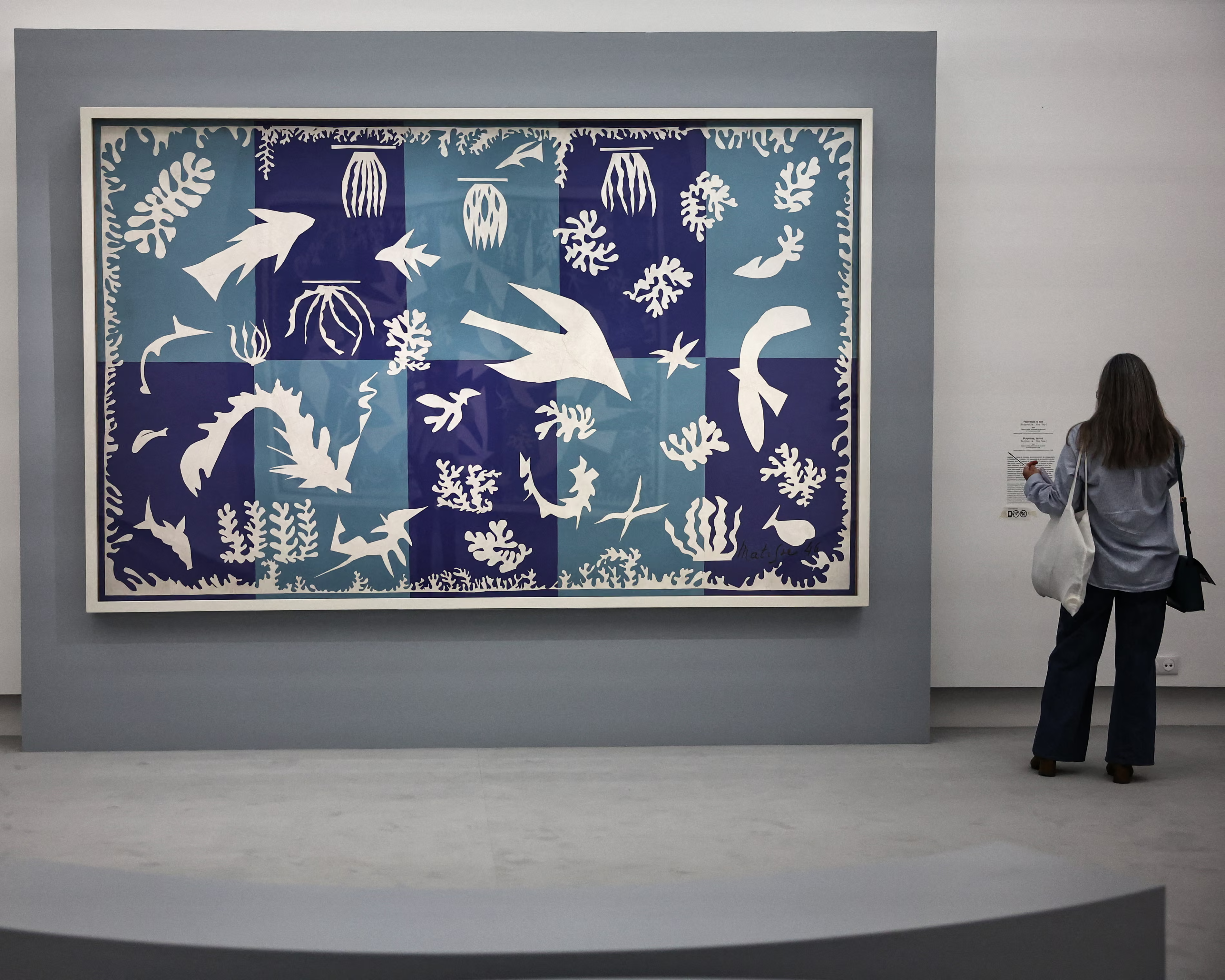
In the neighboring Grand Palais, you can see an exhibition of Matisse's works from the artist's late phase (1941-1954) until July 26.
The Fifth Palais as well as the Grand Palais were built for the World Exhibition in 1900. Since then, both galleries have been exhibition spaces where it is possible to see the works of some of the most important French and world artists. During the 2024 Paris Olympic and Paralympic Summer Games, the Grand Palais was the spectacular stage for some sporting events such as fencing and taekwondo. There was an exhibition at the Peti Paleo then The Body in Motion with artworks from this gallery's collection featuring sports motifs.
Charles Ferenczi
Karolj Ferenczi (1862-1917) was one of the most important modernists of Central Europe. His works marked the end of the 19th and the beginning of the 20th century. He was neither a naturalist, nor a symbolist, nor an impressionist, nor a fauvist - but he was a little bit of everything, says the announcement for the exhibition. 140 works were exhibited - landscapes, portraits, family scenes, biblical motifs, nudes and caricatures.
Photo: Robert ČobanFerenczi
Ferenczi's biography is very interesting and stormy. His mother dies immediately after his birth. He first studied law and graduated from the Faculty of Economics, only to be encouraged by his future wife, the painter Olga Fialka, to try his hand at fine arts. He travels around Italy, studies in Paris and in 1887 he begins to actively paint. For a time he also lived in Sentanderia. In 1893, he moved with his family to Munich, where he studied with the Hungarian painter Simon Holoshij and socialized with artists from his circle. He had two sons and a daughter with Olga. He returns to Hungary, where he founds an art colony in Nagbanja (today's city of Baia Mare in Romania). Ferenczi represented Hungary twice at the Biennale in Venice, the second time in 1914, just before the beginning of the Great War.
Henri Matisse
On the other side of the Parisian avenue named after Winston Churchill is the Grand Palais, where an exhibition of over 300 works by the French painter Henri Matisse from 1941 to 1954 was held.
That period in the artist's life was very dramatic: in 1939 he separated from his wife after 41 years of marriage, in 1941 he was operated on for a tumor, after which he started using a wheelchair. He was cared for by the Russian Lydia Delektorskaya, his former model, until his death.
With assistants, he created paper collages, often on a large scale, called "gouaches découpés". Series Blue nudes they are the best example of the technique he called "painting with scissors" - they showed how he translated his sense of color and geometry into a new medium of extreme simplicity, but with playful and exuberant power.
Photo: Robert ČobanMatis
During the 1940s he worked as a graphic artist and produced black and white illustrations for numerous books, and over a hundred original lithographs at the Mourlot studio in Paris.
Matisse was greatly appreciated by the Greek poet, Nobel laureate Odysseus Elitis, with whom he was introduced by a mutual friend, Theriad. Matisse painted the wall of the dining room of Tériade's residence "Villa Natacha" in Saint-Jean-Cap-Ferrat, which Elitis often mentioned in his poems.
Matisse, otherwise apolitical, was shocked to hear that his daughter Marguerite, who had been active in the French Resistance during the war, had been tortured (almost to death) in a prison in Rennes and sentenced to Ravensbrück concentration camp. Marguerite did escape the camp, however, after escaping into the woods from the train to Ravensbrück during an attack by Allied planes.
In 1947, he published "Jazz", a limited edition of about one hundred prints of multicolored collage cutouts accompanied by written thoughts. Tériade, a respected publisher of 20th-century works of art, produced Matisse's cut-outs as matrix prints.
He lived in a large studio in the Hotel Regina in a posh suburb of Nice. It is interesting that despite the difficulties he had - this cannot be seen in his late works exhibited in the Grand Palais - they are full of light and optimism. He died in Nice in 1954 at the age of 84.
There is a lot of interest in both exhibitions, the queues are long, so I recommend buying tickets online. If you have a press card, it will give you free entry to both galleries and what is even more important - "fast track" and save you from long queues.
What is happening in the country and the world, what is in the newspapers and how to pass the time?
Every Wednesday at noon In between arrives by email. It's a pretty solid newsletter, so sign up!
Holding the Book Fair in its traditional place, reforming the book support system - these are some of the goals of the Initiative 3 platform launched by the publishers Bajac, Hamović and Božović
Three days ago, an artistic painting was reported missing from the Provincial Government building in Novi Sad, and it seems that it disappeared back in August.
The Association of Literary Translators of Serbia and the PEN Center gave the most votes to Ljubinka Milinčić in the proposal for a national pension. After that, three members resigned from the Association
Goran Kosanović, the author of the novel "Inside the Eternal Present" talks to those who have left a mark on culture, connects their times with ours, and it is very inspiring
At the moment when the institutions of the Republic are destroyed, when Vučić's octopus is still alive, when people are disgusted by the injustice and the stench left behind by the Essenes regime, we have, as Machiavelli said, only civic virtue as the fuel with which we can return to the beginning
The four independent members of REM are an example of perseverance and civic responsibility. Rodoljub Šabić even, upon leaving the premises of REM, after the sentencing of the Informer, experienced that the Essenes insulted him, hit him with their hands and feet. But that too will soon be over
Vučić pardoned the batterers and Dijana Hrkalović. The election winners should abolish the sultan's power that allows one man to run afoul of the entire judicial system
The archive of the weekly Vreme includes all our digital editions, since the very beginning of our work. All issues can be downloaded in PDF format, by purchasing the digital edition, or you can read all available texts from the selected issue.