We start the conversation with the best director of this year's film festival in Pula, Dana Budisavljević, with a joke that the Serbian media got another Peter Handke. Namely, we learned that the director of the film about Diana Budisavljević, the woman who saved more than 10.000 Serbian children from Ustasha camps during the Second World War, has quite a few Serbian blood cells, that she is related to Tesla and Jovanka Broz and Julije Budisavljević himself. , a doctor from Zagreb and Diana's husband. We were warned that Dana Budisavljević in Pula defeated the favored Serb hater Antun Vrdoljak and his film General which talks about the hated enemy Anti Gotovina. Dana is a modest, slightly shy woman with a revealing smile, who enrolled in film and television editing in 1994 in Zagreb. In the same year, the building of the Zagreb Film Academy was shelled and Dana's classmate was killed. She later worked as an editor, producer and director. Together with Nenad Puhovski, she launched ZagrebDox in 2005. She made films about women: about herself in Your life is not a song of Hawaii. and others in All five. Her Diana Budisavljević's diary it made many who live in the area formerly known as Yugoslavia cry.
"WEATHER": Since I found out about ten years ago who Diana Budisavljević is, I have come across at least three people who wanted to make a film about her.. Some have done it, but you achieved the most with your film. What intrigues you so much about Diana Budisavljević??
DANA BUDISAVLJEVIĆ: That story is so big that it surely deserves a lot of movies. It was important to us to see it from Diana's perspective. That is why we referred to her diary, and I think that the rescue operation itself and, in general, everything that happened in NDH, the adoption and the fate of all those children... In my opinion, it is a story as big as Sutjeska and Neretva. Actually, I think that one film is too little and that was a big responsibility and obstacle for me. You have to explain too much, you have to include a lot of things because it is about a huge number of saved children and it is really, somehow, awkward when you are the first. It's a story of epic proportions.
You have already talked about the fact that you have been preparing the film for a full ten years. Did you imagine it like this at the very beginning?? To be played documentary?
The first idea was to make it a documentary because that's close to me. However, what needed to be done first was historical research. The topic is too sensitive, it has remained historically untreated and unknown for too long, and we had to resolve it first - yes, in general, let's see who these people were, almost nothing is known about Diana, who were her collaborators, find historical documents that confirm this or they don't confirm, find archives, witnesses... It was a huge research job for a film crew. Somehow, that research process began to determine the future form of the film. The problem was that, in the documentary sense, we were late - Diana died in 1978, all her collaborators too, and there was no one left who could testify authentically. The only authentic thing left of Diana was that diary and then it was just a question of how to recreate it. We didn't want to make a completely feature film, I don't think I would have really known that, on the other hand, it was terribly important to me that the story was authentic. When she has already waited so long, to somehow be credible and accurate and authentic and so that no one can later say: "Oh, it's just a movie." I think the truth of that story is very important for us today. Then I thought, "Okay, Diane is gone, but there's a diary left behind, and there's no point in playing the rescued children because they're still alive." They're alive, but they're old, they're all eighty years old and older. , and I thought that if we don't record them now, then we are too late for them. So it was left for me to find a solution to combine them into one film, and it seemed to me that in some energetic, symbolic sense it was important that what history had unfairly separated, the film should now bring together. Because only film can do that today.
Did you record the confessions of the survivors first??
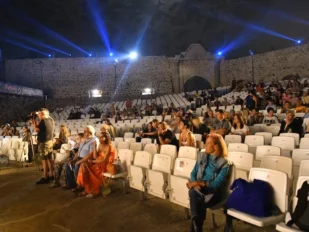
Yes, I filmed them in 2014, and I was afraid that by the time we found all the funds for the feature part and that it would take who knows how long, that they might not be able to be on the set all day. In the end, the footage of the survivors turned out very well, so we used it in the final version of the film, and we shot the feature part at the end of 2017. The premiere was this summer in Pula, and they saw the film for the first time then. Two of my wishes regarding the film were not fulfilled - one is that the witnesses will see the finished film, three are alive, and Mrs. Zorka has passed away in the meantime, and the other is that Diana's granddaughter Silvija, who found her diary and was a great help to us in research and who, in fact, is the only one who remembers Diana, unfortunately, being ill and unable to come to the premiere. She looked it up on the home computer, but that wasn't it. She is happy, she approved the film, she is satisfied, she really likes how Alma Prica plays her grandmother and thinks that this film is very poignant and accurate. But she could not experience that excitement and return of emotions and energy that you can only experience at the premiere, as we experienced in Pula.
And how did you come up with the idea of Alma Prica playing Diana Budisavljević?
I really never thought about anyone else. When the idea came that we would have acting parts in the film, Alma Prica was my first choice. Somehow, Alma carried for me what Diana has. Alma is known for not being exposed to the media at all, she almost never gives interviews, she is very self-deprecating and it seems to me that this is something that Diana also had. After the Second World War, Diana herself never talked about her action again, so when her granddaughter found her diary, she knew nothing. She never heard that from her grandmother. Alma is as it is, small and fragile, but when she stands on the stage, incredible strength is released from her. Diana was also petty, and she did something so magnificent and never talked about it. My meeting with Alma was very funny because I should have asked her if she would go with me to a workshop in Poland. As I had never made feature films before, I had to go to some workshops to master it a bit. And now, you might think, I should ask Alma Prica to come with me to the workshop! (laughs) And it was not difficult for her.
And you left together?
Yes, she just wanted to step back. Alma is a wonderful person, and incredibly easy to work with. She thinks a lot, but she will never impose her opinion. She has nothing of the behavior of someone like a star, she is not demanding, she will do anything for you, nothing is difficult for her. We shot a lot of close-ups of her and she got better and better with each repetition. It's something incredible. She was also a great help to me during the filming. I had no experience in working with actors, and I worked with, indeed, actors' capitals. Somehow, I think that it was precisely because of her calmness and the way she played Diana that all the actors followed her. Now I get very nice reviews that the actors are very functional, minimalistic. That was my wish, but I'm not sure I would have been able to explain it to them as well as Alma radiated and actually led the acting game.
How did all these great actors agree to play in a movie directed by someone who has almost no experience working with actors?
There really wasn't anyone we called who said no. The story, somehow, was big and important and the script was good - and they agreed. (laughs) And it was also important to me that the actors I call, in their public and private lives, should also be people with clear anti-fascist views.
How important is Diana's Austrian, and in a way, after the Anschluss, and German origin in the action to save children from the camps, which she herself organized and led? Would it have been harder for her if she was Croatian??
It would certainly be more difficult for her. It is a unique set of circumstances. The fact that she is Austrian is absolutely her benefit, which she uses to exert some pressure on the Ustasha authorities through the Germans to release the children from the camp. I don't think that as a Croat she could do that, because at that time she could only address the Ustasha, and this way she could address her own. to the Germans. As Živko, a witness from the film, said after one of the premieres: "Well, I watch that film and then I wonder - what did she need?" That is fascinating about her. She did not do it all by herself, it was a branched network of collaborators and not all the merits are hers, however, she is the only one who had no duty to do it. Indeed, even in NDH, she could have lived her life very peacefully and probably without any consequences or risks. But she, nevertheless, decides to take that risk by using her benefit to help those who do not have that benefit. That's basically the basis of any activism - if you want to help, you have to give what you have to those who don't have it.
Many have noticed that your film, both visually and in terms of theme, is somewhat similar to Schindler's List. Is it a coincidence or did you consciously think about it??
I think people relate to it purely because of the story because it is Schindler's List the most famous rescue story. But I think they are two very different films. First, Schindler's List is a complete feature film, it was made by Steven Spielberg in his mature phase and it is really a superb work. The story is completely different from Diana's - we observe the story from a world-famous context, the Holocaust against the Jews. In it, we study the transformation of an individual who starts out of self-interest, to profit from free labor, to turn into a man whose only concern is to save human lives. Diana is completely different - she starts from humanity, from a sense of civic duty and does not have that kind of personal transformation. Schindler's List is the most famous story, even our project in development was called for a long time Diana's list because it was a very communicative name for us. People from the film world immediately knew what it was about, what time we are in, it was a reference to them immediately, but we knew that our film would never be called that. Outside our area, our history is very poorly known. Producer Miljenka Čogolj and I have always found it terribly complicated how to explain to foreigners what kind of story it is. Why are they Serbs and not Jews? What is the Austrian woman doing here? Why are the Germans now, all of a sudden, chasing the Serbs? So, who are these Catholics? Even outside our territory, no one knows that Croats are Catholics and Serbs are Orthodox. The Holocaust of the Jews is the biggest and world-famous story within which less needs to be explained. Here foreigners get a little lost - who is who and where are the Orthodox people in our story from now. And what is NDH? Who are the Ustashas? Well, the Ustashas are now domestic fascists, they understand that. That they persecute the Jews is clear, but why they are persecuting the Orthodox Serbs and what, in fact, role the Germans have, they do not understand very well.
You are an activist, you have been fighting for women's rights for a long time, minority, worker...
For various rights.
You often deal with women in your films, after all, and you are the main actress of one of your films. Is it your urge to make a film about Diana Budisavljević?, among other things, and because she is a woman?
For sure. I think the fact that she is a woman is one of the reasons why that story has remained unknown. To me, even from a feminist point of view, it is a very valuable story that we had such a heroine. I also found her relationship with her husband, doctor Juli Budisavljević, very interesting, about whom she writes very little in her diary, but in any case, her husband supported her throughout the entire action. It's a nice read - I have a respectable husband who supports me in something very risky that I do, which would be very modern and progressive even today, especially at that time. Somehow it seemed to me that it was actually unfair that we know the names of the criminals Pavelić and Luburić, but we don't know the names of the heroines. In Yugoslavia, some tectonic shifts have been made for the equality of men and women, but there is still a great disparity. That's why it was fascinating to me when the jury in Pula declared yes Diana Budisavljević's diary receives the award for the best film, Velika Zlatna Arena, within a few minutes someone from the festival organization said: "Oh, well, it's the first time since 1957 that a film by a female author has won the main festival award." It was won by Soja Jovanović and that, watch out, for the first Yugoslav film in color Pop Ćira and pop Spira. It was unbelievable to me that in 62 years you don't have a female author to win the main prize. In general, the way in which Diana Budisavljević did it was a kind of feminine principle, she almost organized it like a household. It's all a series of small steps, all done from her home. She has an endless persistence, but she does not rush into anything madly. It seemed to me that Diana was a modern type of heroine. She is the progenitor of civil action. How she did it back then is much closer to what we can do today.