

Chronicle
Did the cleaning lady take the picture from the Provincial Government building?
Three days ago, an artistic painting was reported missing from the Provincial Government building in Novi Sad, and it seems that it disappeared back in August.

After Simon Wiesenthal discovered that Vienna police officer Karl Silberbauer was actually the policeman who arrested Anne Frank in Amsterdam in 1944, he was tried but found to be "just doing his duty". He died retired as a free citizen
After the fall of dictatorial regimes, a large number of those who committed crimes are often accused of "just doing their duty".
In the Museum of the City of Graz, I saw the exhibition "Hitler's Executioners", which deals with the policemen from Austria who "did their job" for the Third Reich throughout Europe. The exhibition is open until March 5th, so if your trip takes you to that part of Austria, I recommend that you take a look.
Karl Zieberbauer
One of those who "just did their job" was Karl Zieberbauer, a thirty-three-year-old policeman from Vienna who was sent to occupied Amsterdam in 1942. It was Karl who, namely in 1944, arrested the Jewish girl Anne Frank in her hiding place.

On August 4, 1944, Zilberbauer was ordered by his superior, Julius Dettmann, to investigate a tip that Jews were hiding at 263 Pinsengracht in Amsterdam. He took a few Dutch policemen with him. During a later interrogation, Otto Frank, Anne Frank's father and the only family member who survived the war, testified that Zilberbauer was surprised that a group of Jews had successfully hid there for more than two years.
Anne Frank was sent to the Bergen-Belsen concentration camp where she died of typhus. After the war, Karl was sentenced to a year in prison for "mistreatment of arrested persons" after which he continued to work as a police officer. It was only in 1963 that the "Nazi hunter" Simon Wiesenthal came to know that Karl Silberbauer was the policeman who arrested Anne Frank.
At the repeated trial, it was established that Karl was "just doing his job" and that he "treated the detainees fairly". He was returned to the police service. He died in 1972 in Vienna, retired as a free man.
August Meissner
The exhibition "Hitler's Executors" included the case of August Meissner, a native of Vienna who in 1942 was appointed head of the police and security forces of the Nazi occupation authorities in Serbia. He distinguished himself in the implementation of the Nazi policy of "pure Aryan race" and discrimination against Slavs, Jews and Roma.

As soon as he took office at the end of January 1942, Meissner began the reorganization of all police operations in occupied Serbia. He formed four regional police commands that were based on four military regional commands and ten police districts, which corresponded to military district commands.
He took the command of the Serbian State Guard from Milan Nedić, and also formed numerous auxiliary and volunteer police units throughout the territory of occupied Serbia.
One of the units controlled by Meissner was the Auxiliary Police Troops, recruited from Russian Volksdeutsche from the territory of occupied Serbia, but also from Croatia, Bulgaria, Greece and Romania and trained by the Ordnungspolicaj. It is planned that it will reach a strength of about 400 people, but little is known about its activities.
At the end of the war in 1945, fleeing to the west, he fell into the hands of the American army, which after questioning handed him over to Yugoslavia.
Unlike his colleague Zilberbauer, August was sentenced to death by firing squad in Belgrade and executed in 1947.
Another thing connects the building in which the Museum of the City of Graz is located to our region. Namely, Archduke Franz Ferdinand was born in it in 1863, as evidenced by the plaque at the entrance to the museum.
Three days ago, an artistic painting was reported missing from the Provincial Government building in Novi Sad, and it seems that it disappeared back in August.

The Association of Literary Translators of Serbia and the PEN Center gave the most votes to Ljubinka Milinčić in the proposal for a national pension. After that, three members resigned from the Association

Atelier 212 celebrates its anniversary on Sunday, November 15 at 8:30 p.m. on stage "Peter Kralj" - 100th performance of the play "Constellations"

Goran Kosanović, the author of the novel "Inside the Eternal Present" talks to those who have left a mark on culture, connects their times with ours, and it is very inspiring
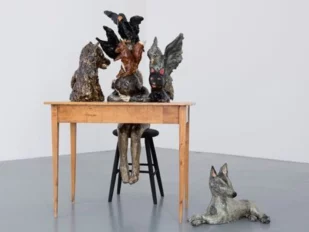
In Belgrade, someone wrote graffiti on the window of the Salon of the City Museum, where the exhibition of the October Salon is held. The graffiti was removed by the end of business hours. The perpetrator should have been captured by security cameras

At the moment when the institutions of the Republic are destroyed, when Vučić's octopus is still alive, when people are disgusted by the injustice and the stench left behind by the Essenes regime, we have, as Machiavelli said, only civic virtue as the fuel with which we can return to the beginning

The four independent members of REM are an example of perseverance and civic responsibility. Rodoljub Šabić even, upon leaving the premises of REM, after the sentencing of the Informer, experienced that the Essenes insulted him, hit him with their hands and feet. But that too will soon be over

Vučić pardoned the batterers and Dijana Hrkalović. The election winners should abolish the sultan's power that allows one man to run afoul of the entire judicial system

Interview: Branko Stamenković, public prosecutor of the Supreme Public Prosecutor's Office
A black picture and the breakdown of the rule of law subscribeThe archive of the weekly Vreme includes all our digital editions, since the very beginning of our work. All issues can be downloaded in PDF format, by purchasing the digital edition, or you can read all available texts from the selected issue.
See all



