

Election 2026.
REC determined the final number of voters in the elections
The Republic Election Commission (REC) made a decision today on determining the final number of voters in Serbia
 Photo: Erich Lessing
We see on television how women in Ukraine are preparing Molotov cocktails in case Russian armored vehicles penetrate the cities. I remember the Hungarian Revolution in 1956. I was there as a young journalist. There are some similarities with what is happening before our eyes in Ukraine, where a large column of Russian armored vehicles is heading towards Kiev.
I watch on various televisions how women in Ukraine fill bottles with gasoline and make Molotov cocktails on the street. One of them, a retired economist who lives in Kyiv, says she looked for the recipe on Google. Photos have emerged of crates filled with these homemade incendiary bombs. Ukrainian President Volodymyr Zelenskiy called on members of the territorial defense to prepare Molotov cocktails and use them to meet Russian armored vehicles if they penetrate the cities, but so far there has been no news that anyone has used them.
As I look at it, I remember Hungarian Revolution of 1956. I was there as a young journalist. Then the insurgents attacked Soviet tanks with Molotov cocktails. Hungarian students, the first fighters of the uprising, had pre-military training in schools according to the Soviet model. Even without Google, they knew how to fight armored vehicles with bottles filled with gasoline and some fabric as a fuse.
How it was presented to today's Hungarian audience: three Russian soldiers in a tank in Budapest are cursing, they don't know whether to go left or right. Their superiors did not give them a map of the city when they were sent to fight against "Hungarian fascists". They see a young woman in front of the tank. "Should we shoot her, this fascist whore?" asks one soldier. However, she waves at them, speaks Russian, is beautiful, so the soldiers open the dome cover. The girl then throws a Molotov cocktail with a shout of "Ruszki, haza!" (Russians, go home). This scene could be experienced in 3D video technology at the Dictatorship Museum in Budapest at the exhibition on the occasion of the sixtieth anniversary of the Hungarian Revolution. Of course, it wasn't exactly like that, the scene is incredible, but we wanted to achieve a strong effect of fearless insurgents that is etched in the memory, skillful manipulation, superstructure of real events to achieve a stronger message. Moletov's cocktails were, of course, used.
Will an exhibition in Ukraine one day show what is happening before our eyes? And how?
Two years before the Hungarian Revolution, I had graduated from the school for reserve officers in Bitola. We were taught how to use a Molotov cocktail, we were taught that a tank in a battle in a populated area without an infantry landing escort becomes an easy target for enemy infantry who get close enough to it. It was necessary to know which spot on the tank the bottle should hit.
We learned, and this was confirmed by one of our retired colonels on TV N1, that the attacker should have at least three times more fighters than the defenders. This is not the case in Ukraine. Does this mean that the Russian attackers will be repelled? Today, it is no longer about the number of soldiers, but about firepower, in layman's terms, how much ammunition can be fired by which side from which weapon in a minute. Russian firepower is many times greater than Ukraine's. By comparison, it's like an Uzi vs. a lady's pistol fight. But there is also the issue of fighting morale. And there are Molotov cocktails. Different rules apply in urban combat.
After the conflict with Stalin, Yugoslavia developed a military doctrine in case of an attack on the USSR. It was assumed that in the event of a tank invasion from the north, from Hungary through the Vojvodina plain, any resistance would be doomed to defeat. It was planned to retreat without a fight in the direction of Bosnia and the hilly terrain in order to preserve the forces, but attacks from the rear would immediately begin when the tanks rumbled, for which territorial defenses were organized and trained locally. It seems that Ukraine did not have a pre-developed military doctrine, although at the latest since 2014 and the beginning of the conflict in Donbass, it could foresee the possibility of what is happening right now: an attack by the Russian army from several directions.
We have not heard the statements of the Ukrainian generals from the scene, we do not even know the names of the Chief of General Staff or the commander of Kyiv. In Hungary, the uneducated insurgents were commanded by Colonel Pal Maleter. Originally, as the commander of the tank division, he had orders to suppress the uprising, but he joined the insurgents. Towards the end of the fighting, he was appointed general and minister of defense. At the invitation of the Russians, he went to the negotiations during which, however, on the order of the KGB, he was arrested, later sentenced to death and executed by hanging, as well as the leader of the Hungarian Revolution, Imre Nagy, who wanted to take the country out of the Warsaw Pact. I understand why the Ukrainian delegation hesitated to go to Belarus for negotiations. In 1989, Pal Malater, Imre Nagy and several other victims of communist Hungary were rehabilitated, and over one hundred thousand people attended the ceremonial funeral in 1989.
If he finishes his work in Ukraine, Russia will probably move on to Moldova. Not only because Transnistria exists as a safer base than Donbass, but also because the mood of the local population is divided, one part is pro-Russian.
And after? Romania and Bulgaria with a predominantly Orthodox population? The Third World War? Am I exaggerating? If there were to be a war in Europe beyond and beyond Ukraine's borders, Western ground forces have no chance against the Russians, who can only be stopped with nuclear weapons. The Kremlin is nervous about the proximity of American missiles.
I don't see anyone analyzing how many large Russian planes land, how many Russian cargo ships arrive in Venezuela every hour. Who says Russian missiles aren't already installed there? At the border of the territorial waters of the eastern coast of the USA, Russian nuclear submarines are merrily pouncing. Russia can immediately respond to America's attack. Of course the American intelligence services know this much better than us laymen. Why are they silent? So don't panic, it wouldn't be good for Biden, and more importantly, it wouldn't be good for business.
All of us in Europe, and perhaps in the whole world, have reason to be concerned. Despite all its neutrality, Serbia could also become collateral damage of the new Cold War, which is heating up more and more.
Read daily news, analysis, commentary and interviews at www.vreme.com
The Republic Election Commission (REC) made a decision today on determining the final number of voters in Serbia

A citizen of Belgrade whose polling station in Banja Luka was changed in the voter list without his knowledge claims that the Ministry did not correct his data and that the deadlines have expired. The elections are on October 25 and he still doesn't know where he will vote.

The pardon procedure implies the appropriate role of the Minister of Justice, who should initiate the procedure or submit an opinion on the pardon, says prosecutor Radovan Lazić.
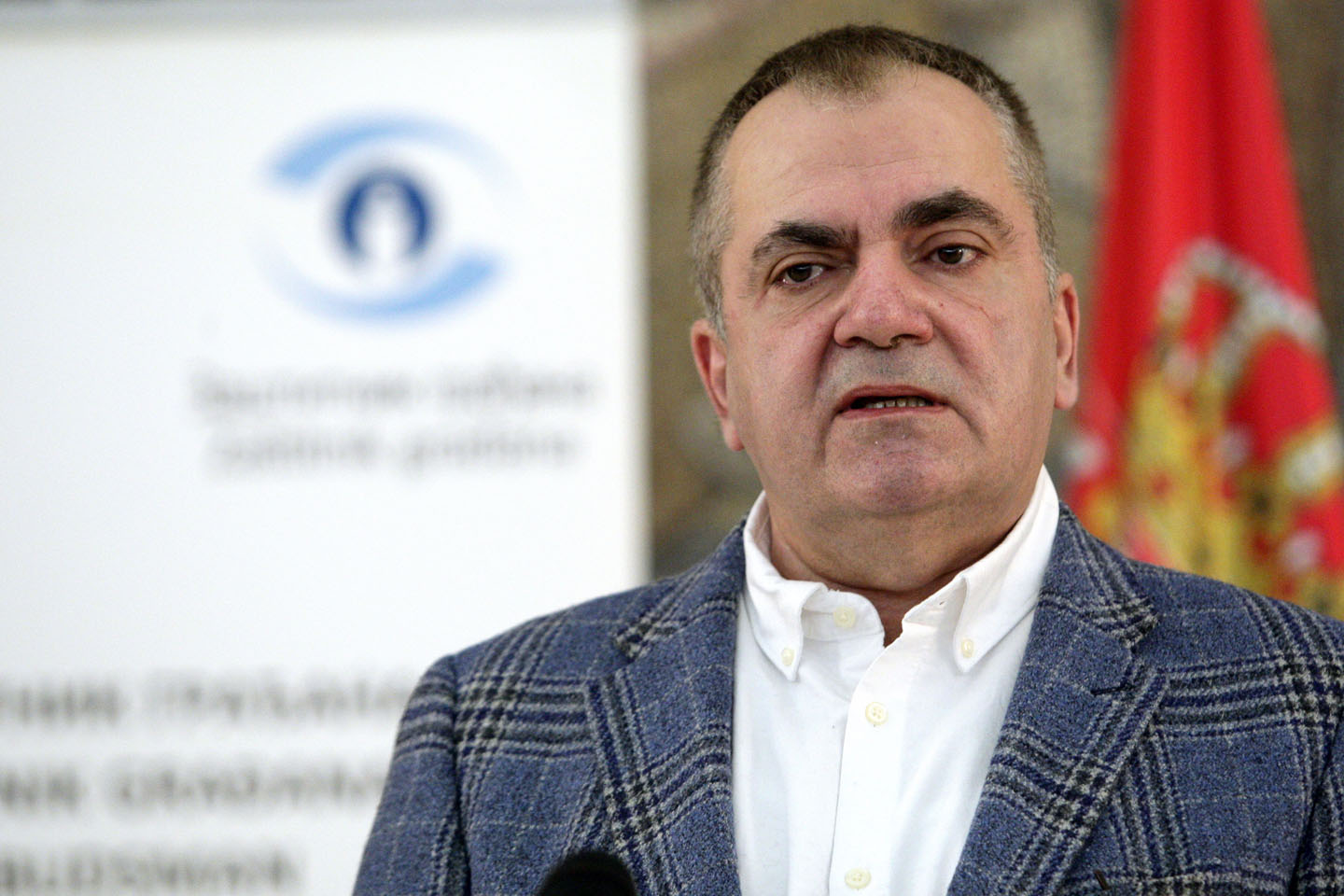
Phone numbers 064 876 85 05 and 011 2068 100 will be available 24/7 for reports and addresses to citizens, and the possibility of direct addresses at the premises of the Protector of Citizens is also provided.

NUNS demands an urgent investigation due to the threats sent to two Radar journalists who wrote about the Sky correspondence in which Aleksandar Vučić is mentioned. The association states that the threats also mention violence against children of journalists and warns of impunity

There is, literally, no difference between the one who claims it is day in the middle of the night, or the one who claims to be a giraffe, from the claims we read on billboards: that Vučić is working to unify Serbs and that Serbia is doing better and better day by day.

The pre-election arrests due to the alleged "overthrow of the state" testify to the regime's panic. The bad news for them is - they can't arrest the whole people who decided to defend themselves from progressive beatings and election theft

The ring that tightens around Ćaciland Student list is getting narrower. Because there are more and more spoiled people who see the false prophet for what he is: a street obscener who is fighting Serbia

The archive of the weekly Vreme includes all our digital editions, since the very beginning of our work. All issues can be downloaded in PDF format, by purchasing the digital edition, or you can read all available texts from the selected issue.
See all




