

New issue of Vremena
How to break a mafia state
The famous Hungarian sociologist Balint Magyar talks about the mafia state for the new "Vreme". How the new election winners can overthrow that system
 Photo: Flickr
I guess in order to divert the conversation from the gloomy question of what will happen after Tito's death, Bruno Krajski, out of context, told how he organized a referendum on the construction of the Zwentendorf nuclear power plant with the intention of losing, but then gaining an absolute majority in the parliamentary elections. Veselin Đuranović looked at me in astonishment, I guess he wondered if I was translating correctly, but I was equally astounded.
Serbia will hold a referendum on changes to the Constitution in the area of the judiciary on January 16. A lot has already been written about it, opinions differ: from the fact that it should be boycotted, to "go out and circle NO", to "go out and circle YES". There were also tensions over the Law on Referendum and People's Initiative, there were protests, so the progressive government under pressure changed that law a little.
I remember another referendum, in Austria, and how it was necessary to pass the corresponding law first, so that it could be held at all.
But let's start in order. The President of the Federal Executive Council (Federal Government of the SFRY), Džemal Bijedić, died in a plane crash on January 18, 1977. Tito was already quite sick and tired, and he was happy to leave a lot of things, especially protocol meetings with foreign statesmen, to the experienced Džema. A replacement had to be found quickly.
Veselin Đuranović, who until then mainly worked only in his native Montenegro, was appointed as the new federal prime minister. He faced serious trials: unlike Titus and his entourage, he cared nothing for protocol. When we were preparing for the visit of German Chancellor Helmut Schmidt in the summer of 1977, I addressed him as "Comrade President", but he did not accept it: "We were from Skojov, my name is Vesa, if you have forgotten..."
Visit of the Austrian Chancellor Bruno Krajski it was scheduled for April 8, 1980 in Slovenia. There were no serious problems on the agenda, but, in general, the cooperation between neutral Austria and non-aligned Yugoslavia. The eternal problem of the Carinthian Slovenes did not interest Montenegrin Đuranović, even though it was always on Tito's negotiating agenda, and especially Kardelj, with the Austrians.
It is very close to the place where the meeting was held in Ljubljana Tito was already dying in the clinic, only that it was kept secret. This is precisely why the conversation between the two Prime Ministers was not cancelled. I guess in order to divert the conversation from the gloomy question of what will happen after Tito's death, Krajski, out of context, told how he had called a referendum on the construction of the Zwentendorf nuclear power plant with the intention of losing, but then winning the parliamentary elections.
Đuranović looked at me in astonishment, I guess he wondered if I was translating correctly, but I was equally astounded.
We had dinner in some restaurant on the mountain, I don't remember what, but the host and his guest looked very good: short, stocky, Krajski in an expensive tailor-made suit, with a waistcoat whose task was to hide his belly; Đuranović in, probably hastily bought, a dark suit of the then well-known domestic company "Beko" with too short sleeves, but a handsome, tall, typical Montenegrin.
Krajski was at the peak of his power that year, he had already been chancellor for ten years and held all the strings in his hands. They mockingly called him "king of the sun", because the French king Louis XIV thought that he himself, like the sun in the sky, was the center of everything, and Krajski, although at the head of democratically elected governments, thought the same for himself.
In his first government, he was forced to give ministerial positions to four former, prominent Nazis, one of whom was even an SS officer whose unit fought on the Eastern Front. He wanted to get rid of them. Heinz Fischer, then a close associate of Krajski, later president of Austria for two terms, told how he cunningly planned to get an absolute majority in the next parliamentary elections, by deliberately suffering a defeat in the referendum on the Zwentendorf nuclear power plant. He also wrote that in the book "Krajskije godine 1967-1983", which he gave me as a gift with a kind dedication.
At the time when all this was happening, there was no mass resistance against nuclear energy. Fischer was surprised when Krajski presented to him his plan to intentionally lose the referendum in order to gain an absolute majority in the elections. In the book, he quotes himself as having objected: "Bruno, as a lawyer I have to warn you that this cannot be done." In our country, a referendum can be called on a law passed by the parliament. We did not pass any law on Zwentendorf, therefore there cannot be any referendum."
Krajski answered him: "You don't need to bother me with that at all." You usually make laws about some nonsense, so you want to convince me that you cannot come up with a law on such an important topic that will allow a referendum to be held." He hinted that he might resign if the referendum, which he himself called for which one thought he cared to pass, really passed.
Krajski had moments when he thought he was allowed everything. And this referendum trick really worked for him. Fischer explains that after Krajski's "defeat" in the referendum, the people felt a need for compensation - in the parliamentary elections in October 1979, he won the biggest victory of social democracy in history, got an absolute majority and was able to form a government only from his own people. Zwentendorf never worked, and Krajski ruled until 1983.
I kept in touch with Fischer and when he was the president of Austria, he recommended my book "Tito's translator" to some friends.
Until today, only one more referendum was held in Austria, and that was whether to join the European Union, which required serious changes to the Constitution. The turnout was over 82 percent, of those who went to the referendum, 66,6 percent voted for joining the EU.
Read daily news, analysis, commentary and interviews at www.vreme.com
The famous Hungarian sociologist Balint Magyar talks about the mafia state for the new "Vreme". How the new election winners can overthrow that system

The message of the last gathering of the Student List before the elections on October 25 is: It's over! It's a little retro, but considering who it's related to, it hits the spot

The "Students are winning" list held a final pre-election rally on Belgrade's Trg Slavija ahead of the extraordinary parliamentary elections scheduled for Sunday, October 25.
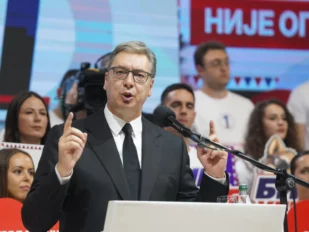
"They tried to destroy our country on an external order. Huge money entered the country and that's why this is the most difficult battle, because they attacked us with billions of euros, and we defended ourselves with purity, our program and love for the homeland," said Aleksandar Vučić at the final pre-election meeting in Belgrade's Hall of Sports

There is, literally, no difference between the one who claims it is day in the middle of the night, or the one who claims to be a giraffe, from the claims we read on billboards: that Vučić is working to unify Serbs and that Serbia is doing better and better day by day.

There is, literally, no difference between the one who claims it is day in the middle of the night, or the one who claims to be a giraffe, from the claims we read on billboards: that Vučić is working to unify Serbs and that Serbia is doing better and better day by day.

The pre-election arrests due to the alleged "overthrow of the state" testify to the regime's panic. The bad news for them is - they can't arrest the whole people who decided to defend themselves from progressive beatings and election theft

The ring that tightens around Ćaciland Student list is getting narrower. Because there are more and more spoiled people who see the false prophet for what he is: a street obscener who is fighting Serbia

The archive of the weekly Vreme includes all our digital editions, since the very beginning of our work. All issues can be downloaded in PDF format, by purchasing the digital edition, or you can read all available texts from the selected issue.
See all




