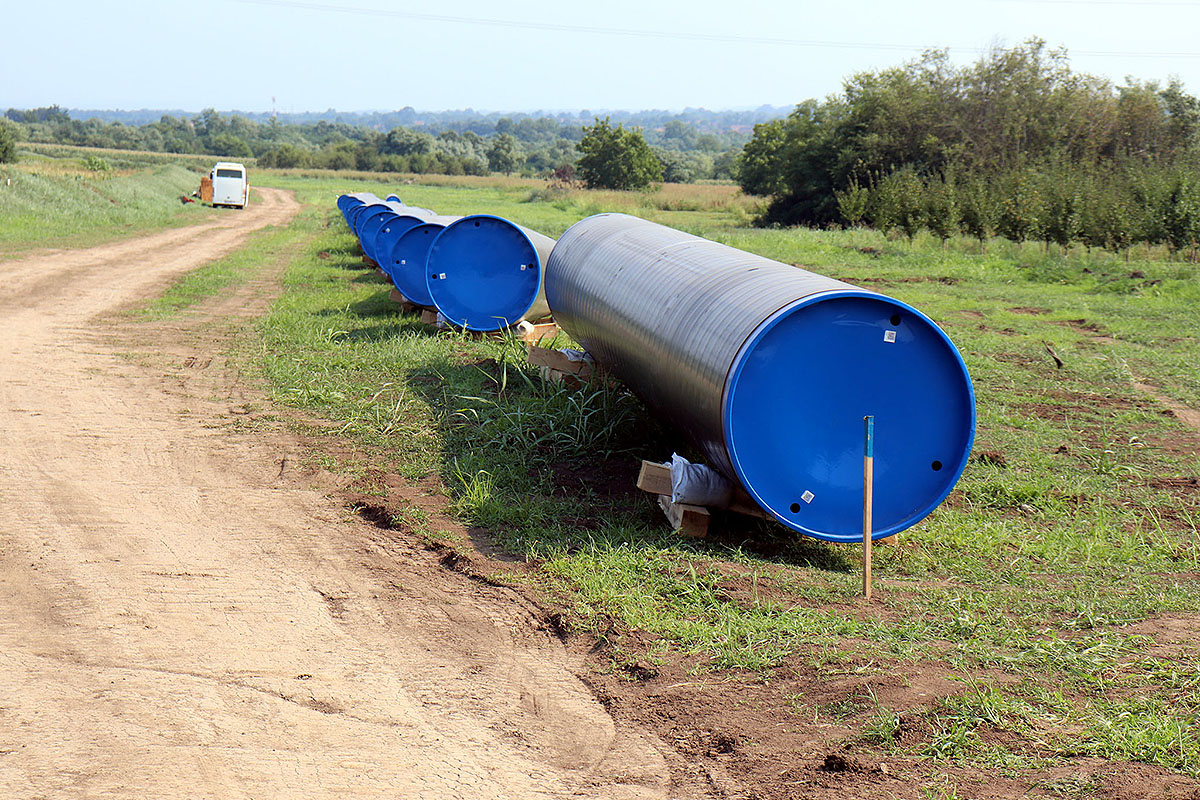
About the pipeline that should via North Macedonia to connect Serbia with the LNG terminal for liquefied natural gas in Greece has been talked about for years, and now for decades. However, only when it is This summer, Serbia signed a Memorandum on energy security with America for the first time, the whole business suddenly exploded. The two governments have confirmed that they have agreed on accelerated implementation.
However, it seems that the agreement on gas was created first, and only then the Memorandum that should protect the energy interests of Serbia and the USA. All this was preceded by a meeting of twelve countries of Central and Eastern Europe and the Balkans in Washington with the United States to establish a partnership that will provide access to American liquefied natural gas and contract deliveries. Serbia was among those twelve, and it took place at the beginning of 2026.
Serious competition to Russian gas
Whether it was business first, then politics, or the other way around, is perhaps not so important, as it is important that in about a year and a half, the Serbs could have more serious competition with Russian gas.
In the last two or three years, Serbia has been taking about 400.000 million cubic meters of Azerbaijani gas through the gas pipeline with Bulgaria, but this is not a large amount if you consider that the entire annual gas consumption in Serbia amounts to a little over three billion cubic meters. However, the plan is for Serbia to transport up to 1,5 billion cubic meters of gas through North Macedonia, which is about half of the country's total annual needs. When these two sources are combined, the country will certainly not need a lot of Russian gas, about a third of the total needs, because we ourselves produce some smaller amounts.
The Minister of Mining and Energy in the technical mandate, Dubravka Đedović Handanović, said that the goal is for the gas interconnection to be completed already in the first quarter of 2028.
It will take more time to complete the works on the North Macedonian side. As the minister stated, according to announcements from Skopje, the section there should be completed by the middle or end of 2028.
At the same time, the interconnection between Greece and North Macedonia should be commissioned in 2027. This would open up an additional route for natural gas supply, and the connection of Serbia and North Macedonia with the so-called Vertical Gas Corridor would enable the delivery of larger quantities of gas from the direction of Greece to Central Europe.
Why Europe is not for
American energy companies are increasingly trying to expand their operations in the Western Balkans. Such efforts, however, are raising concerns in the European Union that countries aspiring to membership could become tied to US gas for the long term just as they seek to transition to cleaner energy sources.
Albania, Kosovo and Bosnia and Herzegovina have already expressed interest in importing large quantities of American liquefied natural gas (LPG) or in building the infrastructure needed for its import. As reasons, they cite the gradual reduction of dependence on Russian energy sources and coal, along with the simultaneous development of renewable energy sources.
In Brussels, however, they believe that such projects are not necessarily justified. Such a development would contradict the European Union's goal of reaching net zero emissions by 2050 and increasing the share of renewable energy sources, Politico wrote in September of this year.
Donald Trump's energy dominance
American gas producers are seeking to take advantage of the reduction in Russian gas supplies to Europe, as well as the disruptions in the world market caused by the war in Iran, to make new deals in the region. Their expansion fits into the policy of the administration of US President Donald Trump, which openly advocates US "energy dominance".
The representative of the European Commission for energy diplomacy in the Western Balkans, Andraš Huyber, warned that the candidate countries for membership have already undertaken to reduce the use of fossil fuels. More massive gas imports, according to him, could move them away from that goal, instead of reducing Russian gas to another supplier.
The most controversial is the project in Bosnia and Herzegovina, where it was agreed to prepare a gas pipeline that would bring gas through Croatia. Additional attention was drawn by the decision of the Bosnian parliament to assign a key role in the project to a small company, AAFS, connected to people close to Trump.
Similar dilemmas accompany Albania's plan to, in cooperation with Greece and the American company Venture Global, ensure long-term supplies of TPG. The proposal envisages a 20-year contract, but the project has so far remained at the memorandum level and the completion of the feasibility study is awaited. Kosovo has not yet made a final decision, while Serbia and North Macedonia could receive American TPG through the planned connection with Greece.
The Energy Community warns that the new energy infrastructure must be open to competition, so that all suppliers have equal access, without the privileged position of individual companies.
The paradox is that the countries of the Western Balkans are looking for alternative sources of energy that even the European Union cannot fully provide. The EU produces very little gas, does not want to finance the construction of new gas infrastructure in the region, and at the same time imports more and more US liquid natural gas itself.
The Director of Energy Community, Artur Lorkovski, therefore believes that the priority should be the harmonization of the countries of the region with the EU rules, so that gas can pass through the European market unhindered, regardless of origin. In such a system, the American TPG could become an important part of the energy supply of the Western Balkans, not necessarily because Brussels especially favors it, but also because the European Union does not have enough of its own gas, wrote Politico.
Election time! And someone has to report to you independently. That's why it's in October annual subscription the digital edition of "Vremena" even 2.500 dinars cheaper. Choose now!