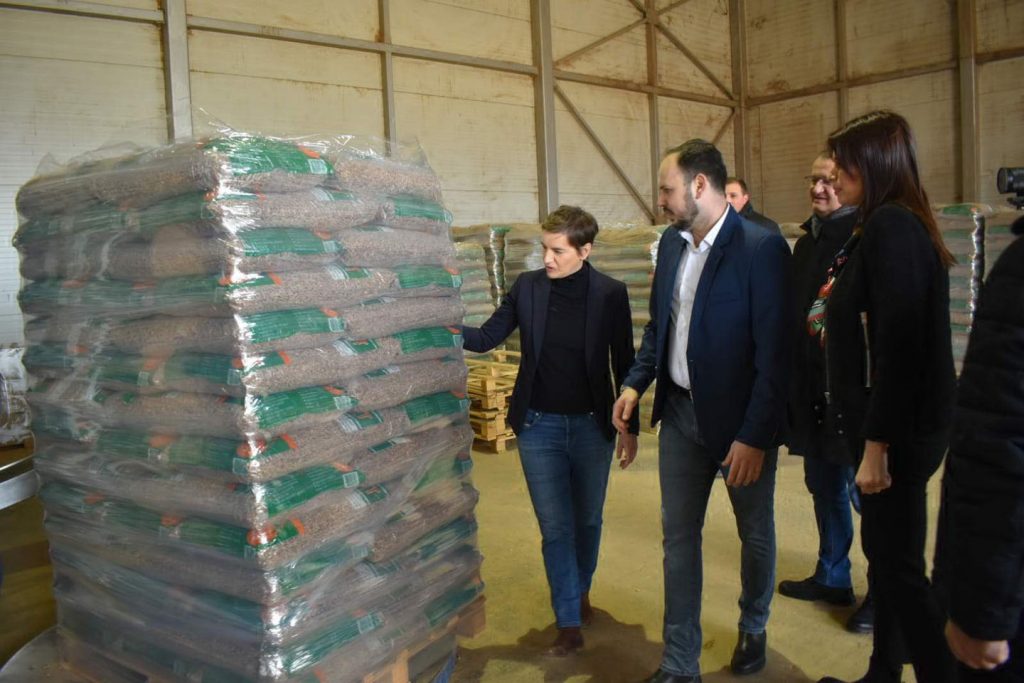
The state did not provide enough raw material for pellets last year, the producers claimed. That is why citizens rushed to buy firewood before the shortage this summer. This immediately increased the prices
Some Belgrade warehouses are sinking pellets selling from 44.000 to 50.000 dinars, although last year the price was from 26.000 to 35.000 dinars, depending on the quality of the energy source.
"The current price of pellets is 47.000 dinars," they told "Vreme" from a warehouse. "It's a class A2 pellet, which is better quality firewood, and we simply can't give a lower price because the purchase price is already high enough."
And at other warehouses, which offer lower-class pellets, prices cannot be found below 40.000 dinars. The reason why pellets have become more expensive compared to last year is the distrust of citizens in the promises of "Srbijašum" that they will provide sufficient quantities of raw material.
Because they simply didn't do it in the fall of 2025, so the consumers are whole heating season had a shortage of pellets, which stabilized only in the spring, when they no longer needed firewood.
"We have 17 forest farms, 67 forest administrations. In all those local self-government units where the headquarters of the farms and forest administrations are located, citizens can contact the commercial services that will instruct them how to pay and where to pick up the purchased wood," Gordana Jančić, director of the Forestry Sector in "Srbijašume", told RTS, who claims that "there is enough wood."
Market psychology
The pre-season of 2026 started in a similar way. There are no pellets at some warehouses this summer, which naturally created panic among customers, because they immediately thought that they would freeze and chase firewood ton by ton this winter as well.
Some warehouse owners used this to introduce waiting lists and justify raising prices up to 50.000 dinars per ton. As a rule, pellets are more expensive at smaller warehouses, and producers complain that factories do not deliver them regularly or in sufficient quantities.
Market analyzes conducted by the Faculty of Forestry show that the supply of large, key warehouses in Serbia is generally good.
They also explain that there are problems with delivery delays at smaller sales points, such as construction material warehouses and other stores where the sale of pellets is not the main activity.
"The good news is that there has been no increase in the price of pellets at most of the key warehouses in the last two weeks. However, this cannot be said for some smaller warehouses in some smaller towns where price increases are recorded almost on a weekly basis," says Branko Glavonić, professor at the Faculty of Forestry in Belgrade.
He also expects an increase in deliveries, taking into account, as he says, that the two large factories that carried out the overhaul have completed the work and are now starting full production.
Glavonjić advises citizens who buy pellets to check the prices in different warehouses in detail - where the differences for the same product go up to 3.000 dinars per ton. He points out that, if they are able, they buy pellets directly from factories, where it is cheaper by up to 10.000 dinars compared to retail.
Photo: TanjugUnder the watchful eye of the state: Ana Brnabić and the pellet in Kladovo
What caused the commotion?
Last year, a large number of citizens switched from electricity to pellets, because due to the change in tariffs, it was no longer worthwhile for them to use electricity for heating.
At the beginning of 2025, the state introduced a new Rulebook on the quality of pellets in order to regulate the domestic market and protect customers. The application of this rulebook to foreign suppliers has created serious delays at the borders.
The sampling and quality control procedure for imported pellets took between 20 and 60 days, which practically stopped the flow of cheaper imported pellets in the moments of greatest crisis.
This was followed by bad weather, which was used by "Srbijašume" to claim that the bad weather conditions in the forests made it difficult to cut and extract wood assortments.
Pellet producers were once again faced with reduced deliveries of logs from public companies, which forced them to buy more expensive wood from private forests or to drastically reduce their work capacities, and the producers directly blamed "Srbijašume". They said that in some periods less than 40 to 50 percent of the contracted raw material was delivered to them.
There were simply no pellets at the warehouses, and those who heated themselves with this firewood did not survive the winter without occasional freezing.
And those who are angry once are much more careful the following year.
Only in August: Save three thousand dinars on the annual subscription to the digital edition of "Vremena"! _Take advantage of the discount hereand support independent journalism.
What is happening in the country and the world, what is in the newspapers and how to pass the time?
Every Wednesday at noon In between arrives by email. It's a pretty solid newsletter, so sign up!
The National Bank of Serbia increased the reference interest rate to six percent, for the first time in more than two years. What does this decision mean for citizens who pay off loans, those who plan to borrow and savers?
The state currently has no money for the second installment of subsidies per hectare, announced the Minister of Agriculture in the technical mandate, Dragan Glamočić. Farmers were waiting for the promised help before the autumn sowing, while agro-economic analysts warn that the government's technical mandate does not release the state from its obligations.
The leakage of half a million liters of oil near Sisak stopped the transport of Janaf, on which the supply of the Refinery in Pancevo depends. NIS has requested access to state reserves, and experts warn that a longer interruption could stop production at the Refinery
The import of fossil fuels has cost Serbia more than 57 billion dollars in the past two decades, with a high price for the environment and the health of citizens. The energy transition is expensive, but its delay seems to be even more expensive
Due to damage to the pipeline on the Adriatic pipeline, crude oil transport to Serbia has been suspended, and the Pancevo Refinery is adjusting the volume of processing. NIS also requested diesel from operational reserves
At the moment when the institutions of the Republic are destroyed, when Vučić's octopus is still alive, when people are disgusted by the injustice and the stench left behind by the Essenes regime, we have, as Machiavelli said, only civic virtue as the fuel with which we can return to the beginning
The four independent members of REM are an example of perseverance and civic responsibility. Rodoljub Šabić even, upon leaving the premises of REM, after the sentencing of the Informer, experienced that the Essenes insulted him, hit him with their hands and feet. But that too will soon be over
Vučić pardoned the batterers and Dijana Hrkalović. The election winners should abolish the sultan's power that allows one man to run afoul of the entire judicial system
The archive of the weekly Vreme includes all our digital editions, since the very beginning of our work. All issues can be downloaded in PDF format, by purchasing the digital edition, or you can read all available texts from the selected issue.