

SHOP NOW
Idea about the fate of 6.500 workers after the arrest of Davor Matsura
Idea has spoken out about the business and workers after the arrest of its new owner, Davor Matsura
 Photo: Tanjug/Strahinja Aćimović
The construction of highways in Serbia in recent years is the main asset of the current government. While these projects are being promoted as proof of progress, the question is - at what cost? Experts point out that the prices of these projects are much higher than abroad, in the countries of the region
According to available data, every year the state allocates hundreds of millions of euros for the construction of new roads. Even when not a kilometer is built in that year.
But let's start in order. First of all, official statistical data on the price of newly built highways in Serbia they exist only in the total amount. This means that there is not only a price for built kilometers, but, as explained by the Republic Institute of Statistics (RZS), the total amount also includes other costs, writes Dunja Marić for New Economy.
"The value of the performed works includes the value of labor, installed materials and finished products for installation procured by the reporting unit, as well as other costs incurred by the reporting unit in connection with the execution of construction works. VAT, costs of land acquisition, design and supervision are not included - because these activities do not belong to construction according to the Classification of Activities", stated RZS in a response to the New Economy.
How many kilometers of highway were built?
There are no official data on the number of kilometers built in one year. However, there are data on how many kilometers of highways there were in the country at the end of each year, so the number of newly built roads can be obtained by simple subtraction. Thus, it can be seen that at the end of 2023, which is the most recent data, there were a total of 963 kilometers of highways in Serbia.
That year, 22 kilometers were built. According to RZS estimates, about 788 million euros were allocated for the construction of highways that year, with the fact that this includes works that have not yet been completed.
A year earlier, in 2022, 13 kilometers of highway were built.
At that time, the state allocated around 612 million euros for the construction of highways.
Furthermore, in 2021 and 2020 there was a standstill, when not a single kilometer of highway was built. However, it should be borne in mind that there was a corona virus pandemic in these years, which is why a state of emergency was introduced in our country, and it is not surprising that certain construction activities, such as these, were suspended.
However, this does not mean that the state did not allocate money for them. Specifically, in 2021, around 390, and in 2020, 119 million euros were allocated. Therefore, there were still construction activities, although the new kilometers were not completed.
On the other hand, a year earlier, in 2019, the most new kilometers of highway were built since the Serbian Progressive Party came to power.
According to official data, 146 new kilometers of highways were built that year.
The year before, in 2018, there was also a standstill, so no new kilometers were built. Nevertheless, the state then spent about 285 million euros, it can be assumed - on various preparatory works and various phases of unfinished construction.
In the years that preceded - it was built. In 2017, 41 kilometers were built, in 2016, 48, and in 2015, 86 kilometers of highways.
As for the money allocated for this, in 2017, RZS data show, the state provided a total of 339 million euros for the construction of highways. As for 2016, the amount was 283 million, and in 2015 it was around 275 million euros.
2014 and 2013 were the first years in which the SNS government did not build a single kilometer of highway.
Despite this, 2014 million euros were allocated in 175, and around 2013 million in 160.
Finally, in 2012, when SNS came to power, 12 kilometers of highway were built. However, as the elections of that year were held in May, it is not possible to say with certainty what was built before and what after the change of government.
Regardless, the state allocated around 49,5 million euros to highways that year.
Why are kilometers expensive in Serbia?
Experts, as well as politicians, often talk about how kilometers of highways are far more expensive than in Europe. Construction engineer Danijel Dašić confirms this for New Economy.
"The only difference, I have to say, is that high-quality materials are installed in the roads abroad, and low-quality politicians here. The whole situation in the infrastructure sector has been systemically, for 13 years, cooked like a frog, so we did not even notice that, for example, in these 13 years, there is not a single infrastructure project that was completed on time, as foreseen by the project, but none that cost as much as predicted and that was not repaired at least once after the completion of the work. The essence is in a large number contract annexes and a large number of subcontractors", says Dašić.
He explains that it is the annexes and subcontractors that create a well-founded suspicion that there are corrupt activities.
"Annexes should be the exception, not the rule, although we don't have projects without dozens of annexes. As for the large number of subcontractors, they are brought into the business in a way that, to put it mildly, is not in accordance with the Law on Public Procurement and the Law on Obligations", says Dašić.
As an example, he cites the section from Belgrade to Kelebija, the border with Hungary - a project within the framework of which the railway station in Novi Sad was reconstructed, where the canopy collapsed on November 1, killing 16 people.
"Out of a total of two hundred subcontractors, as far as we have been able to identify, both contractors and material suppliers, only one-third are those who have been approved. So, when all of that is put together, we arrive at a price that is the highest in the area and not only is the price the highest, but the quality is also the worst. The best example is when you compare our famous section through the Grdelica Gorge with the highway through North Macedonia, near the border with Greece," says Dašić.
Namely, as our interlocutor explains, these two sections are very similar, in terms of terrain, bridges, viaducts, tunnels, retaining walls...
"The Macedonian section cost literally half as much as ours," says Dašić.
Namely, the aforementioned highway through North Macedonia, 28,8 kilometers long, cost 218 million ev. On the other hand, 26,3 kilometers through the Grdelica Gorge cost almost 400 million euros.
Why do we spend and not build?
Although there are years in which not a single kilometer of highway is completed, there is no year in which large sums of money are not allocated for that purpose. Dašić explains that the reason for this should be sought in the paid advances and a large number of other expenses. However, a bigger problem than a lot of money spent on preparatory work is the money spent on repairs.
"Again, that famous highway to Greece, for which we gave tens of millions of euros from the budget for three or four years in a row, to rehabilitate the slope. Then we had to rebuild one lane through the Grdelica Gorge very soon after the works were completed. Also, the complete final asphalt layer had to be replaced. That's where the money goes. How lucky that the preparatory works are being carried out to the extent they should, because they guarantee the quality of the project," concludes Dašić.
Idea has spoken out about the business and workers after the arrest of its new owner, Davor Matsura
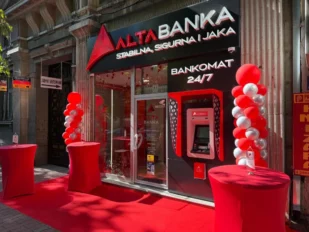
Can Alta bank disrupt the financial system of Serbia? What messages does the introduction of bankruptcy send - should we trust banks and which ones?

The situation regarding Alta Bank does not threaten the regular operations of Belgrade Waterfront

Intesa Invest claims that the impact of Alta Bank's collapse on its money funds is limited and one-time. The funds operate regularly, and the issuance and redemption of investment units take place smoothly.

Which bank, from when and in what period of time, will pay out money to the depositors of Alta Bank, for which the Commercial Court in Belgrade issued a decision on the initiation of bankruptcy proceedings.

Vučić pardoned the batterers and Dijana Hrkalović. The election winners should abolish the sultan's power that allows one man to run afoul of the entire judicial system
Davor Matura's ALTA empire is the transplanted heart of the corrupt regime of Aleksandar Vučić, who was defeated in the October 25 elections. From ALTA Bank, roads lead directly to the top of the progressive government.

Things are unfolding at an astonishing speed, as astonishing as the speed with which Vucic conceded a convincing defeat. Impatience is understandable, but misplaced

Time explores: The construction of the St. Sava Temple
Did the money paid by the Government to SPC end up in Moscow through Alta Bank? subscribeThe archive of the weekly Vreme includes all our digital editions, since the very beginning of our work. All issues can be downloaded in PDF format, by purchasing the digital edition, or you can read all available texts from the selected issue.
See all



