
News
Research: N1 devoted two and a half times more time to Pride than RTS
At the same time, the participants of the walk were three times more represented among RTS interlocutors

The mayor of Belgrade, Aleksandar Šapić, declared the statue of the scales in Terazije as a symbol of this part of the city, although in the minds of Belgrade residents, it is the Terazije fountain. Since March 1991, it has been a symbol of protest against the government
A place becomes a symbol of a city if and only if the inhabitants accept it, not because it decides Aleksandar Šapić.
When you say Pobednik, or the confluence of the Sava and the Danube, the first and probably the only association with those places is Belgrade.
When you say Česma, the image of Terazij immediately comes to mind.

Libra, some describe it as a market scale, which it is placed on Terazije on the night between Monday and Tuesday, it can only be associated with the scales of the goddess Justice with which she justly weighs arguments, with the zodiac sign, and perhaps with the High Public Prosecutor's Office, which is very present in the public. Not at all on Terazije - no.
The part of Belgrade called Terazije has had its own symbol for a long time. It is the Terazij fountain, and neither Šapić nor anyone else can abolish it in order to inaugurate one of their own.
Even Theras themselves have nothing to do with Libra. In the 17th century, where the "Moskva" hotel is now, there was the largest water tank with a tower. The towers were used to raise the water on them with water pipes so that it would have better pressure and then distribute the water through the pipes to the households. Namely, the Belgrade of Turkish times had an organized water supply and sewage system.
One of those towers was on the spot near today's Terazija fountain.
On the website of the City of Belgrade, it is written that "such reservoirs are called terazija". Therefore, this part of the city was named after the largest water tank in the city by the Turks, and the Serbs accepted it, and the entire area from the Old and New Courts, where the seat of the city authorities and the Presidency are today, to near Stambol Gate, was called Terazije.
The Terazij fountain was built in 1860 between today's "Moskva" and "Balkan" hotels, with the funds of Prince Miloš Obrenović, with the idea of celebrating his return when he came to the Serbian throne for the second time.

It was built at the place where the two busiest roads at the time, Smederevski and Kragujevacki, today Ulica kralja Milana, crossed, where a water tank used to be located, and Terazijska chesma was named after it. Sculptor Franz Laurent made it in the form of a tower, the one that helped the people of Belgrade get water, so that the fountain would be in the spirit of the area where it is located.
When this part of the city was reconstructed into a square according to the project of the French architect Edouard Léger, it was moved to the port of the church of Saints Peter and Paul on Topčider. There, it had only the role of a monument because it was not connected to the water supply system.
Šapić's "surprise": The new sculpture "Terazija" placed in the center during the night
It was returned in 1975 very close to the place where Prince Miloš placed it, on the plateau in front of the "Moskva" hotel.
In the minds of the citizens of Belgrade, the Terazij fountain is also a symbol of demonstrations, since the three-day student protest in March 1991. That is why students also use it as a place of protest or gathering.

Šapic can't have it to his liking. The Terazija fountain is a cultural monument, it is protected. Proclaiming the scale statue as the symbol of Therasius is all he can do.
Real journalism costs money, and we will not be bought by tycoons and corporations. Support us with a one-time or monthly donation. The time for it is now!
At the same time, the participants of the walk were three times more represented among RTS interlocutors

PIO Fund has warned pensioners about new fraud attempts to sign declarations about the purchase of certain products, for which the monetary compensation is suspended from their pension
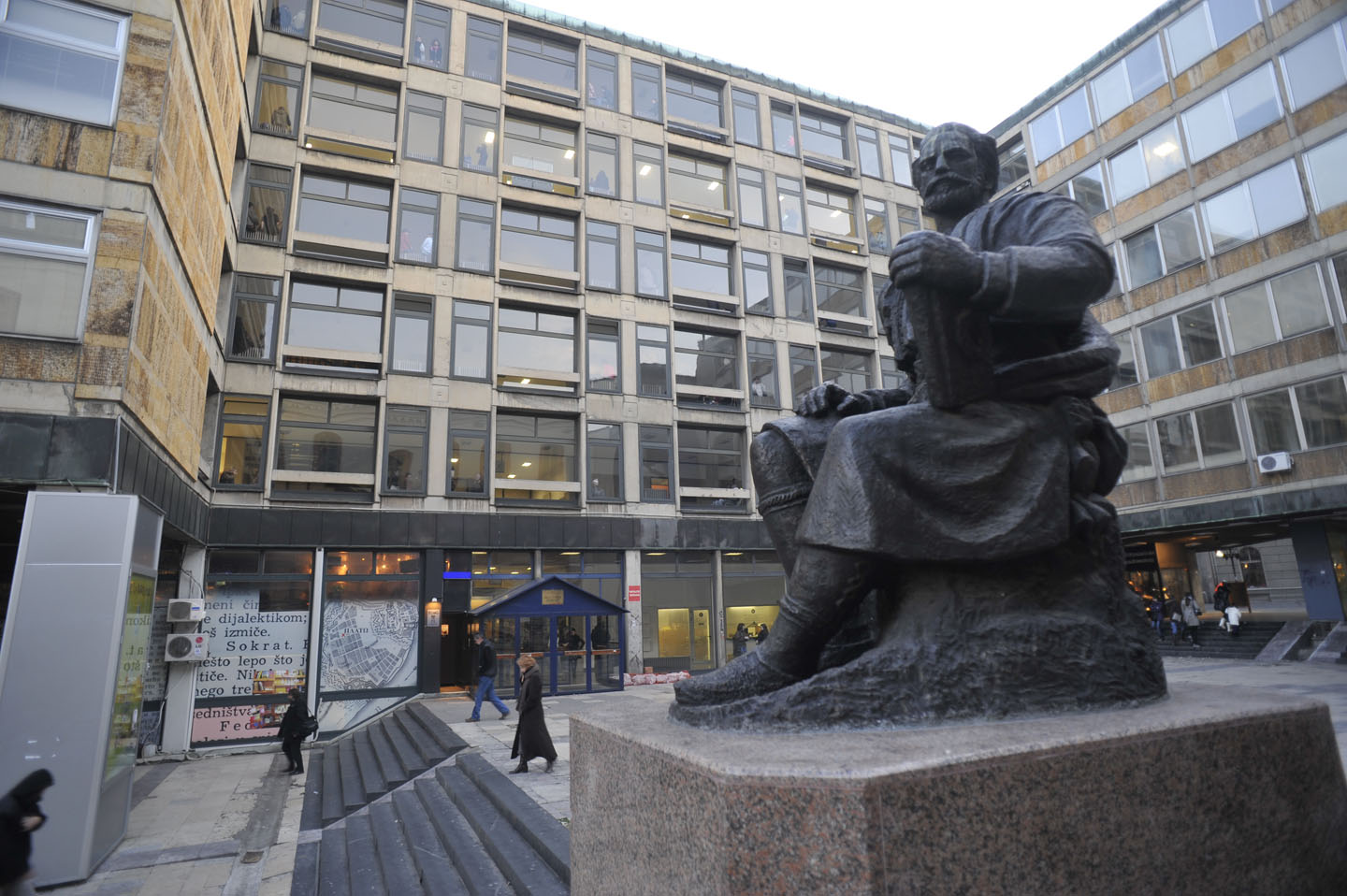
After numerous problems and the transfer of responsibilities, a permit was issued for the reconstruction of the Academic Plateau at the Faculty of Philosophy in Belgrade

The labor inspectorate cannot supervise two applications at Jovan's high school "Jovan Jovanović Zmaj" because the principal Radivoje P. Stojković does not allow them to do so, according to the students' parents.

Greece, as well as numerous other countries, are introducing or at least considering banning social networks for children. However, in Australia it has been shown that such regulations do not necessarily mean that children will stop using them

There is, literally, no difference between the one who claims it is day in the middle of the night, or the one who claims to be a giraffe, from the claims we read on billboards: that Vučić is working to unify Serbs and that Serbia is doing better and better day by day.

The pre-election arrests due to the alleged "overthrow of the state" testify to the regime's panic. The bad news for them is - they can't arrest the whole people who decided to defend themselves from progressive beatings and election theft

The ring that tightens around Ćaciland Student list is getting narrower. Because there are more and more spoiled people who see the false prophet for what he is: a street obscener who is fighting Serbia

The archive of the weekly Vreme includes all our digital editions, since the very beginning of our work. All issues can be downloaded in PDF format, by purchasing the digital edition, or you can read all available texts from the selected issue.
See all