On the Media Freedom Index for 2026 of the organization "Reporters without Borders", Serbia has fallen to the lowest level in the past two decades
The non-governmental organization Reporters Without Borders (RSF), which has been reporting annually on the state of journalism in the world since 2002, defines freedom media as "the possibility of journalists as individuals and collectives to choose, produce and disseminate news in the public interest independently of political, economic, legal and social interference, as well as without threats to their physical and mental safety".
In its report this year, RSF states that the environment in which the media operates is "problematic" or worse in about 75 percent of countries. Media conditions are classified as "severe" to "very serious" in more than half of the countries, writes DW.
The Great Fall of Serbia
Although there is a global downward trend, media freedom varies by region. In general, the freest countries – including the leading four: Norway, Estonia, the Netherlands and Denmark – are located in Europe, while journalists in parts of Africa and Asia face the most difficult conditions.
However, there are also differences within the region. In Europe, for example, there is a strong divide between southern and eastern parts, where challenges to press freedom are greater, and northern and western parts, where countries are generally rated as "satisfactory" to "good."
When it comes to Serbia, it fell from 96th to 104th place, which means that it is at the lowest level of media freedom in the last two decades. RSF assesses that the state of media freedom in that country is "difficult", with frequent attacks on independent journalists, surveillance and political pressure.
Poland and Slovakia are taking different paths
In Eastern Europe, different tendencies within one region can be seen on the example of Slovakia and Poland. While the media in Poland has become freer, the situation in Slovakia is worsening. Both countries are still classified as "satisfactory", but they are moving in completely different directions.
According to Reporters Without Borders, the turning point for Poland was the change of government. After the Law and Justice (PiS) party lost power at the end of 2023, the new government reduced verbal attacks and court proceedings against the media.
In the same year, the elections were also a turning point in Slovakia. There, after several years in the opposition, Robert Fico began his fourth term as prime minister.
"He has a long career behind him and has always claimed that journalists are his enemies," says Lukas Diko, editor-in-chief of the Jan Kuciak Investigative Center (ICJK), an independent journalism organization named after the murdered journalist Jan Kuciak.
Kucijak investigated links between organized crime groups and firms in Slovakia linked to members of Fitz's ruling party. His assassination sparked a wave of anti-corruption protests that helped topple the Fitz government in 2018.
However, as Lucas Dicko points out, attacks on the media intensified after Fitz's return to power. "And really without any rules," he says.
Diko adds that the fear caused by the murder of a young journalist and the hostile rhetoric of officials have discouraged many from choosing a journalistic career. "Many young people no longer want to become journalists," he says. "Kucijak's murder still puts them off - but they don't want to be verbally assaulted every day."
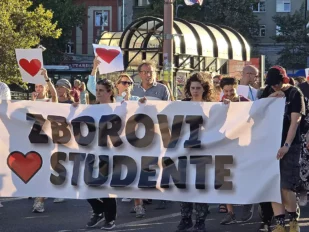
Photo: Vreme/Andrej IvanjiRally of solidarity with attacked journalists
Attacks on journalists as a political strategy
Argentina is another country that fell sharply on the list. Media freedom advocates claim that the anti-media campaigns led by President Javier Millei are creating a hostile environment for journalists. He often uses social media to attack critics and claims that journalists "aren't hated enough".
Like Miley and Fitz, US President Donald Trump has been insulting and threatening the media for years. The United States also saw a decline in the press freedom list, as did other countries whose leaders employ similar methods.
Argentina, Slovakia and the USA show how quickly countries considered stable and democratic can become hostile to journalists. In contrast, in countries such as Eritrea, China, North Korea and Iran, media freedom has never existed due to long-standing authoritarian regimes, according to Reporters Without Borders.
According to the RSF report, "armed conflict is the main reason for the decline of media freedom", for example in Iraq, Sudan, South Sudan and Yemen. Since Israel began its war in Gaza following terrorist attacks led by Hamas in 2023, the Israeli military has killed more than 220 journalists, including at least 70 while they were working, the report said.
Building networks to combat threats to media freedom
Vera Slavčeva-Petkova, a professor at the University of Liverpool, points out that threats to media freedom can be divided into three main categories: political pressures, social factors (such as attacks based on gender, race or sexual orientation) and economic pressures from an insecure labor market.
She emphasizes that journalists can counter these challenges by networking and collaborating with organizations that share their values, including human rights activists and the academic community. "Knowing that there is someone you can rely on for support is very important," says Prof. Slavčeva-Petkova.
Given that most journalists today work in conditions that are problematic at best, such networks will become increasingly important in the future - both nationally and globally.
What is happening in the country and the world, what is in the newspapers and how to pass the time?
Every Wednesday at noon In between arrives by email. It's a pretty solid newsletter, so sign up!
After more than 19 months, the park in the center of Belgrade is once again available to everyone. But memories remain of a space where special rules applied, into which not all citizens and not all journalists could enter. And that must not be forgotten
The Council of the Regulatory Body for Electronic Media (REM) is holding a meeting on Tuesday, where, among other things, TV Informer will be discussed. Dragan J. Vučićević claims that the police came to detain him and thus prevent him from attending that session
Rain and cloudy weather will mark today in Serbia, but the weather conditions will change already in the second half of the week. On Thursday and Friday, the temperature will reach 23 degrees in some cities
The Temple of St. Sava in Vračar does not have a valid use permit, the Republic Agency for Spatial Planning and Urbanism confirmed in response to Insider's questions. The facility has a building permit and approval for the use of the building structure, but the procedure for obtaining the use permit has not been completed
Citizens' assemblies in Belgrade are seeking access to the premises of local communities, which have served as party branches of the SNS for years. At Zvezdara, they got the key, held the first meeting, and then found the lock changed
At the moment when the institutions of the Republic are destroyed, when Vučić's octopus is still alive, when people are disgusted by the injustice and the stench left behind by the Essenes regime, we have, as Machiavelli said, only civic virtue as the fuel with which we can return to the beginning
The four independent members of REM are an example of perseverance and civic responsibility. Rodoljub Šabić even, upon leaving the premises of REM, after the sentencing of the Informer, experienced that the Essenes insulted him, hit him with their hands and feet. But that too will soon be over
Vučić pardoned the batterers and Dijana Hrkalović. The election winners should abolish the sultan's power that allows one man to run afoul of the entire judicial system
The archive of the weekly Vreme includes all our digital editions, since the very beginning of our work. All issues can be downloaded in PDF format, by purchasing the digital edition, or you can read all available texts from the selected issue.