

News
Batut: In Serbia, 220.000 people do not know they have diabetes
On the occasion of World Diabetes Day, Batut warns that a large number of people have this disease and are not even aware of it, because diabetes can go without symptoms for years.

Belgrade is suffocating in traffic. In most cars, there are only drivers who waste hours every day in queues. What is the solution to reduce the huge traffic jams?
Traffic jams in Belgrade, they are no longer an exception, but everyday, and the morning ones too afternoon rush hour turn into multi-hour traffic jams that paralyze almost all main roads. Bridges, central city streets and access routes to New Belgrade, Voždovac, Zvezdara and Čukarica are regularly marked in red on all traffic maps, while lines of vehicles often stretch for kilometers.
One of the taxi drivers of the Belgrade Taxi testified for "Vreme" that a few days ago he took a ride from the Pyramid in New Belgrade to the Metro in Krnjaca around 16 pm. According to him, the crowd was incredible, the car was standing in the line far more than it was driving, and for this 13,5 kilometer long section, it took an incredible two hours to reach the destination.
"It is faster to get from Smederevo than from Dorćol to Zvezdara"
"Fortunately, the middle-aged man who took the ride was fully aware of everything, and didn't cause any problems. We spent a little more than two hours in the 'drive' before we got to the Metro. Literally everything stopped. And Novobeograd boulevards, and Brankov bridge, roads in the city center, Bulevar despot Stefana, Pančevački bridge," he said.
When asked how much the party paid for this two-hour drive, he answered: "3.600 dinars."
This example only confirms that Belgrade has long been among the cities with the biggest traffic delays in this part of Europe.
The average driver in the capital annually loses dozens of hours standing in traffic, and if someone lives in the old part of the city and works in New Belgrade, and vice versa, and goes to work by car, he loses hundreds of hours in traffic. That number grows with each new season, and especially before the New Year holidays. Street works, roadway replacements, infrastructure repairs, as well as large projects that are carried out simultaneously in several locations, further worsen the situation.
This leads to the key question regarding Belgrade's traffic jams: why is there only one person driving in more than 90 percent of the vehicles that move in the city's biggest rush hours, and what needs to be done to change the situation?
If more citizens drove in one vehicle, there would certainly be fewer vehicles on the streets and less congestion, but what needs to be done to make that happen? Is such a way of driving a reflection of a better standard and the bad habit of drivers to drive a car at all costs, or is it a daily necessity conditioned by life in Belgrade with millions?
Retired Professor of the Faculty of Traffic Milan Vujnović tells "Vreme" that there is a known problem with driving one person in a car, and that there is a solution that has been implemented in Great Britain, which he believes could also be applied in our country.
"The British introduced charging for entry into the center, a fee is paid (Congestion Load). Of course, after the introduction of this tax, the congestion in the center of London has decreased, and those who drive vehicles with more than three passengers are allowed to use traffic lanes reserved for public transport and taxis," says Vujnović.
The price of this fee is 15 pounds (a little more than 2.000 dinars) per day, if paid immediately. If paid later, the price is 17,5 pounds (about 2.350 dinars). Exceptions are citizens who live within the zone for which the tax is paid, but they also pay about 10 percent of this amount.
However, the city authorities in London have announced an increase in this fee, so from January 2, 2026, this fee will amount to 18 pounds (about 2.400 dinars).

Vujnović notes that the eventual introduction of a similar tax in Belgrade would certainly reduce congestion, but it would not solve the problem, because the number of cars appearing on the streets of Belgrade, but also on the streets of all cities in Serbia, is increasing.
"For the last three years, the number of cars has increased by about 70 percent. The problem of congestion simply cannot be solved with the existing street network if you do not achieve traffic with a smaller number of vehicles, and this is achieved by measures that are not popular, but are effective," notes Vujnović.
It indicates that after the introduction of such taxis, Londoners began to agree on going to and from work together.
"Thus, instead of four cars, two or one car go to the same company. In this way, they halved the number of vehicles in the center, which was their goal. In order for something like this to be implemented in our country, someone needs to make such a decision. There is no problem in implementing it."
He opposes the possible introduction of the "even-odd" solution, according to which those with an odd last number on the license plate would drive on one day, and those with an even number on the next day.
"I am not a supporter of such a solution. It would be a solution by force, which I do not think is good, and I believe that it would cause a lot of different problems in everyday functioning, for which there would be no adequate quick solutions", says the interlocutor of "Vremena".
He believes that a larger number of public garages, the construction of which is not expensive, would have an effect on reducing traffic congestion.

"As soon as the vehicles are put in the garages, there would be a relief in traffic. In the center of Belgrade, there is practically no place for parking, vehicles pass through streets that are narrow and in each of them there are vehicles parked either on one or both sides. Without vehicles in garages, the roads will not be less congested," concludes Vujnović.
Regarding public transport, which should be one of the solutions to this problem, he points out that it is often a victim of Belgrade's traffic jams. Buses and trams stand in the same columns as passenger vehicles, and the absence of special lanes or their inefficient control further reduce the speed of movement.
"In developed cities, public transport is designed and built by building public transport terminals on the outskirts of the city, but with huge parking areas. And then citizens can leave their vehicles there and use public transport. We don't have that. We haven't applied it so far, but that doesn't mean we won't", concludes Vujnović.
Although the city authorities announce new solutions such as the expansion of roads, smart traffic lights or the construction of the subway, many road users state that these are long-term projects, while citizens need immediate solutions. For now, traffic jams remain one of the most striking features of life in Belgrade – a symbol of a city that is growing faster than its infrastructure can keep up.
On the occasion of World Diabetes Day, Batut warns that a large number of people have this disease and are not even aware of it, because diabetes can go without symptoms for years.

The suspension of the work of the Refinery in Pancevo is considered inevitable, and the only unknown for now is the date when production will be completely stopped.
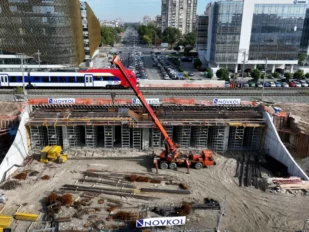
The late joining of Grecia and Surčinska streets, the construction of an underpass between Red Army Boulevard and Art Boulevard, the expansion of Patriarch Pavle Boulevard and many other infrastructure works

Payment of money starts on Friday, November 13, and scheduling is made possible through the website of Poštanska Štedionica

The student movement asks the competent state institutions to examine public procurement, the implementation of contracts, the spending of budget money and the respect of workers' rights in the construction sector.

At the moment when the institutions of the Republic are destroyed, when Vučić's octopus is still alive, when people are disgusted by the injustice and the stench left behind by the Essenes regime, we have, as Machiavelli said, only civic virtue as the fuel with which we can return to the beginning

The four independent members of REM are an example of perseverance and civic responsibility. Rodoljub Šabić even, upon leaving the premises of REM, after the sentencing of the Informer, experienced that the Essenes insulted him, hit him with their hands and feet. But that too will soon be over

Vučić pardoned the batterers and Dijana Hrkalović. The election winners should abolish the sultan's power that allows one man to run afoul of the entire judicial system

Interview: Branko Stamenković, public prosecutor of the Supreme Public Prosecutor's Office
A black picture and the breakdown of the rule of law subscribeThe archive of the weekly Vreme includes all our digital editions, since the very beginning of our work. All issues can be downloaded in PDF format, by purchasing the digital edition, or you can read all available texts from the selected issue.
See all



