

Mediji
Aleksandar Timofejev is the new editor-in-chief of TV Prva
After the measures imposed by the Regulatory Body for Electronic Media on Prva TV, Aleksandar Timofejev took over as editor-in-chief

Private security agencies in Serbia employ between 40 and 50 thousand people, roughly the same number as the entire Ministry of Internal Affairs. Tens of millions of euros of budget money are paid to them
Citizens of Block 4 in Novobeograd have been protesting for months, and the reasons for the rebellion are both understandable and gruesome: a private investor started building a building on the green area, probably some kind of hotel, which walled up a residential building, directly relying on it. The residents were deprived of light and air, not to mention the commotion. The investor somehow, and we know how, managed to get a construction permit for this, let's call it that, barbaric act, and at the same time he managed to privatize part of the street and the pedestrian crossing.
Even for Vučić's Serbia, whose cities are destroyed by construction, where urban plans are adapted to investors and general greed, producing urban collapse, that is, cities of incredible impossibilities dominated by the smell of sewage - this seems too much.
Men in yellow and men in black
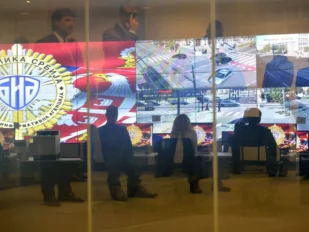
On the screens, we could follow the citizens' protest live, and see that the investor hired a private security agency to deal with them, as well as some "strange" and rather nervous security guards in yellow vests, one of whom prevented the N1 television crew from reporting, cursing and insulting it. We don't know who the people in yellow are, what their role is, what their responsibilities are, where they have the right to physically attack the protesters, but if we think about it - we don't even know who the people in black are who wear the label of a private security agency. We only know that two police officers stood on the sidelines and watched this event like a football game, not getting excited about the degenek.
In recent years, since various civil demonstrations have been going on in Serbia, with minor breaks, private security agencies have become part of our political folklore. Although there is a law that governs their functioning, they are far from following any rules, and that is very obvious. First of all, they serve to intimidate and humiliate political and other opponents.
After that, they often apply, and in front of the cameras, violence against citizens, even against opposition MPs and councilors in the republic and other parliaments, which is to say - in their houses. There are countless examples, let's remember the conflict inside the republican parliament, in front of the Vojvodina assembly, in Kraljevo, on Zvezdara, Čukarica...
Private "gorillas" as many as police officers
According to estimates, between 40 and 50 thousand people are employed in private security agencies in Serbia, approximately the same number as the entire Ministry of Internal Affairs. The figure is probably even higher, and it is said that at least one third of "securities" work "in the dark".
According to the law, there should not be among them those who are criminally prosecuted, but since there is no serious supervision of their work, this is certainly not respected, especially not among those who are invisible, that is, they are not permanently employed and receive their wages in cash.
There is no supervision of which of them owns a weapon and what kind of weapon it is. Tens and tens of millions of euros are poured into private security agencies from state and other public budgets, and those who are close to the regime are hired, if there are others at all, at least among the big players. There are probably small agencies that work within the law, probably.
The "gorillas" are recruited from the lower social strata, who received their education either in gyms or in groups of tough guys from the hot asphalt. Since they have no business alternatives, they are very loyal to the bosses, who in turn are loyal to the authorities. Experts have been warning for a long time about the politicization of the sector, that is, that any line of demarcation between SNS and private security agencies has been lost, that is, that political suitability is, if not always, in the vast majority of cases - a condition for joining the agencies.
Parallel government structure
The SNS has created a parallel structure of government that extends from the top of the state to the local communities, in which the parastatal actually has far greater power. This seems to be the case when it comes to security services. Both parapower and parasecurity are difficult to separate from criminal organizations and mafia bosses.
If we add to those employed in agencies those "boys in black" who, without agency markings, we also see in large numbers in government institutions, in front of the party and at various receptions, and then also those who practice in yellow vests as in the case of Block 4, we cannot even imagine how numerous this "army" is.
One thing is clear: it represents a group that protects the regime and all those who are attached to it in one way or another, especially the rich - from the citizens.
It could even be said that the progressives, who have such heavy experiences with similar actions during the nineties, formed their paramilitary formations in this way. Symbolically, all the surviving leaders of the paramilitary formations from the nineties are in the progressive chain of corruption and interests, and we saw some of them sparring in the "Caciland", and exchanging intellectual experiences with students who want to learn, learn and only learn.
Citizens of neighboring countries do not need to be afraid of this paramilitary force, where the "Arkanovci", "Sešeljevci", "Bokanovci" and others did, to say the least, great damage, while raising money for several generations. Now that force is turned towards the citizens of Serbia. I guess that's how natural processes go.
But there is no need to panic: as they have lost all wars, they will lose this one as well.
After the measures imposed by the Regulatory Body for Electronic Media on Prva TV, Aleksandar Timofejev took over as editor-in-chief
Dozens of journalists, students, activists and opposition members in Serbia found out that they were "under the radar". Psychologists and research from around the world warn that the psychological consequences of persecution do not disappear when surveillance is revealed

"Eko straža" filed a criminal complaint for corruption against Jelena Karleuša and Manja Grcic. The singer asked the former director of RTS to urge the employment of journalist Vukašin Katić

Based on international criteria for determining internet accessibility, the price for the socially disadvantaged in Serbia should not be higher than 2.528 dinars

Former Minister of Economy Rade Basta was arrested on suspicion of approving unfounded donations to sports clubs at the expense of "Belgrade Power Plants"

At the moment when the institutions of the Republic are destroyed, when Vučić's octopus is still alive, when people are disgusted by the injustice and the stench left behind by the Essenes regime, we have, as Machiavelli said, only civic virtue as the fuel with which we can return to the beginning

The four independent members of REM are an example of perseverance and civic responsibility. Rodoljub Šabić even, upon leaving the premises of REM, after the sentencing of the Informer, experienced that the Essenes insulted him, hit him with their hands and feet. But that too will soon be over

Vučić pardoned the batterers and Dijana Hrkalović. The election winners should abolish the sultan's power that allows one man to run afoul of the entire judicial system

Interview: Branko Stamenković, public prosecutor of the Supreme Public Prosecutor's Office
A black picture and the breakdown of the rule of law subscribeThe archive of the weekly Vreme includes all our digital editions, since the very beginning of our work. All issues can be downloaded in PDF format, by purchasing the digital edition, or you can read all available texts from the selected issue.
See all



