Not so much because the American president is looking Donald tramp, but because the awareness is spreading in Germany that military aggression cannot be stopped with nice words, writes Deutsche Welle.
That's roughly how the new German foreign minister, Johann Wadeful, announces that the new German government should invest as much as five percent of GDP in defense in the future. He stated this at a meeting of foreign ministers of NATO in Antalya, Turkey.
According to the minister, Germany supports NATO Secretary General Mark Rutte's proposal to allocate 3,5 percent for military needs, and an additional 1,5 percent for defense infrastructure.
The final decision and plans of all NATO members will probably be heard only at the NATO summit at the end of June in The Hague.
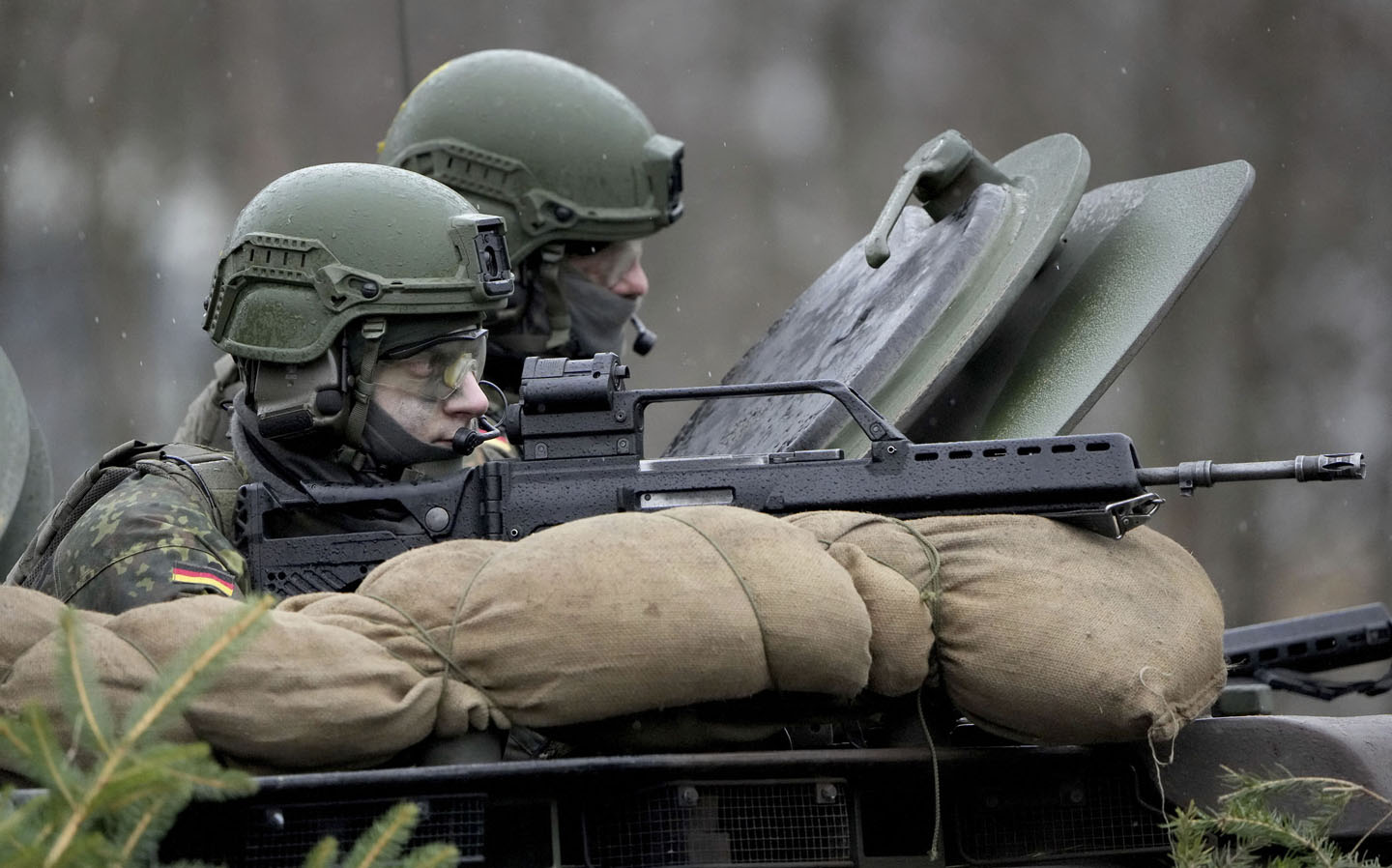
And Chancellor Friedrich Mertz announced in his address to the Bundestag that he wants to develop the Bundeswehr into "the conventionally strongest army in Europe."
But other European countries also set ambitious goals:
Poland: Rampart on the eastern wing
For years, Poland has been investing intensively in the armed forces with the aim of becoming the strongest land power in Europe. Last year, 4,12 percent of GDP went to the defense budget.
Warsaw's main goal is to be effectively armed so that Russia does not even think of threatening its territory.
The Polish army currently has around 150.000 soldiers in the professional army and territorial defense. By 2035, that number should rise to 300.000.
Equipping with modern military equipment is underway: more than 600 tanks - ordered, among other things, from South Korea and the USA - then HIMARS missile systems, drones, and in the future F-35 fighter jets should become the equipment of the Polish infantry and air force.
On the other hand, the Polish navy is considered relatively weak.
Germany: From faltering to leading role?
The announced increase in defense allocations to five percent of GDP would mark a historic turn in security policy.
Since the end of the Cold War, the Federal Republic of Germany has insisted on international cooperation, diplomacy and a "culture of military restraint". The turning point was marked by Chancellor Olaf Scholz's speech on February 27, 2022, three days after the Russian attack on Ukraine, known as the announcement of a "new era" (Zeitenwende).
Immediately afterwards, the German government established a special fund of 100 billion euros for the Bundeswehr. Regular defense expenditures for 2024 amount to about 90 billion euros, which is about 2,1 percent of GDP. An increase to five percent would mean an annual defense budget of over 160 billion euros.
Twice as much expenditure would certainly put a heavy burden on the state budget, and for now no additional funds have been provided.
Trump shook "Little America" in Germany
The Bundeswehr currently has around 182.000 active soldiers. The Ministry of Defense plans an increase to at least 203.000 by 2031, while the goal of 240.000 is occasionally mentioned.
Modernization includes all branches of the military: old tanks, planes and warships need to be replaced, and the emphasis is on digitalization and improvement of the chain of command. Because even in German arsenals, many weapons and equipment exist "only on paper" since in the past there was no money for their maintenance.
The key industrial actors in Germany are Rheinmetall, Airbus Defense and Space and Deal-Group, but in that sector international cooperation is increasingly pronounced because exports are also extremely important.
France: A nuclear power with global ambitions
France is the only nuclear power in the EU and leads a strategy of global presence and military independence. About 203.000 soldiers serve in the army, with 175.000 members of units such as the Gendarmerie and about 26.000 reservists.
The French Navy has a nuclear aircraft carrier "Charles de Gaulle" and strategic submarines, thus having a strong nuclear capacity. Rafale fighter jets provide air superiority and are also equipped to use nuclear weapons.
President Emmanuel Macron has significantly increased the defense budget since taking office in 2017. In a dramatic televised address in early March, he detailed the "Russian threat" looming over Europe. Therefore, the French defense budget should be almost doubled.
France has historically had a similar military budget to Germany, but has used it to build a more combat-effective military – not least thanks to state-led defense industry incentives and state co-ownership.
Great Britain: Well armed but vulnerable
With a target of almost 2,4 percent of GDP, the UK also plans to increase defense spending, with an emphasis on high-tech equipment: drones, artificial intelligence and laser systems.
The Royal Navy has two aircraft carriers, although only one is operational. The air force is highly modernized - its core is made up of American F-35B fighter jets, of which the British government plans to acquire a total of 138.
However, the British armed forces of around 140.000 active troops (including 4000 Gurkhas) are relatively small. Unlike many EU countries, no major staff increases are currently foreseen.
Prime Minister Keir Starmer emphasizes loyalty to alliances and global readiness for interventions. British military equipment is heavily dependent on American technology, especially when it comes to nuclear weapons on submarines.
Italy: Strength at sea and in the air, weak on land
At 1,49 percent of GDP according to NATO data for 2024, Italy is still below the previous target of two percent.
Nevertheless, with 165.000 active soldiers, two aircraft carriers and a strong air force that includes Eurofighters and F-35s, Italy belongs to the heavier military category of Europe.
However, the ground forces are considered outdated and in dire need of reform. Prime Minister Giorgio Meloni wants to make Italy the strongest tank force in Europe.
For this purpose, more than 1.000 battle and multi-purpose tanks were ordered from Rheinmetall. Italy's strategic focus is the Mediterranean and the security of global trade routes.
The global balance of power remains unchanged
Despite the billions of euros invested in armaments in Europe, the global order of military forces will not change significantly in the medium term. The United States is still in the lead, followed by Russia, China and India.
The first European power - Great Britain - comes only in sixth place. They are followed by France in ninth, and Germany is currently in eleventh place.
The Global Firepower platform compares the military strength of countries according to more than 60 indicators - from the number of tanks, naval capacity, to the size of the capable military population - to get a comprehensive picture of global military power.