Prime Minister Zoran Đinđić was shot in the courtyard of the Government of the Republic of Serbia on Wednesday, March 12 at 12.45:13.30 p.m. Witnesses say that two shots and one scream were heard. The Prime Minister was hit by two bullets - in the back and in the stomach. In an extremely serious condition, Đinđić was transferred to the Clinical Hospital Center. Two surgical teams (cardiac and abdominal) performed a complex operation. Clinical death was declared at XNUMX:XNUMX p.m. The Government of Serbia proposed to introduce a state of emergency.
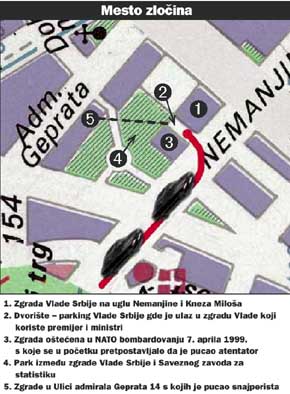
The official BMW in which the Prime Minister was located entered the courtyard of the Government of Serbia building from Nemanjina Street in the direction of the Railway Station and after a U-turn stopped in the rear yard of the Government of Serbia building in front of the entrance guarded by three bodyguards, two towards Nemanjina, one opposite them.

The Prime Minister sat in the back seat behind the driver; in the front seat were, in all probability, crutches. While this text is being written, it is claimed that the prime minister was shot with a large-caliber sniper rifle. It is most likely a caliber of 12,7 millimeters. It is a weapon that can only be handled effectively by a trained person. According to initial information, shots were fired from building number 9 in Nemanjina Street. It is a building that belonged to the Yugoslav Army and was damaged to such an extent during the NATO intervention that it was abandoned. It was later confirmed that the shots were most likely fired from building number 14 in Admiral Geprat Street. On the first floor of this building, in an apartment, the police found a blanket. The apartment was probably rented. It is assumed that the assassin stayed in that apartment for more than 12 hours. There is a park between this building and the courtyard of the Government of Serbia.
As soon as he was hit, the prime minister's bodyguards immediately pushed him into the back seat of the car, which headed up the Nemanjin hill. Not long after, there were claims that two people had been arrested for the assassination. The latest news is that three suspects have been detained. It is assumed that these are "observers" who provided the snipers with information about the Prime Minister's movements by mobile phone or some other means of communication.
Police officers armed with long pipes blocked the government building. A large group of journalists gathered on the other side of the street from where you could see the courtyard where the Prime Minister was assassinated. That courtyard is located between the government building and the building destroyed in the NATO bombing. The building at Nemanjina 9 is in a dilapidated state and a sniper could easily hide in it. Namely, at the moment when this text was written, which was two hours after the assassination, journalists were speculating that the Serbian prime minister was the victim of a sniper. One side of that yard is only open with a low fence towards the green area that leads to the Statistical Institute and Admiral Geprat Street where, in all probability, an escape route could have been opened.
On Wednesday at midday, the police started a strict control of cars and citizens in the city center. The airport is closed. According to the observations of our reporters, during identification and searches of citizens, the police examined only larger bags. Two young men were stopped at Terazije around 13:XNUMX p.m., one of whom was carrying an ordinary backpack, and the other a travel bag - on that occasion only the bag was searched, while the backpack was not even searched.
While Zoran Đinđić was living on Studentski trg, in the center of Belgrade, German security experts, by inspecting the surrounding buildings, established that there were 36 locations from which an assassination could be carried out without hindrance, and that at the time when Đinđić was leaving and entering his building. That pushed the prime minister to move to Dedinje. No one calculated how much security risk there was in the vicinity of the Serbian Government building, or, at least, it was not communicated to the public. "Vremen" experts estimate that it was equal to the risk on Student Square. It is not only about the abandoned building that towers over the courtyard from which the ministers enter the building, but also about the park, a large cleared area, towards Admiral Geprat Street, which turns that parking lot into a shooting range.
It is unthinkable that the building (Nemanjina 9, a building that was damaged in the bombing in 1999 and is currently being renovated) from which the alleged assassin shot was not inspected and that the people in charge of security did not pay special attention to the only building in the immediate vicinity of the Government of Serbia in which no one is.
It is also incomprehensible that during the last attempt to assassinate the Prime Minister, the first vehicle in his escort (the so-called sweeper) went far ahead, in front of the Prime Minister's car. Thanks to this, the truck driven by Dejan Milenkovic Bagzi was able to move smoothly from the stop lane to the middle one, and then block the way of the car carrying Đinđić, which was in the third lane. Otherwise, the "cleaner" vehicle had to be much closer to the Prime Minister's car and "receive" a possible incident. On that occasion, there was not even a side car in the Prime Minister's entourage, which would have had to go parallel to the vehicle under protection - a third vehicle, it is true, did exist, but it did not go parallel to the Prime Minister's as required by the rules. Circles close to the government claim that the prime minister intended to change his security and include new people in it.
![]()
The assassination of Prime Minister Zoran ĐinđićTHE UNIMAGINABLE CRIME: Investigating...
If the correct version is that it was a sniper, the police would undoubtedly have to find the weapon from which the shot was fired - if for no other reason than that it is a weapon of larger dimensions that would be extremely difficult to hide. It is strange, however, that no one from the security service, at the moments when the prime minister arrives or leaves, was in the building whose windows literally "look" at the Government parking lot and from where it is easiest to shoot. The second version, which appeared in the first moments after the murder, according to which two assassins shot at the prime minister from close range, would mean that the security guards either knew the assassins or completely failed in what they were supposed to do.
After the incident on the highway, Djindjic was advised to wear body armor, but his leg injury and difficulty moving gave him an alibi to refuse this type of protection. In any case, the investigation being carried out must also provide an answer to the question of how Zoran Đinđić was secured.
![]()
The assassination of Prime Minister Zoran Đinđić...and Ružica Đinđić, wife of the late prime minister
There have been announcements that the prime minister could be the target of an attack by criminal groups with a political background. In the newspaper documentation, it is possible to identify several possible groups from which the threats came - criminal circles, primarily drug smugglers, people and tobacco who could feel threatened, centers from the environment linked to past wars, and almost all campaigns talked about the extradition of Hague fugitives that they are surrounded by armed groups. In particular, there was speculation that General Ratko Mladić has a strong armed group. A few days before the assassination, an action began against the financial network that possibly supports Radovan Karadzic. After the action in Bosnia, the Belgrade authorities were asked by the American side to cut such a potential network in Serbia as well. According to a statement by Goran Svilanović, Minister of Foreign Affairs, some companies in Serbia that could be under suspicion were also mentioned.
Who is behind this monstrous act, whose consequences for the stability and future of the country still cannot be fathomed? The only thing that is certain is that nothing will be the same in Serbia, nothing like before.
Various announcements and statements from the police, but also from various political structures, in which it was claimed that the life of Zoran Đinđić was seriously threatened, were taken lightly as some kind of political marketing. The prime minister himself, in his first reactions to the incident on the highway, claimed that someone was learning to drive on the highway. Part of the public also experienced the relocation of the Đinđić family from Studentski trg to a residence on Dedinje as a Skorojevic promotion; all assurances that it was only about security reasons were met with derision.
It should be recalled that on October 27, 2002, members of the MUP arrested Nikola Maljković in Belgrade, suspected of killing police general Bosko Buha on July 10. Željko Maksimović Maka was designated as the organizer and head of the group to which Maljković belonged. As the Security and Information Agency (BIA) announced at the time, the goal of Maksimović's group was "to carry out murders of representatives of state and political bodies and institutions, as well as prominent figures from public life." The goal of these intentions is to destabilize the government and cause chaos in the country in order to create an atmosphere for the existence of organized crime." According to this information, the murder of Zoran Đinđić was the main and immediate goal of this group; it was unofficially claimed that on the same day as Maljković, a person from the prime minister's close circle was also detained, under the suspicion of having provided information on the movements, conversations, meetings and activities of Đindjić. As the investigation progressed, the public was not informed.
And then the first assassination of Zoran Đinđić really happened. During the prime minister's trip to Banjaluk on February 21, on the Belgrade-Zagreb highway near the Limes hall in New Belgrade, a "Mercedes" truck with Austrian plates suddenly "cut" the column of cars in which the prime minister was: only the driver's great composure avoided a collision . The truck driver was immediately arrested. We are talking about Dejan Milenković Bagzi, a man who in the book "Criminal groups and individuals engaged in organized crime" is marked as a "long-term inseparable companion" of Ljubiša Buha, known as Chume, the head of the Surčin clan. However, after Čumet was shot in Zemun Polje, he left the country and then announced that Bagzi had joined the rival clan of Dušan Spasojević Duce, with whom Milorad Luković Legija, former commander of the Special Operations Unit ("red berets") closely cooperates. However, Milenkovic was released after spending two days in custody. Indeed, the assumption that he caused a collision with a lighter truck and thus killed the prime minister, is not founded; something else was established - that the intention was that after the column stopped, from the opposite direction, from another vehicle, the team of assassins opened fire.
Prime Minister Đinđić initially rejected the possibility that February 21 was an assassination. Later, when police released more details about Bugsy and the highway incident itself, the Prime Minister changed his mind. However, in any case, after being released from custody, Milenkovic simply disappeared. One more thing is certain: that no one who was in charge did everything they should; neither the police, nor the prosecution, nor the courts...
In the past period, Prime Minister Zoran Đinđić was often warned that an assassination attempt was being prepared against him. After the highway assassination, he said "that it speaks to the complete obsession of those people who use those methods, thinking that nothing has changed here and that they can do what they did in the previous regime." Djindjic also added that his eventual death would not change anything.
The letter of Milorad Luković Legija, which was published on February 28, after the explosion that blew up the entire construction equipment of the Defense Road company in Zemun Polje, also had a threatening tone.
It was known to the public that before October 5, 2000, Đinđić met Legija and that he reached a "gentleman's agreement" with him that the special police forces would not intervene against the demonstrators on October 5. Although he confirmed in an interview with "Vremen" that the meeting with Legija took place, Đinđić later denied the myth that arose around that meeting.
"I claim with full responsibility that no one from any service in Serbia at the time, including State Security, nor former representatives of that service participated in the preparation of October 5." There is no credit for October 5 to anyone except those who legally participated in the elections and the citizens who took to the streets on October 5. It follows that there is no agreement on honoring and amnestying anyone's criminal acts."
Before leaving for The Hague, Vojislav Šešelj, the president of the SRS, hinted in one sentence that after his departure to The Hague, there will be bloody confrontations.
It is hard to imagine worse news. The murder of Prime Minister Djindjic, the first man of this country, leaves us with the feeling that we are hostages of dark forces that are not even hiding too much. An attempt had already been made to assassinate the Prime Minister, which he himself did not take too seriously, but worse than that, those whose job it was to protect the Prime Minister did not take it seriously either. And when that assassin was arrested, then released and disappeared, it should have been concluded that the people in power in the country of Serbia are not the ones we see, but some criminal and political underground that has the greatest influence on the police, prosecutors and courts.
Zoran Đinđić ran as fast as he could and pushed with all his strength towards reforms, modernization and Europe. For a long time no one in this country has shown so much will, strength, energy, skill and organizational ability, no one has spread so much hope and faith in the future. There is no substitute for such a man. I think that Djindjic was hit by a bullet that was intended for him on October 5. They didn't dare then, probably believing that the new authorities would come to their senses, but it was Đinđić who showed that Serbia might have a chance to move forward, that it is not doomed to failure, lagging behind, misery and laziness. That's why this murder is an attempt to stop Serbia on its way out of the hole we were sinking into during the nineties. The only thing the government needs to do now is to declare total war on the underworld, the underworld that the police know everything about but claim to have no evidence. Now let him arrest every suspect first, and we'll all agree to wait for the evidence. It occurred to the Prime Minister that there are too many murderers in this country walking around or lying in wait in the absence of evidence. Serbia must win. Djindjic must not remain a victim in vain. This must become a country of law and democracy, it must open itself to the world, and it must trample the criminal beast that threatens to devour us. Let the state of emergency serve that purpose and no other.
Stojan Cerovic
The official news about the murder of Zoran Djindjic was announced early Wednesday afternoon by one of the Deputy Prime Ministers, Nebojsa Covic. He confirmed that the assassination of Djindjic was carried out at 12:25 p.m., and that the prime minister died an hour later in the Emergency Center, where he was brought unconscious with two gunshot wounds to the stomach and chest. Emergency surgery and resuscitation were in vain. Covic confirmed that the second assassination of Djindjic happened at the moment when the investigation into the first failed assassination on February 21 on the highway was supposed to produce the first concrete results.
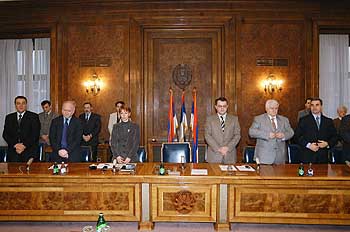
Čović also informed the journalists that the Government of Serbia has decided to propose the introduction of a state of emergency in Serbia to the Acting President of Serbia, Natasa Micić, considering that the country's constitutional order and security and the normal work of state bodies are threatened. The first practical consequence of the introduction of the state of emergency would be that all the affairs and responsibilities of the police would pass into the hands of the Army of the State Union of Serbia and Montenegro.
The Constitution of the Republic of Serbia on the State of Emergency (Article 83, Clause 8):
"At the proposal of the government, when the security of the Republic of Serbia, the freedoms and rights of man and citizen, or the work of state bodies are threatened in a part of the territory of the Republic of Serbia, the President of the Republic declares a state of emergency and passes acts to take the measures required by such circumstances, in accordance with the Constitution and the law ."
Photo: Goranka Matić
"This is a truly unlucky day for the Balkans and for Serbia." He was a man who persevered on reforms more than anyone else," said Pauline Neville Jones, a former adviser to Carl Bildt, upon hearing the news about the murder of Serbian Prime Minister Zoran Djindjic. With her first, spontaneous reaction, she in a way summed up the essence of the first comments that arrived from around the world on the shocking news from Belgrade, which was received with disbelief and anxiety both in the immediate environment and beyond.
"It is terrible that this kind of violence still exists in a democratic country," said Javier Solana, the High Commissioner of the European Union for Foreign Policy, in an exclusive statement to Radio B92. Recalling the fact that he was personally friends with Prime Minister Djindjic, Solana added that he was a "brave man", "determined to reform your country and bring it closer to the European Union". On the same occasion, Solana expressed the hope that the government will continue with reforms and added that, as a democratically elected government, he has full confidence in it.
The majority of the first comments that reached our editorial office by the time the newspaper closed saw the murder of Zoran Đinđić as an introduction to uncertainty and potential instability in Serbia, the newly created state community and in the region.
In the first information about the assassination, the Associated Press profiled Djindjic as a "pro-Western leader", who tied Serbia's future to the West and who advocated greater cooperation with the Hague Tribunal. That is why - AP reminds - "he was attacked by Serbian nationalists, including his former ally Vojislav Koštunica".
"If it is a political assassination, it shows that the disagreements in the Balkans are still deep, despite the improvement that has occurred recently," said Norwegian Prime Minister Kjel Magne, emphasizing at the same time that the assassination of Zoran Djindjic was "a tragic and revolting act." ".
On Wednesday afternoon, Croatian President Stjepan Mesić sent a personal letter to the President of Serbia and Montenegro, Svetozar Marović, in which he condemned the murder of the Serbian Prime Minister as an act of terrorism; he also expressed the hope that "this senseless act will not have lasting negative consequences on the stability of Serbia, as well as on the situation in the region". On the same day, Mesić also gave a shorter statement to Croatian Television, emphasizing that the assassination in Belgrade "certainly is not good for the democratic development of Serbia, nor for those of us who are in Serbia's neighborhood."
(1952 2003)
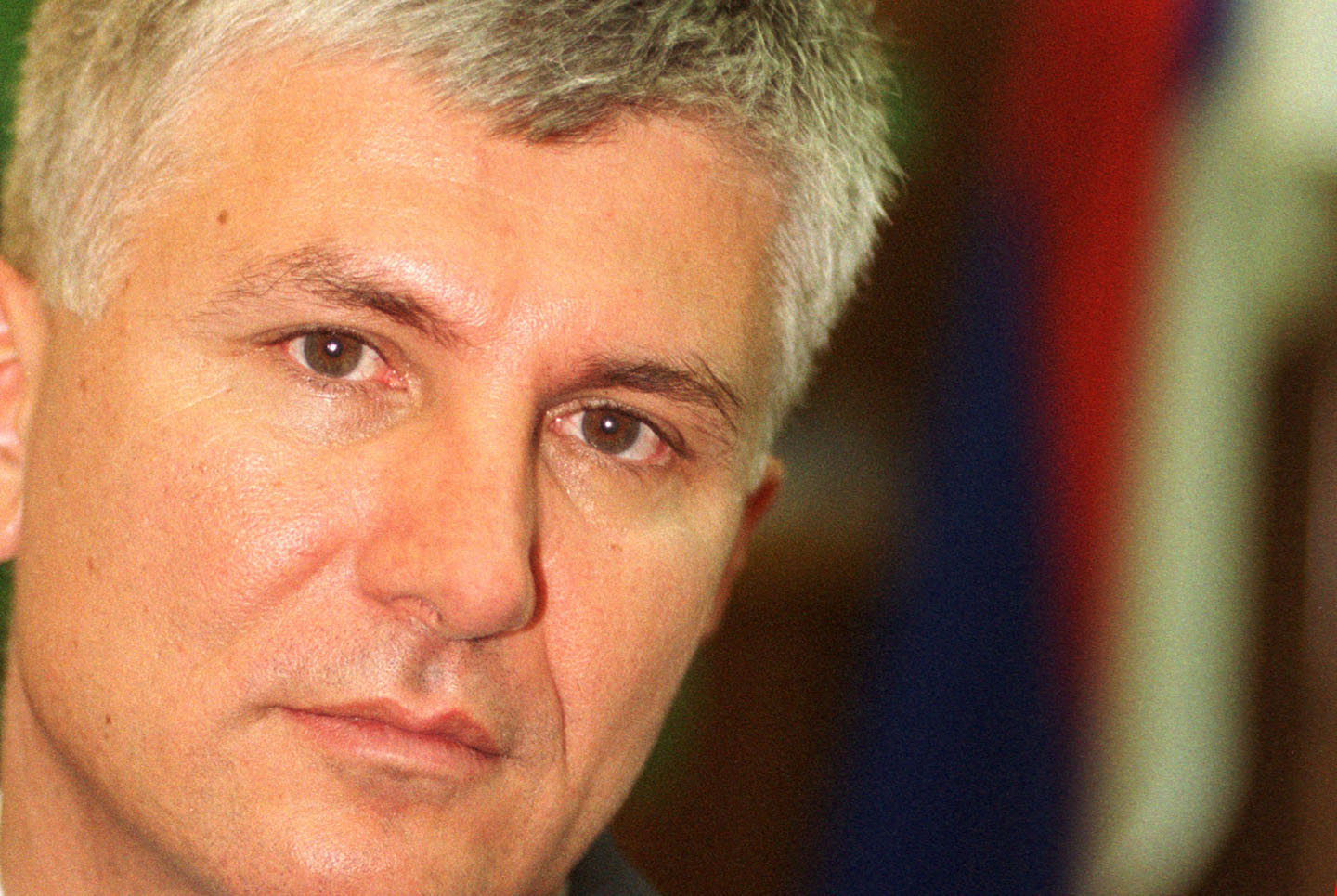
Zoran Đinđić was born on August 1, 1952 in Bosanski Samac in an officer's family. Matriculated in 1970, and graduated from the Faculty of Philosophy in Belgrade in 1974. He completed his postgraduate studies at the University of Konstanz (Germany), where he received his doctorate ('79) with the thesis "Problems of the Foundation of Critical Theory of Society". The titles of the books he translated indicate his interests as a young philosopher. Translated books by Loyola ("Principles of Jesuitism"), Kropotkin ("Morality and Anarchy"), Heller ("Critique of Left Radicalism"). He is the author of the books: "Subjectivity and violence", "Autumn of dialectics" and "Yugoslavia as an unfinished state". He was the editor-in-chief of the journal "Theoria", the newsletter of the Philosophical Society of Serbia.
The American weekly "Time" in September 1999 included Djindjic among the 14 leading European politicians of the third millennium. He is the winner of the prestigious German media award "Bambi" for 2000 in the field of politics. He spoke German and English.
Married to Ružica, father of daughter Jovana and son Luka.
As a student activist, he was sentenced to one year in prison for trying to found an autonomous student organization with fellow students from Zagreb and Ljubljana. To avoid prison, he took refuge in Germany, where he was close to anarchist student groups and for a time lived in student communes. After returning from Germany, he became a lecturer at the University of Novi Sad, after which he got a job at the Center for Philosophy and Social Theory.
He is one of the founders of the Democratic Party. In September 1990, he became the president of the DS Executive Board, in the same year he was elected in the municipality of Vračar as a deputy in the Serbian Parliament, and since 1992 he has been the head of the DS parliamentary group. He became the president of the DS in January 1994. He was elected president of the DS twice more: at the party's extraordinary assembly on July 18, 1998 and at the regular assembly on February 27, 2000. He was a deputy in all three multi-party convocations of the Assembly of Serbia and the Chamber of Republics of the Assembly of the FRY. He was elected mayor of Belgrade on February 21, 1997, as a candidate of the "Together" Coalition. He was removed from the post of mayor on September 30, 1997. SPO, SPS and SRS councilors voted for his removal.
In a court dispute with the Prime Minister of the Republic of Serbia, Mirko Marjanović, on September 20, 1996 (grain affair), he was sentenced to four months in prison, suspended for two years. On July 9, 1998, the Supreme Court of Serbia overturned the verdict and issued a new one in which he was sentenced to seven months in prison, suspended for three years. In June 2000, Đinđić assumed the position of coordinator, and then became the head of the central election headquarters and coordinator of the promotional campaign of DOS for the elections held on September 24, 2000. Holder of the list of the Democratic Opposition of Serbia for the Council of Republics of the Federal Assembly. In those elections, Đinđić was elected as a deputy in the Council of Republics of the Assembly of the FRY, and a month later as a republican deputy. He was elected Prime Minister of the Government of Serbia on January 25, 2001.
Dragoslav Grujić