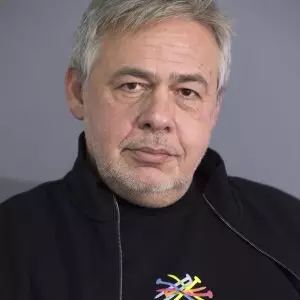
"Aggression - especially in language - has become something completely normal. Because when you lie all the time, and we've been lying for thirty years, what else is left for you but to fuck? No one is ashamed of anything anymore. When he says 'my aunt gave me money for an apartment', he is actually saying that he should hurt you and everyone else below him. It exists at all levels, from politics to various other fields. I think that's where all that aggression comes from."
Srđan Valjarević and I have known each other for a long time. That's why, because of belonging to the same generation and something else, there is no persuasion in this interview. And how could it be? Because when he writes about himself, Srđan writes individually and about each of us who read him. It is not possible to put him in any mold, nor to separate his own feelings, experiences and experiences from those he writes about in his works. So quiet, impressively modest and just as attentive to everyone, I could never imagine him as a boxer.
WEATHER: What brought you into the ring??
SRĐAN VALJAREVIĆ: Until then, I was training football. And in order for me to sign for Sinđelić, at that time the Football Association of Belgrade asked for consent from the parents. My father did not give me consent, I was a tragically bad student. So I couldn't coach football anymore. And then, as I finished elementary school, I went secretly with a couple of friends to Radnički. The coach started the first training sessions before entering the ring by making sure that the fifteen-year-old kids - to use that phrase - no longer had blood rushing to their heads. Elem, we're learning guard, he shows you how to hold your hands, then he slaps you along the way. Your blood rushes to your head, you would like to hit him, but you can't: firstly, he will beat you up, and secondly - you can't because you have the authority. At first, as a kid, you are completely confused. But, of course, you keep listening to him and those slaps are repeated. Nevertheless, I continued to come to the trainings - I agreed to it myself. Boxing is a fair sport - you take a beating, you give a beating, but at the end of the day it's not about the beatings, it's about the points because you follow the rules. Now, after almost forty years of boxing, one thing remains for me - the blood does not hit my head.
There is a saying that a boxer in the ring is the loneliest man in the world...
That's true. But in the forty years that have passed since then, there have been so many situations where I have felt like the loneliest man in the world. When you start writing something, there is no help from anyone. Boxing and writing are very similar things.
And how did you get from boxing to writing??
I got a job early – I was seventeen and a half years old – and started going straight to the cinema every day. Those films completely displaced me from boxing, football and the workshop, they opened a special kind of rapture for me. And since I was missing something else, I discovered books. I didn't have to look any further, my wandering ended there.
Do you remember the first book you read??
I think Dostoyevsky's Notes from a Dead House was the first book I read. I reacted in the following way: give me more of the same kind... Then came Camus' "The Stranger", then Buñuel's autobiography. Reading that book, I fell into a special state - I can't say bliss, but something you long for without even knowing what it is.
Did you have any favorite heroes??
Meursault from "The Stranger" left a special impression on me, I guess because he was among the first, then Don Quixote. After that came many other books and heroes.
And in the movie?
Charlie Chaplin and Buster Keaton were love at first sight for me. I still watch them on YouTube today like a fool. Charlie Chaplin is one of the greatest geniuses of the 20th century on film, but also outside of it. However, I must admit that at that time I was also particularly impressed by Gary Cooper in "Tachno u podne".
How long did it take you to write the first book??
A month. A friend gave me an apartment and I wrote my first novel from mid-June to mid-July.
At what age??
When my first book came out I was twenty-two years old. I wrote it on a typewriter. A friend told me that serious writers overtype and edit their works, so he showed me what a whitespace is because I typed without it, discovered that I could make corrections by hand, and so on. I retyped "A leaf on a crust of bread" three times, quite attentive to advice and suggestions, but only those that seemed convincing to me. Then I went to work as a waiter in Korčula, returned to Belgrade, revised the manuscript twice and sent it.
01-22-07...
Whom?
I went to the bookstore near Bata in the Yugoslav Drama Theater and copied the names and addresses of the publishers in Yugoslavia from the books - it still existed then. Basically, I sent the manuscript everywhere. "Literary Word" came to me and that's how my first book came out.
I am asking you all this because of a key question: Why did you start writing??
Watching movies and reading, I say to myself: I can do it too. But not in the sense that something I do will be fantastic and similar, but because in dozens of movies and books you recognize yourself as a character and in the way it is shown. There is no money there. Godard's films are very cheap and now, if someone younger watched them for a year and nothing else, everyone would think: I can shoot this too. So record! It was the same in my case with writing. It's simple - pen, paper and it works. It costs nothing, you don't need anything.
Some of your readers believe that in your works you strip yourself to the bare skin...
I don't see it that way, because I don't believe in an autobiographical novel. He does not exist. There is a novel and there are autobiographies, confessions and memoirs that I like to read. I especially like two books - Confessions of Saint Augustine and Confessions of Rousseau. But I don't compare them to novels. A novel is a novel. As much as you don't invent, you make a selection of your experiences so that the story resembles something and you are satisfied with what is written. I don't feel like I'm stripping, nor do I need to. My thoughts and feelings are not important, the text is important.
But you are also read for your honesty, isn't it?
We all seem to crave honesty. Anyway, it's easier for me to write about things I know well because I can't know any of my fiction better than what's real. At least I think so.
How authentic are the experiences and events you write about?
They are authentic, but when we are already there, the thing is the following: when you get to the end of the text and in order to be satisfied with it, one percent of everything should be some fabrication. It may sound pretentious, but this is what is called creativity. I am convinced that each of us has it.
Do you take notes??
Earlier I used some notebooks, today I type on my mobile phone. It is enough for me to come up with five or six sentences and start writing the text. Then everything goes on its own path that I can't plan and all kinds of things happen. It's roughly the same as my hike - I know I'm going to Zemun, but I have no idea which way to go. After all, writing itself is one of the ways of thinking that guides you and meanders, the spontaneity that you enjoy the most.
Do the impressions from those walks influence your writing??
It all depends on how focused I am. When I was younger, it happened that some observations - see this, see that - affected me. Now what I have in my head is much more important than what I see, and sometimes during a walk I come up with the whole text. And again, a person notices all kinds of things while walking. Right next to the Danube, I saw a couple: he is half-blind, and she is reading him a newspaper. Then I meet them later – she's reading him a book. I slow down, try to see the title, but can't.
Speaking of walking, do you go to anti-violence protests??
I have only been to the current protests once.
Why?
I don't like parties, never have. When the protests started to look like a party, I stopped going.
How is your contact with the audience??
I have it now, unlike when I started. It never made me uncomfortable. I have readers in Serbia, but also in Bosnia, Rijeka, Zagreb... Everywhere I go, they tell me that it is impossible that my contacts are not important to me. I say: they are important, but they are not, because my life is the same. I don't write so that readers will like me. I don't really know who I'm writing for, except maybe for myself. You write for anyone, you never know who will read it.
Do you have stage fright at those public appearances??
I don't even have stage fright anymore. Now I was on television for the first time. The occasion was the second part of "Coma". I spoke to a very pleasant presenter, she couldn't believe that I had never been on television before.
And before?
I used to have stage fright for everything. When my first book "Leaf on a crust of bread" came out, I was still working in the workshop. Boss Voja was a great guy, he banned calendars with naked women and folk songs. At Studio B, in the program "what's new in Belgrade" this week, they mentioned my novel and me. I hear that and my legs are cut off. And most of all from the fact that someone else heard it. That is, teasing and the like will begin in the workshop. However, everyone was happy.
What was it like to work at the age of seventeen and a half? Boys and girls at that age have completely different concerns.
I was the youngest and threw garbage into the bins. That's how I managed to steal a few minutes from work - cross the street, hide behind a dumpster and light a cigar. It was like being in the Maldives then. I drilled holes on the drill press, all kinds of things. And I mostly worked on cabbage pressers because that sold well all over Yugoslavia.
Can you estimate how much the boss Voja's workshop shaped you as a person??
I was young, nothing was difficult for me. I've never been someone who sleeps for a long time, nor were there any hard jobs. But what affected me the most at the time was that movies and reading were more important to me than anything else I was doing. I was in the workshop by force of opportunity because of my mistakes, this or that... So what formed me were books and movies, and in the workshop - time to think about them.
Did you read it? "A razor blade"?
Da
Do you look a little like Larry yourself?, the hero of this novel?
Now that you say that, yes, I do look a bit like that.
We are peers. What a lost generation we are?
Totally. I resisted that generational determination for a long time, but in the end you can't avoid it. Just one trip to Konjarnik is enough for me, where I grew up and where, along with many acquaintances, I now have only one good friend left. I go with him to the tavern and immediately see how many of us have been executed.
22-14...
Where did we lose ourselves so much?? In wars?
When someone says now that he knew there would be a war, I can't believe him. That is not my experience. No one I knew had any idea there was going to be a war. Perhaps the most beautiful and honest thing for me was when I read that the lawyer Srđa Popović stated in an interview that even he, with his great life experience, did not think that there would be a war. The journalist asked him why. He replied that he didn't think we were that bad.
I didn't believe we were that bad either. And where is the greater confirmation that we are worse than the war? She is gone. And now for thirty or more years you have lived with the experience of being bad. Fortunately, there is literature on how others have dealt with it in other settings. But it's not a terrible thing to realize that you're bad, it's about doing everything to become better, correcting what's bad. You try as hard as you can. We are talking about Serbia, but all this applies to any society in the world. But when it comes to us, how can you correct anything when you sweep the whole history under the rug? Who are you hiding it from?
What specifically do you mean??
When the war started, we all know it's a war, but Serbia is not at war! How is it not? But it was accepted, for thirty or more years no one could say that we were at war. And let's not list all those things from the nineties, and in 2003 when Đinđić was killed... We are constantly in a war.
At the end of the nineties, you were in Belađ on Lake Komu and wrote a novel of the same name, which immediately gained cult status. Now you've gone there again.. How does everything look to you after twenty-five years??
The excitement I now set out to describe. When I got there I wasn't sure if I was back in the book or in Italy. I was only there for a month then, and two and a half decades have passed. But as I wrote the book about it, that time is not measured in days, months or years. And here I am again in the book, and I didn't even know who else was there from those I used to hang out with. Let's say, Augusto. I calculated that he is now eighty-seven years old, I know that he is alive, but not how his health is. Basically, as soon as I arrived with my photographer and friend Sancho, I couldn't resist running to the Sport Bar. I walk in and immediately recognize August! His joy at seeing me at least doubled mine. In the book, I attributed some things to Augusto that he didn't say or do, simply because I don't have too many characters. I apologize to him for that, and Augusto interrupts me right after the first sentence and says: it's a book, I'm just a character. He keeps two copies of "Coma" under the bar - one in Italian, the other in French. We take a picture, and I am happy and completely confused because I am standing with both my friend and my literary character. Actually, it kind of worked out that we did that book together. He's the character, I'm the storyteller.
Did you read it again? "Komo" before leaving again?
No. I didn't want to be drawn into forcing something out of the book, making parallels and so on. I just wanted it again for the first time.
What has changed??
I have a similar experience when I go to Korčula again. I haven't been there for twenty-nine years, and five years ago I went for the first time. There are some rocks there where I learned to swim as a kid. All my life I remember how, when my aunt and uncle bring me there, I catch the crabs with my hands and return them to the holes from which they came out. Now I can no longer see those holes or those crabs without glasses. And then you realize how everything changes - both dioptre and perception. I want to say that for what I saw twenty-five years ago on Kom, I could say that it no longer exists. But that may not be true, but I don't see it anymore.
You didn't answer me..
Bellagio, the place where I was, now has fewer inhabitants than then, many more apartments than then, people rent out their houses and live somewhere else. More or less, that whole part of Italy has changed in that sense.
You thought you would spend your life as a waiter on Korčula. Why?
I saw that as something ideal: you work three or four months a year, the rest of the time you write. Where will you do better? And among other things, at that time my relatives had a house on Korcula, so everything seemed very feasible to me.
You took a ten-year hiatus from writing...
But not from reading... Simply, I needed to stop writing. As soon as you feel that it is becoming your manner, your way of life and that you are becoming a part of the society in which you do not want to be, then it is best to stop. That way I saved the possibility to continue writing if I felt the need.
Do you think that the writer has a public responsibility.
He has it, and not only him, but everyone who does something that is published. It always bothers you when you listen to lies, even in the smallest company. You have only two choices - either you leave or say wait a minute, things are not like that. I can neither accept nor agree to things that are not true.
Bob Dylan wrote a sixteen-seventeen minute song about the Kennedy assassination in the middle of the pandemic. And then contam, some new virus, little is known about it, the whole world is in it, Dylan is eighty years old, he goes down to the studio, sits down at the piano and sings a song about the Kennedy assassination. So, he is fighting some of his own battles, he can't solve something his whole life. Since then, I know that I will never solve my problem about that indifference during the siege and shelling of Sarajevo. As much as I don't engage in engaging art, I will never solve it. I have friends in Sarajevo, we see each other, everything works, but the whole thing still bothers me. I can now mention Srebrenica and other places, but if during the four years of shelling of Sarajevo most people here had earaches, I will never be able to understand that. If I live to be eighty, I will still be able to talk about it.
Do you use social networks??
No way, I don't have that.
We are witnessing enormous aggression and hate speech in society. Where are they from??
Man cannot imitate himself. If you don't know French, you can imitate it by mumbling something that looks like that language to you, but you can't imitate Serbo-Croatian. We don't know what it sounds like. Likewise, we can't imitate swear words - we know what they mean, but not what their tone is. I am saying this because I had the opportunity to listen to a group of young people on Korčula in a cafe. They traveled around Europe and imitated the languages they heard. I recognized the Hungarian one, but the next one I didn't. And they imitated, let's say Serbian, since they were in Belgrade as well. It sounded very harsh even though the words meant nothing. All in all, they were very uncomfortable when my friend asked them what language it was, and they said Serbian - they heard it in Belgrade - and then I told them I was from Serbia. It's okay, I tell them, it's the first time I've heard what we sound like to you. They answered that our language is the most aggressive to them. Do you know the meaning of any of those few words you are trying to repeat, I ask them. And they tell me - you know, if you keep repeating something to someone with a frown on your face, it must be just a swear word or a bad word. So that aggression, especially in language, becomes something completely normal. Because when you lie all the time, and we've been lying for thirty years, what else is left for you but to fuck? No one is ashamed of anything anymore. When he says "my aunt gave me money for an apartment", he is actually saying that he should hurt you and everyone else below him. It exists at all levels, from politics to early other fields. I think that's where all that aggression comes from.
How do you view the tragedies in that context? "Fishmonger" and the surrounding area of Mladenovac?
In these crimes you can find all the symptoms of this society. It's there anyway, it just slaps you in the face when it happens. Is it something new to any of us that the father took his son to the shooting range. Did that shock you? There is no one.
What is happening in the country and the world, what is in the newspapers and how to pass the time?
Every Wednesday at noon In between arrives by email. It's a pretty solid newsletter, so sign up!
Pursuant to the Agreement signed by Partyarch Porfirije and Đuro Matsut on Vidovdan this year, the Government approved 763.100.000 dinars to the SPC. 234.800.000 dinars were immediately paid to the church, and the rest should be paid by the end of November 2026. The document obtained by "Vreme" shows that this money - that is, about 6,5 million euros - is intended for the construction of a new music hall measuring 2315,33 square meters. It is not clear which mosaic it is because the interior decoration was completed in 2020. The public was alarmed by two facts: public money was paid into one of the accounts that SPC has in "Alta Bank", and the second is the suspicion that the money in cash was taken out of Serbia and handed over to certain partners in Moscow. Dejan Nakić is mentioned as the whistleblower, and according to numerous sources of "Vremena" from the Serbian Orthodox Church, he has been mentioned before for various controversies related to the business of the Church.
What can the new government do with people from the security system who have accepted to wage a special, hybrid war against the majority of their citizens on behalf of a regime? What should we do with people who have accepted such rules of the game? We need to get rid of the burden they represent, because they are not capable of doing their job. No, it's not retaliation. From the beginning, the student movement insisted that the state system be regulated, and this implies very radical measures in the security system, where people who have received high salaries for years to follow and harass opponents of the government sit. They have to leave the service. If they're all like that, they all have to go
Students for Time about their experiences with BIA
Invitations to "friendly talks", accusations of espionage, recruitment attempts, threats and surveillance. Doroteja Đenisijević and Lazar Mišić, students of the Faculty of Agriculture, tell "Vreme" what their meeting with the Security and Information Agency was like and what happened when they refused to cooperate
Hidden equipment in a college amphitheater, spyware on a student's phone, surveillance by prosecutors and private conversations on television. After the political change, the question remains as to who manages that system. Judge Milimir Lukić demands the abolition of Bija, an independent investigation and the opening of the file. Predrag Petrović warns that the Service could survive this change too - through new allies
From the documentation that BIRN had access to, it is clear that there were reasons for the National Bank of Serbia (NBS) to enter into a detailed control of the work of Alta Bank much earlier, and some of the risks that the control of the central bank found at the end of October 2026 existed for more than a year. The question is why the NBS did not react earlier
The four independent members of REM are an example of perseverance and civic responsibility. Rodoljub Šabić even, upon leaving the premises of REM, after the sentencing of the Informer, experienced that the Essenes insulted him, hit him with their hands and feet. But that too will soon be over
Vučić pardoned the batterers and Dijana Hrkalović. The election winners should abolish the sultan's power that allows one man to run afoul of the entire judicial system
Davor Matura's ALTA empire is the transplanted heart of the corrupt regime of Aleksandar Vučić, who was defeated in the October 25 elections. From ALTA Bank, roads lead directly to the top of the progressive government.
The archive of the weekly Vreme includes all our digital editions, since the very beginning of our work. All issues can be downloaded in PDF format, by purchasing the digital edition, or you can read all available texts from the selected issue.