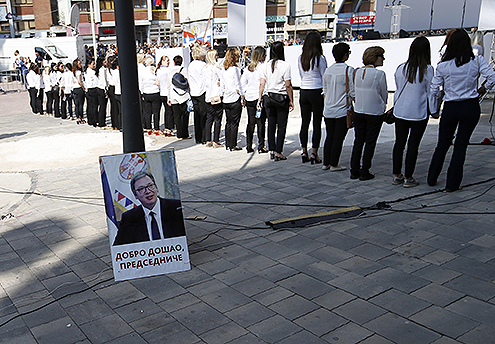
Vučić's speech, presented as the most important in his life, did not bring anything new for Serbs in Kosovo. The only new thing we heard is that the president of Serbia is afraid of his own historical irrelevance and that he has no solution for Kosovo. He admitted defeat as if declaring the greatest victory and received applause
The two-day visit of the President of Serbia, Aleksandar Vučić, to Kosovo and Metohija has been breaking news in the media for ten days. It started with megalomaniac announcements and epithets like "historic" and "fatal", culminated in the following of the president's every step on national television, and ended as if it had never happened - nothing in the lives of Serbs in Kosovo changed after this.
The historic speech, perhaps the most important in his life, as he announced, Vučić had been writing for weeks. If we engage in the diabolical work of deconstructing that speech, several key points emerge: morbid historical parallels, revision of the period from 2000 to 2012, amnesia regarding one's own role in Serbia's policy towards Kosovo until 2000, and the key message that Aleksandar Vučić has no solution for Kosovo and hopes that some future generations will reach a compromise with the Albanians.
However, even though he managed not to say anything specific, Vučić skillfully threw several verbal shock bombs.
REHABILITATION OF SLOBODAN MILOSEVIC: Of course he mentioned Gazimestan, because many, especially those who are not in favor of him, dared to compare Milosevic's speech at Gazimestan with Vučić's announced visit to Kosovo, and it is known that the president needs to respond to every headline, every tweet at every opportunity in which someone makes fun of him, no matter how irrelevant it is: "Almost thirty years ago, not far from here, hundreds of thousands of people, and Slobodan Milošević was big enough to gather them in that number at Gazimestan, welcomed is the end of his speech, famous, for some unheard of, it depends on who interprets it and why, do you remember how?" We remember. And we also remember what happened afterwards, that's how we got here, to the moment when we are all waiting for some kind of outcome of the Kosovo crisis, to the moment when the president of Serbia announces that he will hold an important speech in Mitrovica in which he will say what the solution is, and then essentially admits his own impotence.
However: "Milosevic was a great Serbian leader, his intentions were certainly the best, but our results were much worse." Not because he or anyone else wanted it, but because the wishes were not realistic, and we neglected and underestimated the interests and aspirations of other peoples. And for that we paid the highest and heaviest price."
Let's show good intentions at this point and express our belief that Vučić took Milosevic to heaven because he addresses the "target group" in which Milosevic was unquestionably popular until the end of his reign. But let's also be rational. The year is 2018. We are already well into the 21st century. How reasonable is it to declare as a great leader the man who plunged the country into three wars, under whose rule there was the second largest hyperinflation in the world, who left the Serbs in the Krajina in the lurch, a man whose reign is remembered for standing in lines for bread and milk, smuggling everything, from gasoline to salami from Szeged, for political murders and the flourishing of organized crime, and finally, for the bombing of Serbia. Okay, no one denies that there were "interests and aspirations of other nations", but to say that Slobodan Milošević had good intentions, and that everyone else is to blame, is neither reasonable nor true. Because foreign powers were not involved in emptying the pension fund and robbing old foreign currency savings, for example. Nor did they force him to commit election theft in 1996. Which great statesman is stealing the elections and what good intentions could be behind this organized enterprise?
After all, there is one part in this speech by Vučić that is quite easy to imagine Slobodan Milošević uttering: "Again, we will be equally to blame, I guess because we didn't have enough water to put out the fires they started." And it's always like that. That is why our job is to continue to fight, to change the reputation of Serbia in the world, to change the image not only of ourselves, but to change the angle from which they look at things here in the Balkans."
Some analysts have already interpreted part of Vučić's speech about Slobodan Milošević as ambivalent, both complimentary and critical; it is striking that in even two places in that section, Vučić insists on the "intentions of others" that led to bad consequences for Serbs both inside and outside the borders of Serbia. Because, enumerating that there are almost no more Serbs in Knin, Sarajevo, Pristina, Kosovo Polje, the President of Serbia points out that this is not because others were stronger and braver, but "because we did not understand the position of Serbia and the world, because we did not realized that we are not alone in the world and that we cannot live without the world. Because we underestimated everyone else and failed to count. Neither succeeded, nor could they. Because we always saw and listened to ourselves, we were not interested in others. It turns out that Milošević, the great Serbian leader with the best intentions, was not in agreement with reality and that he was staring at his own navel a lot.
For the umpteenth time, Vučić returned to the old excuse for Serbia's political failures, an excuse on the level of "the dog ate my homework" - how we did not understand the historical moment and Serbia's place in the world. And for the umpteenth time, he persistently uses the pronoun "we", when it should actually be "I". Because if there is something strikingly missing in Vučić's recapitulation of the period before the fall of Milosevic, it is the answer to the question of where he was during that time and what he was doing and saying. Especially when it comes to Kosovo and Metohija, because, let's recall, the only party in the ruling coalition of the FR Yugoslavia at the time that threatened to leave the federal government if the Kumanovo Agreement was signed was the Serbian Radical Party, of which Vučić was the general secretary, and in that government Minister of Information. Let us recall that the Kumanovo Agreement ended the bombing of Yugoslavia in 1999.
And it's not a bad thing to remember what opposition MP Aleksandar Vučić said in January 2012, shortly before he came to power: he said that for that party, the Constitution of Serbia is a point that will not be crossed when it comes to Kosovo and Metohija and that will, if he comes to power, openly tell the citizens what can be done about that province: "If it is not possible to implement everything written in the Constitution of Serbia, we would first sit down with all political parties and establish what we can do to get, and we don't know that now, because we don't know how the negotiation process is going. And we can only know that when we come to power, when we will openly tell the citizens how things are," and he also added that the then Serbian President Boris Tadić's plan for Kosovo: "What is Tadić's plan, that is what is written in Ahtisaari's plan. If he says special status for the north of Kosovo, does that mean that he recognizes Kosovo and within what is that special status - within Kosovo or within Serbia".
These are all questions that he could comfortably ask himself today, but not about Tadić's or Ahtisaari's plan, but about the Brussels Agreement. Speaking of which, the topic of the Community of Serbian Municipalities has conspicuously disappeared from Vučić's, and therefore from the public discourse. Let's also add that there are quite a few who believe that Ahtisaari's plan offered more to Serbs from the north than ZSO.
DON'T BUILD ME MONUMENTS: Zagreb University professor Dejan Jović noticed a morbid feature in Vučić's speech. Vučić is also prone to making ominous predictions to himself (remember the famous statement: "I work in the interest of Serbia and I know how I will end up"), and to pretending when he gets used to the role of a victim. This time, however, he surpassed himself, because in the same speech he managed to hang himself, shoot and burn himself at the stake, but - he does not ask for a monument. It started with a noose and without a noose: "If Stefan Nemanja, the founder of the Serbian state, could stand in front of Manojlo Komnenos with a noose around his neck, bare-handed, for the sake of Serbia, I can, must and will without a noose, and for the same Serbia and in front of Thaci , and in front of Mogherini and Merkel and Macron and Putin. And as you can see, I can and I can. And I fight and will fight for our Serbia and for our Serbian people." The only reasonable question after this is: where did you go, President? Manojlo I Comnenus did imprison Stefan Nemanja in order to impose a vassal relationship on him, which later served as the foundation of the future Serbian state, but why this analogy? Federica Mogherini hardly has a prison with which she threatens Vučić every time he meets with her in Brussels. And that noose on Nemanja's neck is historically unconfirmed - it appears, namely, only in the series "Nemanji - Birth of a Kingdom" produced by RTS. It's a good thing that Vučić doesn't have time to watch "Game of Thrones", otherwise, those gathered in Kosovska Mitrovica could hear how he will ride a dragon and unite the warring countries of the east and the west, that is, in our case, the Serbs north and south of the Ibar .
With noose, the president moved on to shooting and self-sacrifice: "And I can, and I do it, and I will, and a thousand times if necessary, at any price, even at the price of universal hatred, towards me, and whatever they call me, some a traitor, some a Great Serbian chauvinist, and that tomorrow they will shoot me, because, unlike them, I know the difference between salon and real patriotism. And that true patriotism and patriotism is only the one in which you are ready to sacrifice everything, including your own present, for the sake of the future of your country and its children." Now the big question is what exactly the president of Serbia is doing to solve the situation of Kosovo Serbs. Because, after each round of Brussels agreements, we only hear a bunch of generalities, anecdotes about outsmarting Thaci and a general assessment that the negotiations are going well. In addition, we get a spoonful of stories about the Union of Serbian Municipalities, a vague idea about demarcation, Marko Đurić's icon-painted train and the distribution of rabbits in Laplje Selo. And that's about it.
Somewhere towards the end of his address, Vučić also said: "I am convinced that when all this is over, if some people condemn me, curse me, when the bonfires are extinguished one day, that at least you, you present here, the Serbian heroes, our heroes of Kosovo and Metohija , that at least you will know what and for what I worked. For Serbia, for the motherland, for you and for life. And every child born tomorrow, every man who gets a job, every new school, hospital, will be proof that we did the only right thing. And that's more than enough for me. Monuments, let them erect monuments to those who lost, as they always say, honorably and, in addition to their own, mostly so many other people's victims." Apart from predicting to himself that he would be burned at the stake again (and why?), Vučić could not resist show his megalomaniac trait: because this "let them raise monuments to others" is nothing more than a hidden desire to one day go down in history as a great leader. Maybe not quite as big as Stefan Nemanja, but certainly big enough that someone or everyone could think of erecting monuments to him. Okay, everyone who is involved in politics is certainly a little bit burning with the desire for historical importance, but it is achieved by actions, not words and, which is inconvenient for Vučić, it cannot be planned in advance.
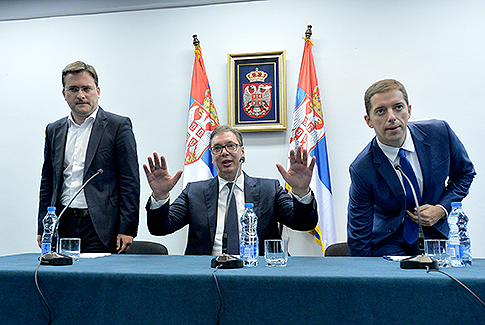
photo: Zoran Zestić / TanjugLISTEN TO ME WELL: A. Vučić with N. Selaković and M. Đurić
FREE ADMISSION OF DEFEAT: Although the famous demarcation was not mentioned, it is interesting that during the two-day visit, Vučić paid much more attention to the Serbs living in the north of Kosovo than to those in the south. True, the barricades of veterans of the Kosovo Liberation Army and the Kosovo authorities prevented him from crossing the Ibar, but the very fact that Vučić gave such an important speech in the north contains an implicit message. Fortunately, if nothing else, he at least sent a message of peace: "You are the strongest and bravest left." And don't forget that in 1991 there were, percentage-wise, three times more than today in Kosovo and Metohija. Three times more, less than 30 years ago. And that's why I'm talking about reality today. And that's why I don't sing battle songs, I don't want to incite you, I don't want to promise you weapons and ammunition, even though it's clear, and I promise you that, that we won't allow anyone to use weapons and ammunition against you. I have said that five times, and I repeat it today at this magnificent meeting. And I say all this because we want you alive. We want Serbian children, schools for them, textbooks, kindergartens. I want you to have enough work to want those kids. I want maternity hospitals, playgrounds, roads, factories, so that in the end you have a reason to stay here."
Of course, the desire for people to stay where they are is good, as well as the desire for the place where they stay to develop and progress. However, this will not happen for the simple reason that Kosovo is rapidly being emptied, primarily due to economic reasons, as well as the rest of Serbia. Here we should bear in mind the repeated statements of Rada Trajković and Marko Jakšić that Serbs are increasingly leaving the north since January, after the murder of Oliver Ivanovic. And precisely in connection with that, Vučić would have to answer the question he asked almost seven years ago in connection with Ahtisaari's plan: where do these people stay, within the borders of Serbia or independent Kosovo? And there is no answer to that question, unless we agree to the symbolism that some commentators have already noticed: by forbidding him to reach Banja, the Kosovo authorities sent a clear message to Vučić - walk around the north of Kosovo as much as you want, but we control below the Ibar.
Vučić admitted something else, and few people looked back on it, although it is probably his key message to the Serbs in Kosovo: "Do we have some kind of draft solution in Brussels, since the whole world is buzzing about it, everyone in Serbia who has never participated in the talks is talking and who have no idea about that? I am speaking here in front of you in the most open and responsible way - we do not have any plan for a solution, we are not even close to it. But, for the first time, it seems to me that we know very well that we have to talk and at least try to fix our relations. And I'm not an optimist in that regard. And I know that there are thousands of those who are just waiting to say: Aha! He went down! And that down there is Kosovo for them. For me, Kosovo and Metohija are not below, they are above, they are above everything, they are important and the most important for every Serb. And they will say - he didn't say anything new. As if saying something new about Kosovo is even possible. As if all the stories have not been told for a long time. But it is also new that I am not going to curse the Albanians here, nor those who threatened me today, and threatened our people south of the Ibar. I don't even want those who, by beating the Serbs, created a state for them, and who are still pretending to be silly about all that happened, but I want to see how we can create a better tomorrow for the Serbs in Kosovo and Metohija through actions."
Aleksandar Vučić admitted that he has no solution for the Serbs from Kosovo. And not only is he not there, but he doesn't expect that there will be any solutions soon: "We must and will have to live together and next to each other." And that is why we will talk and negotiate, until exhaustion if necessary. And that's why I came to Kosovo to tell you that someone, sometime in the future, will have to reach a compromise with the Albanians." So, he came to say that there is no solution and that someone else will have to look for it in the future. He came to say that he had nothing to say, but: "When we have anything to tell you, about any solution, about anything, we will not announce it either in Belgrade or in Brussels." We will tell you, here in Kosovska Mitrovica and Gračanica. And don't worry for a single hour or a single day about it."
At the end of the speech, Vučić referred to a graffiti in Mitrovica that says "There is no going back from here", and then he turned and went back to Belgrade. On Sunday, September 9, Aleksandar Vučić held a demonstration exercise on how to leave 120.000 people in the lurch and still get applause for it.
Attacks on journalists
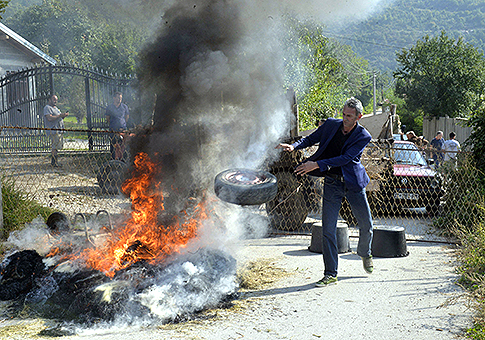
HOW TO ACHIEVE RECONCILIATION: Barricades on Drenica
Three journalist teams were attacked at the barricades that Albanian protesters had set up to prevent Aleksandar Vučić from reaching Banje. The team of Insiders and journalists from Deutsche Welle and Tanjug were attacked, and apparently no one cared about their safety. Deutsche Welle reporters Sanja Kljajić and Elona Elezi were attacked on the way to the village of Banje, in the municipality of Srbica, from where they were reporting on roadblocks in protest of Vučić's visit. With the help of the local population and the police, they managed to return to the north of Kosovo. They were attacked by a dozen demonstrators, claiming that they were provoking them with signs. Sanja was asked for her identity card to make sure she was Serbian. She was scared and thought that she would not get out of that situation and that the protesters would not let them go.
The Insider team was attacked on the road leading from the village of Banje to Kosovska Mitrovica. Namely, Insider journalists took an alternative route as advised by the police patrol, but encountered another roadblock. First, the gathered citizens, at the moment when the Insider team was stopped to identify themselves, surrounded the car. According to Insider reporters, the situation became more and more tense, and even individuals from the group, at the moment when the car started, opened the door and tried to pull out one of the journalists, while the rest of the crowd pounded on the car. In the end, the Insider team still managed to get through.
At the barricade in Vojteš, on the route from southern Kosovska Mitrovica to Banja, Albanians threw bottles at the team of the Tanjug news agency. About 200 people blocked the road with vehicles, set fire to car tires, and placed banners in the Albanian language across the entire road accusing the Serbian people and Aleksandar Vučić of genocide. On the slogans there is a banner with pictures of the missing and murdered from that area. In front of the barricade, the police advised the reporters of Tanjug to turn around and leave because there are many "young and nervous" people, so an oyster could fly. Although four or five police officers were present, Tanjug's team was told that they could not guarantee their safety, RTS reported. Some gathered provoked Tanjug's team by throwing, and before leaving, they threw bottles at the journalists.
photo: Rade Prelić / Tanjug
Olivera Ivanovic Street
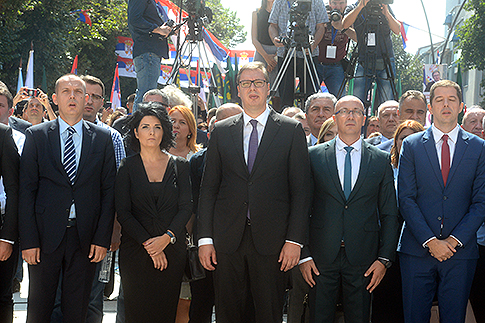
CONTROVERSIES IN PART OF THE PUBLIC: Milena Ivanović with A. Vučić
Back on August 29, councilors from the Serbian List in Kosovska Mitrovica submitted an initiative to have the current Nemanjina Street named after Oliver Ivanovic. Unlike them, the sons and sister of Oliver Ivanovic wanted him to get the street where he worked and where he was killed. As is well known, after the unsolved assassination of Ivanovic, his wife Milena, together with her minor son, moved to Belgrade and works in the Government of Serbia. On Sunday, she accompanied Aleksandar Vučić when he laid a wreath on the memorial plaque to her late husband. Vučić also addressed her in his speech: "Even today, I am especially proud to be here, in Kosovska Mitrovica, and thank you, Milena, for being with us." It is about the wife of the late Oliver Ivanovic. And that street will be the most beautiful in Kosovska Mitrovica, and it will not be decided on any forums. That was decided by the people and that was decided by the Serbian state. And thank you for staying with your country and for not succumbing to all those provocations and all those offers you received, gold, silk and velvet, to accuse your country and your country of something in which it did not participate."
The appearance of Milena Ivanovic next to Vučić caused lively and rather disgusting comments on social networks, starting with the fact that she has nothing to look for, to disgusting comments about her appearance and how she was dressed. There were also those who believed that she was blackmailed or helpless, but it is undeniable that the reactions to the presence of Milena Ivanovic were tasteless and cruel. Ružica Đinđić also went through a similar harangue at one time, which tells us that as a society we are particularly cruel to widows and that, unlike the rest of the family, they are forever under scrutiny and are judged and judged for every blink of an eye or dress combination. Milena Ivanovic took to Twitter and told critics to keep quiet if they haven't walked in her shoes.
photo: dimitrije goll / tanjug
Tears in Banje
Even the Banja residents did no better than Milena Ivanovic on social networks, whom Vučić was unable to reach, so he spoke to them by phone. All national televisions broadcast a close-up of a crying woman, and that very woman was the target of fierce criticism and insults. However, none of those who had something nasty to say to her knows what it's like to live in an enclave, in a not very friendly environment, where any arrival of someone from Serbia means a lot, especially the arrival of the President of Serbia. In this sense, it turned out that even the Serbs in Serbia do not really understand the situation in which the Serbs in Kosovo find themselves, especially those south of the Ibar.
What is happening in the country and the world, what is in the newspapers and how to pass the time?
Every Wednesday at noon In between arrives by email. It's a pretty solid newsletter, so sign up!
Why is there nothing else between the overcome regime and the changes? What does the regime mean when it says it is defending Serbia? Why is the Student Movement indomitable? Who has the knowledge and real experience, and who leads without a day of work experience outside of politics? And why students win
Elections 2026: From student revolt to decision at the polls
After almost two years of protests, hundreds of kilometers walked, arrests, persecution and unprecedented social mobilization, Serbia is holding elections that could mark the end of a political era. Sociologist Marija Babović tells "Vreme" that the hope for change has not been so great since October 5, 2000, but she also warns of the danger that, if changes are not made, the country will face an even tougher authoritarian regime.
Interview: Tihomir Stanić, actor on the Student list
Their only weapon now is the media they control: like, we don't have an agenda, which is not true; as, we will betray the national interest, which is not true. One of their arguments is that we are afraid to go to the debate with Vučić. They do not understand that it is their punishment. This is a punishment for Aleksandar Vučić, who for 14 years conducted exclusively a monologue. For fourteen years he did not allow anyone any kind of dialogue, and now he would like to be rewarded or pardoned with the opportunity to talk to us. Well, he won't be able to. What he sowed is now reaping
These elections are not elections about Serbia's membership in the European Union, Kosovo and Metohija, gay marriage, tax policy or any other single political issue. Although parties on the fringes of political power try to impose these themes, at the heart of the upcoming political election is a much simpler dilemma: change or preserve the existing order. For more than a year now, surveys have shown that this is the primary dilemma on the ballot
In the RS, 19.800 people registered for the elections in Serbia, who will be able to vote at 28 polling stations. It remains unknown how many of them will cross the Drina on October 25 and vote in Serbia. In any case, I do not believe that the voters from Republika Srpska are the ones who will decide the winner of the elections in Serbia. Realistically, the voters from Republika Srpska can influence a little, but it seems that they are symbolically very important to both Vučić and the opposition.
There is, literally, no difference between the one who claims it is day in the middle of the night, or the one who claims to be a giraffe, from the claims we read on billboards: that Vučić is working to unify Serbs and that Serbia is doing better and better day by day.
The pre-election arrests due to the alleged "overthrow of the state" testify to the regime's panic. The bad news for them is - they can't arrest the whole people who decided to defend themselves from progressive beatings and election theft
The ring that tightens around Ćaciland Student list is getting narrower. Because there are more and more spoiled people who see the false prophet for what he is: a street obscener who is fighting Serbia
The archive of the weekly Vreme includes all our digital editions, since the very beginning of our work. All issues can be downloaded in PDF format, by purchasing the digital edition, or you can read all available texts from the selected issue.