In the first place, I would quote German official sources. I assume that they are known to Serbian historians. All of them have been published several times. I wonder if it will be brought up at the trial about the man's rehabilitation.
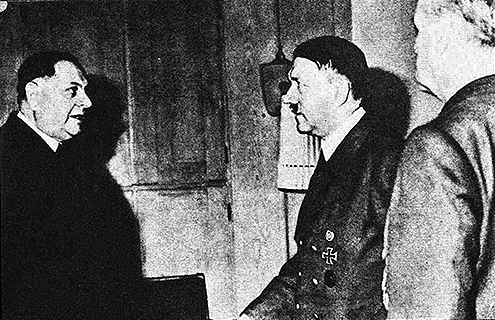
On September 22, 1941, as part of the "clearing of the area on the banks of the Sava", German General Walter Hinghofer ordered the arrest of "the entire male population between the ages of 14 and 70" and sent them through Sremska Mitrovica and Šabac to the camp, which was built under the supervision of his division. It was practically an order to kill the male residents regardless of whether any of them collaborated with the partisans or not. General Franz Boehme, who had the title of "plenipotentiary commander of Serbia" since September 16, informed Milan Nedić about this on September 27, 1941, saying that "the intended action will be carried out with the harshest measures" and offered him to resign because of this. , which Nedic refused. Boehme wrote this in his official report on September 28.

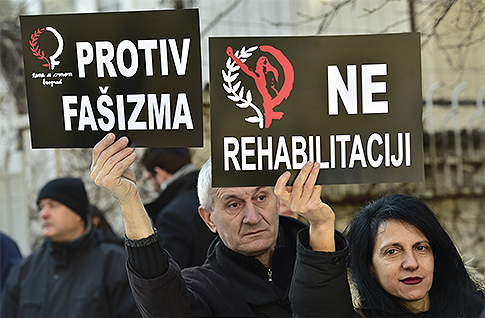
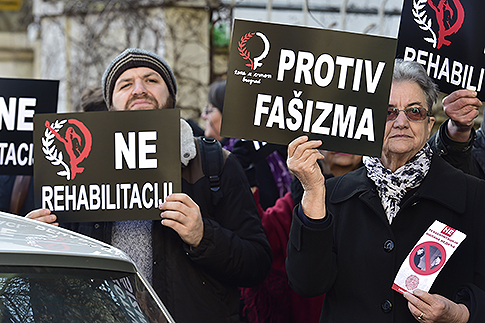
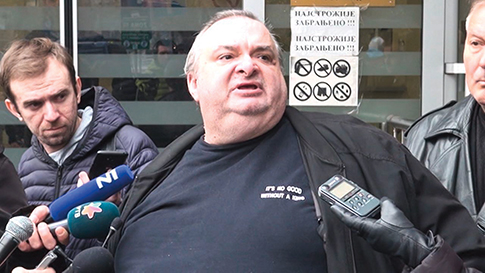
photo: tanjug / s. ilić...protests outside the courtroom against the rehabilitation of a Nazi collaborator...
I emphasize that it was about the Serbian male population, not yet about Jews. By the way, Beme was accused as a war criminal on May 13, 1947, was in an English prison, and committed suicide there on May 29, 1947. I remind you that his associate in Serbia, Milan Nedic, allegedly committed suicide, which was announced to the public on February 5, 1946. It was not in the authorities' interest to kill Nedić, to throw him out of the window, which is one of the versions of his death. On the contrary. It was much easier to accuse Nedić and sentence him to death than Draža Mihajlović, and that would have been more in line with the Yugoslav propaganda of the time. That's why I believe that he managed to commit suicide because he thought it was more worthy of an officer than being beaten to death in court.
Not long after the massacre at the end of September 1941, the Ustasha from the left bank of the Sava, and Nedić's police from the right, combed the area and transferred all suspicious persons to the camp for Jews in Zasavica near Šabac. There were already about 1200 Jews there, who in November 1939 embarked on three Yugoslav ships with the intention of reaching Palestine via the Danube and the Black Sea, but the Romanian authorities did not allow them to pass, so after many vicissitudes and hardships, they arrived first in Šabac, and then to a camp specially built for them. They were shot by members of the regular German army, the Wehrmacht, on October 12 and 13. This marked the beginning of the "liberation" of Serbia from the Jews, which was part of the agreement between Beme and Nedić. (Quoted from the book of the Austrian historian Walter Manošek "Serbia freed from the Jews" - Serbien ist judenfrei, published in 1993.)
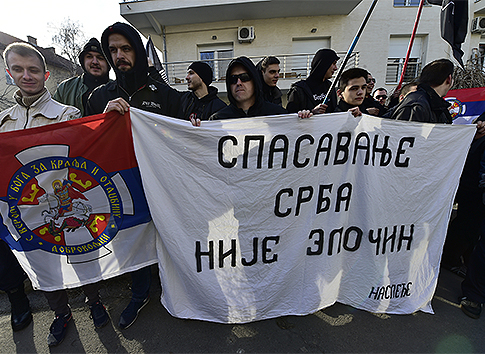
photo: tanjug / s. ilić...and for her
German diplomat Felix Benzler previously informed his ministry: "We should not expect any political difficulties from Nedic's Quisling government." No mass protest is expected from the population either. Nedić called the harshest action against the Jews one of his main tasks." (Benzler's dispatch to his Ministry of Foreign Affairs dated October 10, 1941.) I find it interesting that Benzler calls Nedić's government "quisling" in official correspondence. Although he was implicated in the mass murders, Benzler was never charged, dying on his diplomatic pension in Gronau, West Germany in 1977.
SERBIAN PETEN: In one of his reports regarding the attempt to persuade the Chetniks of Draža Mihajlović to cooperate with Milan Nedić, General Beme wrote that Nedić considered himself a "Serbian Peten". (Behme's report to the higher command on November 15, 1941) I add that Nedic was undeniably one of the Serbian heroes during the First World War, although in a lower position than Marshal Pétain, but no one in France thinks of rehabilitating Pétain. On August 14, 1945, Philippe Pétain was sentenced to death in Paris for collaboration with the enemy and high treason. Due to his advanced age, de Gaulle pardoned him for life imprisonment, which he served in a fortress on an Atlantic island. Ille d'Yeu, where he died and was buried on July 23, 1955.
Nedic made 3,5 million dinars available to Draža Mihajlović. In order to negotiate about this, his emissaries Colonel Branislav Pantić and Captain Nenad Mitrović came to Belgrade, who negotiated with the captain of the German military-intelligence service Abwehr Jozef Matla. Matl was given the power of attorney by General Beme himself. Beme also invited Draža Mihajlović to Belgrade for an interview, but the Chetnik leader refused. (Official report of Josef Matl dated October 30, 1941.)
I did not find any trace in the German documents about whether Milan Nedic knew in advance or found out afterwards about the mass murder in Kragujevac, when the students of the gymnasium he once attended were shot. I think it is impossible that at least he did not find out anything afterwards, but so far no document has appeared on whether he protested or commented on the act in any way.
SAVIOR OF SERBS: Even those who normally condemn Milan Nedić for his humble cooperation with the occupier, give him credit for receiving hundreds of thousands of refugees from Croatia, Bosnia, Slovenia, Kosovo and Srem. It is very naive to think that he had the power to receive them or not. The entire region was ruled by Hitler's Germany, every smallest, let alone mass movement of people could not be carried out without the approval of the German command. Nedić was only an executor of affairs based on the orders of Berlin, where they wanted to keep the Serbs together in order to control them more easily.
Another argument in favor of Nedić is that not a single Serbian soldier was sent to the eastern front. However, this is also a half-truth, because the German military authorities did not want Serbian soldiers in that sensitive position. Hitler personally hated Serbs and doubted "their character". The negative attitude of the criminal is, of course, the highest praise. There is no information that Nedić ever spoke on the subject.
ANTI-SEMITIC REGULATIONS IN THE KINGDOM OF YUGOSLAVIA: I think that Milan Nedic was a consistent man, he believed in the correctness of Hitler's policy, and that even long before the start of the war in Yugoslavia. Immediately before the beginning of the Second World War, on August 26, 1939, he became the Minister of the Army and Navy of the Kingdom of Yugoslavia. When, a few days later, Germany attacked Poland, and England and France declared war on it, Nedic expressed the opinion in the government that we should certainly cooperate with the Axis powers, even at the expense of territorial concessions in Dalmatia, Vojvodina and Macedonia. Because of this, as well as because of his closeness to Ljotić's organization "Zbor", Prince Pavle dismissed him on November 6, 1940. It is logical that the Germans knew they could count on him.
Was Pavle Karađorđević consistent? Apparently not. He hesitated. Namely, the government of the Kingdom of Yugoslavia already on September 16, 1939 passed two anti-Semitic decrees in the spirit of Hitler's policy towards the Jews, which is a kind of prelude to the latter massacres, because it already lists who is Jewish and who is not. Prince Pavle could have gone down in history as a patron of art and a decent connoisseur of painting, but he didn't, but as a signatory of the accession of the country entrusted to him to Hitler's "triple" pact.
The Karađorđević family were not privately anti-Semitic. My late friend, Ambassador Aleksandar Demajo, told me that as a peer of the still minor King Peter II and as an excellent student and "Serb of the Mosaic faith", he was invited to the court with some other friends to play with his majesty. However, on October 5, 1940, the decree prohibiting Jews from trading in foodstuffs and the introduction of a strange number of clauses for the enrollment of "persons of Jewish origin" in high schools and universities was passed on October 1940, 41, which my father explained quite dramatically to me, instructing me that I had to I will be particularly diligent and obedient. I didn't really understand, I don't understand exactly now, it came down to the fact that a percentage of more Jews must not be enrolled in the school or university in question than there are Jews represented in the population, but it was not clear whether in Yugoslavia in general or in a certain area . As a child, I didn't take it particularly seriously, at the end of the first grade of high school, (that's today's fifth grade of elementary school), I got all A's and I enrolled in the second grade without any problems. Problems arose for me only when the Germans occupied the country. However, that school year 19/XNUMX. sixteen children of "Jewish origin" enrolled in the first grade of the St. Petersburg high school before the beginning of September, but eleven of them were again expelled from the high school a few weeks later by a unanimous decision of the teachers' council on October XNUMX.
photo: phonetBLOOD IS NOT WATER: Aleksandar, great-grandson of Milan Nedić
HITLER AS SAINT SAVA, REVIEW OF NIKOLAJ VELIMIROVIĆ: Anti-Semitism in the Kingdom of Yugoslavia appeared before. Nikolaj Velimirović, then a bishop, in 1935 held a lecture on the topic "Nationalism of St. Sava" and on that occasion, among other things, said: "Still, credit must be given to the current German leader, who, as a simple craftsman and a man of the people, saw that nationalism without faith is an anomaly and a cold and uncertain mechanism. And here, in the twentieth century, he came up with the idea of Saint Sava and, as a layman, undertook the most important work in his people that befits only a saint, a genius and a hero." In 1935, the persecution of Jews began in Germany, the first concentration camps were opened, but no decision has yet been made on the Holocaust.
Nikolaj Velimirović in the Dachau camp in 1944 continues even more terrible. In the camp, together with patriarch Gavril Dožić, he was in the barracks for prominent inmates, where the same food was served as for the SS officers. They kept their clerical robes, they did not cut their hair and shave them like other prisoners, they had a special yard for walks. Velimirović certainly knew what was happening in Germany, Europe and the world. He then writes: "All modern European slogans were composed by the Jews, who crucified Christ: democracy, strikes, socialism, atheism, tolerance of all religions, pacifism, general revolution, capitalism, and communism." All these are the inventions of the Jews, that is, their father, the devil..." He interprets the Holocaust as God's retribution for the murder of Christ: "They proved to be worse opponents of God than the heathen Pilate, because in the fury of their malice they uttered the terrible word 'His blood be upon us' and our children!' Thus the innocent blood became a scourge that drives them like cattle through the centuries from land to land, and like a fire that burns up all their plots of plots against Christ. Because that's what the devil, their father, teaches them."
He was in Dachau together with the patriarch for only three months, in December 1944 the SS released him based on the agreement of Dimitrije Ljotić and Herman Neubacher, the special representative of the Ministry of Foreign Affairs for the economic issues of the Southeast. After the war, Neubacher was sentenced to twenty years in prison in Yugoslavia, but was soon released "due to poor health". With that German and Milan Nedić, who escaped from Belgrade, Velimirović headed to Slovenia, where he wanted to meet with Dimitri Ljotić. Ljotić, however, died in a traffic accident in Ajdovščina, so Bishop Velimirović gave a speech over his bier and called that fascist leader a Christian statesman: "He was a politician with a cross... He answered all the questions." In his ideology, he encompassed all branches of the people's life."
GERMAN CHOICE, REVIEW OF DIMITRIJ LJOTIĆ: Austrian historian Walter Manošek claims that the Germans hesitated whether to appoint Milan Nedić or Dimitrije Ljotić as the prime minister of occupied Serbia.
General Helmut Förster, the temporary commander of the German military forces in Serbia, appointed Milan Aćimović, an experienced policeman, who specialized in Berlin, Stuttgart and Magdeburg, and later served as the Minister of the Interior in the government of Milan Stojadinović, as the head of the commissar's administration at the end of April. However, they soon realized that this man had no authority in the people. In 1945, during the retreat of the Chetniks from Serbia, Aćimović was killed in Zelengora in a battle with the People's Liberation Army.
The decision was made that the formal first man in Belgrade should be Nedic, who they believed enjoyed a reputation as a soldier, especially as a hero from the Balkans and the First World War, but Aćimović also became his minister of internal affairs.
The closest to the German authorities, however, was still Dimitrije Ljotić. After the introduction of the king's dictatorship, he was briefly the Minister of Justice in the government of Petar Živković, but he was dismissed when he proposed the adoption of the Constitution, which was a misguided order similar to what Adolf Hitler had already predicted for Germany at the time. After that he founded his organization "Zbor". Few people remembered that the name of that movement was actually the "United Fighting Labor Organization." He referred to the workers just like Hitler, whose party "in full name and surname" was called the National Socialist German Workers' Party." As early as September 1941, Ljotić was allowed to gather five battalions of the "Serbian Volunteer Command" with 3000, at the end of the war up to 8000 fighters. . He did not agree to join Milan Nedić's government as Minister of Economy, but he delegated two members of the Assembly to it. In several places, I came across the claim that Ljotić was a distant relative of Milan Nedić, but not about the kind of family ties. More important is their mutual relationship, in which Milan Nedić was superior.
Patriarch Gavrilo voluntarily returned to Yugoslavia, Nedić was arrested by the English and handed over to the Yugoslav authorities, Bishop Nikolaj wisely moved to England, and then to America.
Since I am not an Orthodox believer, it should not concern me that Velimirović is declared a saint, just as it does not concern me whether Alojzije Stepinac will be declared a Catholic saint. Stepinac, a Serbian officer during the First World War, of course a much lower rank than Milan Nedić, later because of an unhappy love, he was ordained, became a priest and, based on an agreement between King Alexander and the Vatican, was appointed one of the youngest archbishops. Afterwards, he led the policy of his superior, Pope Pius XII. For them, communism was a much greater evil than Hitler's Nazism and Mussolini's fascism. I am free to compare Nikolaj Velimirović and Alojzij Stepinac, but the comparison is not in favor of the Serbian saint. I compare both Nedić and Pavelić and state, if I may say it so lapidically, that Pavelić was certainly "much worse", but managed to get away with it and died of natural causes. There is no justice!
SAD MOMENT FOR SERBIA: On its first program on Monday, February 8 this year, in Dnevnik, RTS called the people protesting against the rehabilitation of Milan Nedić "neo-communists", which should probably be understood in a negative context. I note it as an interesting phenomenon, because it is about the public service of this country. A group of citizens advocating for the rehabilitation of Milan Nedić carried the poster "Saving Serbs is not a crime." In this respect, of course, they are right, but no one denied it. For myself, I accept that I am a "neo-communist" and whatever, but can historical facts be established only from a "communist point of view"? Aren't the "non-communist" gentlemen and ladies jumping into their own mouths? Their problem, not mine.
I'm not a lawyer, but I thought until these days that the courts could only rehabilitate persons convicted by a court decision, for example, Draža Mihajlović, but not pass judgment on anyone's role in political life and history.
What would have happened if Milan Nedic, regardless of his closeness to the ideas of National Socialism, refused to become a lackey of foreign invaders? For him personally, the risk would not be great, in the worst case he would go to war as a prisoner of war like many other Yugoslav generals. Would Dimitrije Ljotić then become the president of the so-called government of national salvation? Probably would. In that case, the course of events would have been the same, but I guess no one would have thought of rehabilitating him.
Rehabilitation of the highest-ranking associate of the occupier or revision of history?
The documents speak in an all too clear language. The revision can only be short-lived, but it is a sad moment when a part of Serbia is trying to renounce its anti-fascist past.