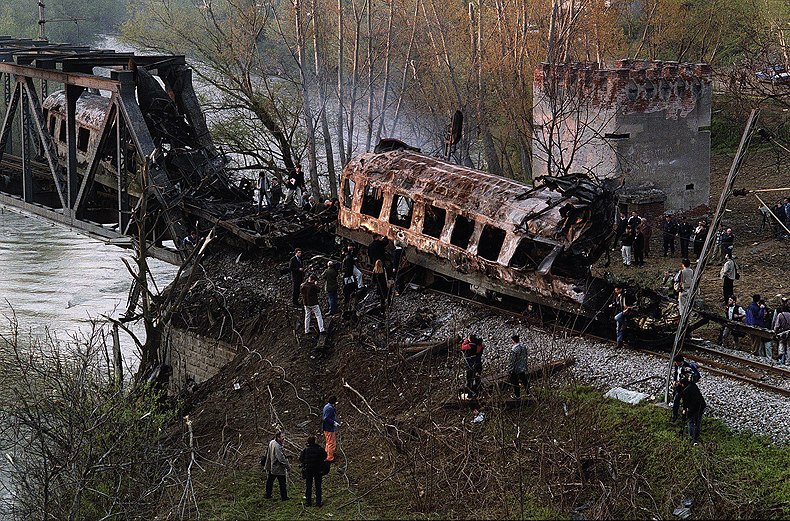
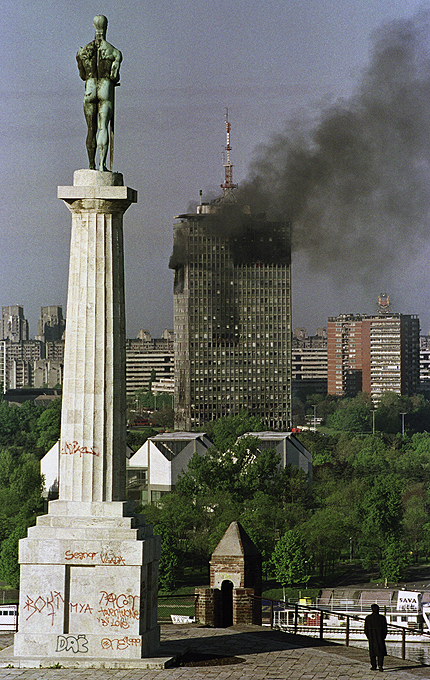
At dusk on March 24, 1999, the streets were deserted in Belgrade, Novi Sad, Nis, Kragujevac, towns and villages. Citizens were intently watching television, and soldiers were watching radar screens. The radar operators took their breath away: there was not a single plane in the sky above Serbia. A few hours later, they won't be able to count them. Around twenty o'clock on March 24, 1999, the first cruise missiles and guided bombs exploded. Soon, the siren of general danger was heard throughout Serbia - later called the shizela. NATO's intervention in FR Yugoslavia has just begun.
At the military airport in Niš, two pilots of the Fighter Aviation of the Yugoslav Army, Dragan Ilić and Ilja Arizanov, sat in their MIG 29s on standby number one. They were waiting for the order from the command to take off. From the cockpit quite far from the air traffic control, Ilić saw with astonishment Arizanov's plane taking off because he was the one who was supposed to take off first. The reason for the change in sequence was extremely banal: the device for connecting to the control was broken. Soon, a technician from the operations center ran to Ilic with the order to take off. Both pilots, on planes that had to undergo a general overhaul back in 1996, went on a combat mission. Among other things, Ilić's MIG did not have a radar, and Arizanov's had a device that warns the pilot if he is in the crosshairs of the enemy.
Both Yugoslav pilots were soon hit. Ilić managed to land the damaged MIG at Niš airport. Arizanov was forced to jump out and parachuted down somewhere in the area of Drenica, which was controlled by the Kosovo Liberation Army. Moving at night and hiding in the woods during the day, Arizanov managed to reach the military airport in Pristina after several days.
Regardless of their courage and determination, members of the Yugoslav Army had no chance in the conflict with NATO.
THE WAY TO WAR: In Kosovo, years before the NATO intervention, people lived in two parallel states that did not recognize each other. The first state was Serbian, and the second was Albanian. Tension between the two national communities reigned permanently. All institutions were parallel: from the president of the Republic to the president of the local community; from the tax administration to primary and higher education.
The then president of the Federal Republic of Yugoslavia, Slobodan Milošević, owed his political rise to the frustration of the Serbian public at the end of the 1989s due to Albanian domination in Kosovo. As president of Serbia, Milošević centralized the state in 1990. Fierce Albanian protests and demonstrations after the abolition of Kosovo's autonomy were crushed by police force. Albanian political leaders retaliated by boycotting the Serbian state. Their leader was Ibrahim Rugova, writer and leader of the Democratic Union of Kosovo. Since XNUMX, he has been the president of the Republic of Kosovo, which was proclaimed a year earlier by the Albanian part of the dissolved provincial assembly.
Although Rugova had only a nominal function, he united the Albanian political parties. Proverbially divided, they all had the same goal - secession from Serbia and the independence of Kosovo.
There was no contact between the Serbian authorities and the Albanian parties for a long time. However, when the war in Bosnia and Herzegovina ended with the Dayton Agreement, the international community's interest in the situation in Kosovo was renewed. It was clear to everyone that status quo won't last much longer.
In the fall of 1997, Albanian students began demonstrations. They demanded that they be allowed to take over the faculty and study outside the Serbian system. The MUP of Serbia brutally broke up the demonstrations. It was at that moment that Rugova's authority suffered the biggest blow: organized and financed by the Albanian political emigration, a previously unknown paramilitary formation, the Kosovo Liberation Army, appeared on the scene. Armed with automatic weapons and trombone mines, members of this paramilitary formation began in the fall of '97. a series of coordinated attacks on patrols and police outposts. Albanians who cooperated in any way with the Serbian state were also targeted by the KLA.
Two policemen were killed and four wounded in an ambush near Srbica in Drenica at the end of January 1998. The attackers were led by Adem Jašari from nearby Donji Prekaz. When the police pursuit reached the house of Adem Jašari and his large family, there was an exchange of fire for several hours in which both sides were injured. The police eventually retreated, and Adem Jašari and his brothers became overnight heroes of the Albanian struggle for independence.
A month after the skirmish in Donji Prekaz, Jašari's KLA group from Drenica attacked again. In an ambush near the village of Likošane, at the end of February 1998, four policemen were killed and two were wounded.
The police went in pursuit again: five members of the KLA, as well as at least fourteen civilians in the village of Likošane, were killed in the shooting and clearing of the area.
Funerals were still going on in Albanian villages when on March 3, 1998, strong police units surrounded the houses of the Jašari family. This time retreat was out of the question. The police claimed that they had called on the besieged to surrender, and that the women and children had been given a deadline to leave the ring. When that deadline expired, an attack followed in which mortars and heavy machine guns were used. Among the fifty-six killed in this conflict were Adem Jašari and his brother Hamza, other members of the KLA, but also children, women and the elderly. If it may not have had it before, the KLA gained massive support from the Albanian population after this action by the MUP of Serbia.
Due to the consequences of this police action, ambassadors accredited in Belgrade visited Donje Prekaze, and the United States of America and the European Union accused the Serbian authorities of excessive use of force.
Milošević resolutely refused all international requests for mediation in the Kosovo crisis. After a cheap demagogic campaign, he confirmed his decision in a referendum in April 1998.
Few took the referendum seriously in Serbia, and even less in the international community. While the Albanian armed uprising was spreading across Kosovo, financial sanctions were tightened against the Federal Republic of Yugoslavia. At the same time, some American and European journalists began to openly advocate NATO's intervention against Serbia.
A year before the bombing, it seemed that the Federal Republic of Yugoslavia would find itself in total isolation, and when it comes to Kosovo, nobody will be taken care of.
And then, on Milosevic's side, his old partner from the Dayton negotiations - Richard Holbrook - sat down again. The special envoy of American President Bill Clinton demanded that Kosovo receive at least the status of a federal unit within the Federal Republic of Yugoslavia. For Milošević, it was too big a concession, and for the Albanian leaders too little gain. Nevertheless, after Holbrook's pressure, the Yugoslav president met with Ibrahim Rugova for the first time. The meeting ended without any results.
Results in the spring of '98. it only had the KLA: there were more and more members of this paramilitary formation and they were more and more active. Almost all of the weapons at their disposal came from Albania. There, after the collapse of the pyramid savings banks in the summer of 1996, the state literally fell apart. At least six hundred thousand different firearms were taken from military warehouses and barracks. Since the fall of 97, the KLA has been systematically transporting these weapons over the difficult-to-pass mountains on the Yugoslav-Albanian border.
In the early summer of '98, about twenty-five thousand members of the KLA had already taken the oath. They controlled not only the places where there were no Serbian authorities for decades, but also the settlements from which the police were forced to evacuate the outposts.
The KLA spread throughout the rural areas of Kosovo. Entering and leaving those villages, and even going for a medical examination, was only possible with the permission of the local commanders. From the settlements where it operated, the KLA attacked communications in an effort to stop traffic and thus cause a general paralysis of Kosovo. In return, the police set up numerous strongholds and checkpoints on all important roads. Police officers and their vehicles thus became the target of daily attacks.
In June '98. The KLA surrounded certain Serbian enclaves. It was particularly dramatic in Dečani, on the Peć-Đakovica road. For days, this small town was surrounded, without electricity or telephone connections, crowded with refugees from the surrounding Serbian villages... It seemed that it was only a matter of days before the KLA would take over the enclave.
The unblocking of Dečan and the control of the Peć-Đakovica road began in June 98. For the first time, along with the police, the Yugoslav Army participated in the fighting in the interior of Kosovo.
During the heavy fighting over Decani, the United States of America and the European Union accused the Serbian authorities of war crimes, ethnic cleansing and humanitarian disaster in Kosovo. According to the estimation of the United Nations, there were at least sixty-five thousand Albanians who had fled.
It was during this period that the foundations of the bombing of the Federal Republic of Yugoslavia, which would last seventy-eight days, were laid. Claiming that a humanitarian disaster would occur in Kosovo, NATO deployed its first units in Albania and Macedonia along the Yugoslav border. At the same time, the Contact Group for Kosovo, composed of major powers, demanded that Belgrade allow the return of refugees and the withdrawal of special units to Serbia. The Contact Group did not pay attention to the increasingly strong KLA attacks.
Almost in desperation, Milošević begged Russian President Boris Yeltsin for support. After their meeting on June 16, 1998, it turned out that Serbia has no ally worthy of attention. In the Kremlin, Milošević accepted almost all the demands of the Contact Group - from the withdrawal of the police and the return of refugees to the unhindered movement of Western diplomats in Kosovo.
Even while Milošević was flying to Moscow, NATO materialized the threat of intervention: eighty-six planes from thirteen members of the alliance carried out a large air maneuver called "Decided Eagle" over Macedonia and Albania.
A day later, the Yugoslav Army responded with an air show at the airport in Batajnica. In March 1999, in less than nine months, most of these pilots met over Serbia: a squadron of twenty-nine Yugoslavian MIGs, ready for overhaul in '96, flew against at least six hundred NATO fighters.
At the same time, while demanding that Serbia withdraw its police from the province, American diplomats met with KLA commanders. First, the American mediator for Kosovo, Robert Gelbard in Switzerland, and then Holbrook himself, 2l. June 1998 in the village of Junik.
Surrounded by American support, in mid-July '98, the KLA commanders planned to occupy at least one major city in Kosovo in order to impose themselves as the only legitimate Albanian representatives. Their target was Orahovac, where there was neither a garrison of the Yugoslav Army nor a stronger police unit. After two days of fighting, the combined forces of the Army and the police managed to take control of Orahovec. The attack on this small town was a line that the KLA was obviously not allowed to cross. Soon, all his strongholds were attacked by a general offensive by the Serbian security forces and the Yugoslav Army.
The civilian population retreated in front of the police together with the KLA. UNHCR announced that during the summer of 1998, the number of Albanian refugees rose to more than two hundred thousand, of which at least fifty thousand were hiding in the forests.
Wanting to take advantage of the success of the offensive and reduce international pressure, Milošević tried to initiate any negotiations. Negotiators from Belgrade sat in Pristina for days, even though they were boycotted by all Albanian parties.
Citing the victims of the conflict between the police and the KLA, the Albanian leaders refused any dialogue with the Serbian authorities. They convinced the international community in every way that Belgrade understands only the language of force and that there will be no peace in Kosovo as long as the Army and the police are present there.
In order to provoke the police to violent actions with civilian victims, the KLA stopped at nothing. At the very least - to cause fierce conflicts in previously peaceful places.
In the same way, the police also discovered the crimes of the KLA. At Radonjić Lake, its members killed at least thirty people - Serbs, Albanians and Roma. In the village of Klečka, the KLA executed twenty-two people, including women and children, after abuse. The bodies of these victims were then burned in a lime kiln.
And yet, due to NATO's pressure and threats of military intervention, part of the police actually withdrew from Kosovo. That withdrawal was presented in the regime media as a complete victory.
Indeed, the KLA in September '98. was in a mess. However, no political solution to the status of Kosovo was in sight, and sporadic fights and skirmishes continued.
In mid-September '98, it seemed that whatever Milošević did - short of admitting defeat and withdrawing the army and police from Kosovo - would not prevent the intervention. All his assurances that he was ready for negotiations and that the police were withdrawing were just false promises for Clinton and British Prime Minister Tony Blair. When the United Nations Security Council condemned Belgrade for the indiscriminate and excessive use of force, the NATO High Command announced that plans for intervention were over. All she needed was a political decision to start airstrikes.
For the first time after World War II, on October 1, 1998, a state of imminent war was declared in the Federal Republic of Yugoslavia: diplomats left Belgrade, warning sirens were tested, the Supreme Defense Council announced that the country would defend itself by all means, and television broadcasted patriotic videos.
In order to calm the war psychosis and strengthen the morale of the population, Milošević behaved in a very strange and unusual way: he received children from the Joy of Europe festival in the Federation Palace.
The peak of the crisis came when US Secretary of State Madeleine Albright and NATO announced that the bombing was only a matter of days...
And then Richard Holbrook sat down on Milošević's couch again. After several days of negotiations behind closed doors - known in Serbia as holbrooking - an agreement was reached. On the basis of the Agreement reached by Milosevic and Holbrook, a ceasefire was declared in Kosovo. Part of the Serbian security forces had to withdraw, and NATO gained the right to aerial surveillance of the province. To control what was agreed, two thousand six hundred OSCE observers, known as verifiers, were deployed in Kosovo. They were headed by American diplomat Christopher Walker.
The KLA immediately took advantage of the truce and the withdrawal of the police and the army and began to reorganize: at the beginning of the winter of '98, the KLA re-established the bases from which it was expelled in the summer. In the winter of 1998 and 1999, the KLA carried out a series of terrorist attacks in the cities of Kosovo. Bombs, assassinations and kidnappings became everyday. After a series of murders in Kosovska Mitrovica, strong police forces surrounded the KLA base in the village of Racak. The fierce conflict took place on January 15, 1999. The head of the OSCE verification mission, Christopher Walker, immediately announced, without any investigation, that the forty killed Albanians were civilians, victims of the massacre, and not members of the KLA as claimed by the police. Although Belgrade demanded an international investigation, plans for intervention were reactivated.
The United States of America and NATO gave Milosevic an ultimatum: either accept the Contact Group's plan for the status of Kosovo or bombardment.
The negotiations at which the Serbian and Albanian sides were supposed to agree on solutions from the Contact Group plan began on February 6, 1999 in Rambouillet.
The Albanian delegation, in addition to Rugova and other politicians, also included KLA commanders such as Hashim Thaci.
The Serbian negotiating team was composed of unknown representatives of various nationalities from Kosovo - Egyptians, Goranians, Ashkali and others. The delegation was headed by Milan Milutinović, President of Serbia.
During the negotiations, NATO Secretary General Javier Solana had a free hand to order intervention as soon as he judged that the negotiations had failed. The Alliance was not interested in the approval of the United Nations Security Council.
The Contact Group's plan for the status of Kosovo was the diplomatic brainchild of US Secretary of State Madeleine Albright. For the Kosovar Albanians, autonomy bordering on independence was foreseen, with the condition that in three years, after the referendum, the status of Kosovo would be definitively determined at a new conference.
The contact group demanded that Serbia - with the exception of symbolic contingents - withdraw its entire army and police. Kosovo would then become a protectorate protected by twenty-eight thousand NATO soldiers.
The Albanian delegation barely accepted the Contact Group plan under American pressure. Negotiators from Serbia refused to sign the final agreement in Rambouillet.
The key reason for rejecting the Agreement was the deployment of NATO soldiers, the same ones who will arrive in Kosovo after two and a half months of bombing.
While the NATO pilots were receiving the coordinates of the targets in Serbia, Richard Holbrooke sat down on Milošević's couch for the last time. The last time he tried to convince the President of the Federal Republic of Yugoslavia to accept the Rambouillet Agreement. For the first time, he returned from Belgrade with unfinished business.
RAT: From March 24 to June 11, 1999, waves of hundreds of NATO aircraft alternated over the Federal Republic of Yugoslavia. The opponent of the most powerful military alliance in history was a small army, with poor and outdated equipment. Nevertheless, it also achieved certain successes: in the atar of the village of Budžanovci, an F117A stealth aircraft, called invisible due to its extremely low radar reflection, was shot down for the first time, and in addition to several cruise missiles and unmanned aerial vehicles, an American F16 fighter-bomber was also shot down. Radarmen, rocketmen and gunners were constantly on the move and constantly changing positions. Together with members of the ground army, they showed enviable creativity in camouflaging and deceiving the enemy.
The Yugoslav Army proved to be a tough opponent of NATO. Air strikes on its units and facilities did not bring results. NATO thus celebrated its fiftieth anniversary at the beginning of April '99, and the intervention, which was expected to be short, could not be seen to end. From that moment on, infrastructural objects became the target of cruise missiles and bombs.
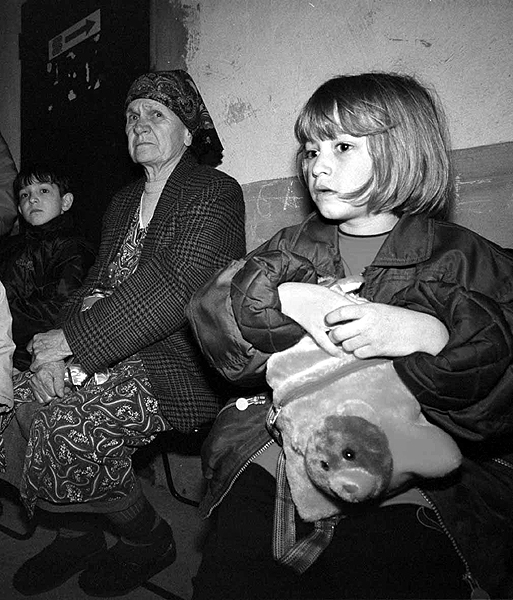
A large number of Serbian citizens, especially those who lived next to barracks and state institutions, spent nights and days in shelters. There they anxiously followed the news about the targets of the NATO attack and guessed what was next. Because, after the destruction of the embassy of the People's Republic of China, it seemed that no rules apply.
Cities in Serbia are bombed day after day, night after night. However, from the very beginning of the intervention, the heaviest and most intensive airstrikes were carried out by NATO in Kosovo. As soon as the bombing began, the Yugoslav Army and the police launched a major offensive against the units and bases of the Kosovo Liberation Army: their bases fell one after the other.
While NATO bombed villages and towns, and the police and army fought with the KLA, the Albanian population left Kosovo in large numbers. It is indisputable that a large part of Albanian civilians in '99. escaped from Kosovo due to bombing and fighting. But it is also undeniable that a huge part was forcibly expelled. It is also indisputable that the Serbian security forces committed war crimes, for which the trials are still ongoing, and the entire top of the VJ and MUP of Serbia were sentenced to multi-year sentences before the Hague Tribunal.
While the bombing continued, the Yugoslav Army was also preparing for a conflict with NATO troops on the ground. It was expected that one of the main lines of ground intervention would come from Albania. Behind the minefields on the border with Albania, large forces of the Yugoslav Army were deployed and fortified.
As a NATO ally, the Kosovo Liberation Army is reorganized and well armed in Albania. Its goal was to break through the positions of the Yugoslav Army and occupy as much of Kosovo as possible. A few weeks after the start of the bombing, large forces of the KLA, including Albanians from Albania, gathered at the border with the Federal Republic of Yugoslavia.
Fighting soon began: KLA attacks on the ground were followed by NATO aircraft support. Members of the Sixty-third Parachute Brigade of the Yugoslav Army were deployed on the most threatened part of the border - between the Košara and Morin checkpoints.
During their entire stay at the border, there were fights with the KLA, which could not compete with the elite unit of the Yugoslav Army.
NATO tried to compensate for the lack of discipline and military skills of the members of the Kosovo Liberation Army with constant airstrikes.
At the end of May 1999, the KLA launched an offensive on Mount Pastrik with large forces on a front six kilometers wide. The offensive was broken, and the few lost square kilometers of territory of the Federal Republic of Yugoslavia were soon returned. This attack by the KLA - like almost all the previous ones - was followed by carpet bombing from NATO strategic bombers.
Paratroopers and members of the Pristina Corps of the Yugoslav Army remembered one type of aircraft in particular. It is about the American plane A10, nicknamed "tank killer", which fires grenades with depleted uranium. In Kosovo '99, the A10 was used mainly for attacks on infantry positions.
While the Army firmly held the border, Milošević was finalizing the negotiations that were supposed to end the intervention. Representatives of the Yugoslav Army and NATO began talks in Kumanovo at the beginning of June. Bombardment from strategic bombers, however, did not stop even when the signing of the armistice was only a matter of time.
When the Kumanovo Agreement was signed on June 11 and the NATO intervention ended, there was only one bridge on the Danube; in Belgrade, Novi Sad, Kragujevac, Pristina, Prizren and other cities, factory halls and houses were smoldering, and from Kosovo, together with the withdrawal of the Army, the Serbian population went into exile. The price of miscalculations and even worse decisions by all parties in this war was paid.