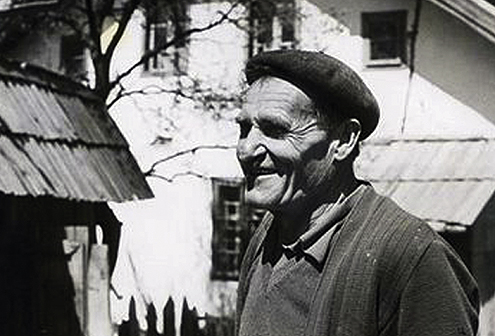
Facts: He was born in Trtorići, a village near Breza, Bosnia and Herzegovina. The exact date of birth is not known. He spent his whole life in his native village, and his working life in the brown coal mine "Breza", in which, on July 24, 1949, in Pit 1 known as the Traveler's Trench, with his eight cameras, in one eight-hour shift dug 158 tons of coal - 253 mine wagons, which exceeded the brigade norm of 215 tons for a shift by 50 percent and broke the previous record of Alexei Stakhanov from 1936 - 102 tons of coal, which was dug in 5 hours and 45 minutes. . Because of this feat, Alija was awarded the fourth most important order in the FNRJ/SFRJ - Hero of Socialist Labor. The press wrote widely and at length about this feat, and over time many legends were spun about Aliya, which, like most legends, are only partly true, and some are absolutely false, such as the one about the size of the shovel he worked with, about what he said Titu, on which banknote is his image... The highlight is the claim that Andrzej Wajda, inspired by his feat, made a film The marble man.
Order: Modeled on the Soviet Hero of Socialist Labor award, the Hero of Socialist Labor Order was established on December 8, 1948, and until 1986, when it was abolished, 114 persons were awarded it. The order was made of gold and silver, initially decorated with real, later artificial rubies.
Sirotanovićka: Allegedly, especially for that occasion, because breaking the record was agreed the day before with the management of the mine, he forged himself a shovel with which he could scoop up 50 kilograms of coal in one go. However, Alija didn't even work with a shovel, he was a digger and his tool was a pneumatic drill, and he worked with two at the same time, while they were shoveling cameras. Legend or not, only for a big shovel, because shovels come in different sizes, in Bosnia they say "sirotanovićka".
Tito: Again, allegedly, Tito once, possibly when he was presented with the Hero of Socialist Labor Order, asked Ali if he needed anything, and he laconically replied "a bigger shovel", so Tito, as it were, ordered that big shovel be forged for him. According to another legend, to the same question from Tito, he said: "It's not for me to ask, Comrade Tito, because I'm a miner, but I'm not asking for myself... If only a little electricity could be brought to my village Trtoriće." They say that electricity arrived in his village before he returned from Belgrade. They also say that sometime in the seventies he was at a reception again and that Tito offered him a "car of his choice" as a gift. Alijah, they say, chose "fica".
See more, even more: Only four days after Alija set the record, it was surpassed by his colleague from the same mine, Nikola Škobić, also a holder of the Hero of Socialist Labor Order, who with his brigade dug 14 tons more than Alija. This started a series of breaking records in Yugoslavia - Ibrahim Trako on August 17, 1949 with 270 tons in Zenica and on the same day Risto Mijatović with 354 tons in Kakanj, the next day, again in Kakanj, Džemal Ramović excavated 442 tons, then Abdurahman Babajić On September 10 of the same year, as many as 1010 tons in the "Banovići" mine.
The image on the banknote: No, Alija Sirotanović is not a smiling worker on the former 1000 banknote, and after the 1965 denomination of 10 dinars. On this banknote is Arif Heralić, a worker at the Zenica Ironworks. Arif was not a hitman, and his character, "taken" from a documentary film about the Ironworks, found itself on the biggest banknote at the time thanks to his charming smile. Alija Sirotanović is a miner on the 20.000 dinar banknote, which was put into circulation in 1987 and withdrawn in the monetary reform of Anto Marković.
Voivodeship: No, Andrzej Wajda did not make a film The marble man inspired by Alija Sirotanović, but Mateusz Birkut, Polish Stakhanovite and holder of the Hero of Socialist Labor order. He was not a miner, but a mason, and he earned the order in 1952, after he and five assistants laid 30.000 bricks in one shift, thus achieving a world record, which he later surpassed several times.
Fates: Andrey Stakhanov, after setting his record, was sent to study in Moscow, after finishing school he worked in the Ministry of Industry of the USSR, then he directed several mines. From 1957 until his retirement in 1974, he worked as a manager (director or engineer) in state mines, and was also a deputy of the Supreme Soviet of the USSR. He spent his retirement days at a neuropsychiatric clinic, died on November 5, 1977, and the following year the city of Kadijevka, where he began his working career, was named after him - Stakhanov.
Alija spent his entire working life in the same status - miner-brigadier, he retired in the mid-seventies. Although at that time miners' wages were significantly higher than workers' wages, his pension was modest. The "comrades" remembered him in the mid-eighties, so at the time when his image was "struck" on the "two-hundred-pounder", they awarded him the AVNOJ award, which "pulled" the national pension, and in front of the entrance to the administration building of the "Breza" mine his bust was placed. It is not known whether the national pension reached him. He died on May 13, 1990, just before the death of Yugoslavia.
What is happening in the country and the world, what is in the newspapers and how to pass the time?
Every Wednesday at noon In between arrives by email. It's a pretty solid newsletter, so sign up!
Why is there nothing else between the overcome regime and the changes? What does the regime mean when it says it is defending Serbia? Why is the Student Movement indomitable? Who has the knowledge and real experience, and who leads without a day of work experience outside of politics? And why students win
Elections 2026: From student revolt to decision at the polls
After almost two years of protests, hundreds of kilometers walked, arrests, persecution and unprecedented social mobilization, Serbia is holding elections that could mark the end of a political era. Sociologist Marija Babović tells "Vreme" that the hope for change has not been so great since October 5, 2000, but she also warns of the danger that, if changes are not made, the country will face an even tougher authoritarian regime.
Interview: Tihomir Stanić, actor on the Student list
Their only weapon now is the media they control: like, we don't have an agenda, which is not true; as, we will betray the national interest, which is not true. One of their arguments is that we are afraid to go to the debate with Vučić. They do not understand that it is their punishment. This is a punishment for Aleksandar Vučić, who for 14 years conducted exclusively a monologue. For fourteen years he did not allow anyone any kind of dialogue, and now he would like to be rewarded or pardoned with the opportunity to talk to us. Well, he won't be able to. What he sowed is now reaping
These elections are not elections about Serbia's membership in the European Union, Kosovo and Metohija, gay marriage, tax policy or any other single political issue. Although parties on the fringes of political power try to impose these themes, at the heart of the upcoming political election is a much simpler dilemma: change or preserve the existing order. For more than a year now, surveys have shown that this is the primary dilemma on the ballot
In the RS, 19.800 people registered for the elections in Serbia, who will be able to vote at 28 polling stations. It remains unknown how many of them will cross the Drina on October 25 and vote in Serbia. In any case, I do not believe that the voters from Republika Srpska are the ones who will decide the winner of the elections in Serbia. Realistically, the voters from Republika Srpska can influence a little, but it seems that they are symbolically very important to both Vučić and the opposition.
There is, literally, no difference between the one who claims it is day in the middle of the night, or the one who claims to be a giraffe, from the claims we read on billboards: that Vučić is working to unify Serbs and that Serbia is doing better and better day by day.
The pre-election arrests due to the alleged "overthrow of the state" testify to the regime's panic. The bad news for them is - they can't arrest the whole people who decided to defend themselves from progressive beatings and election theft
The ring that tightens around Ćaciland Student list is getting narrower. Because there are more and more spoiled people who see the false prophet for what he is: a street obscener who is fighting Serbia
The archive of the weekly Vreme includes all our digital editions, since the very beginning of our work. All issues can be downloaded in PDF format, by purchasing the digital edition, or you can read all available texts from the selected issue.