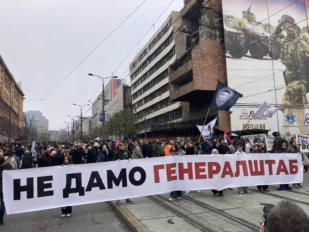
These days, the public is increasingly talking about the possibility of calling parliamentary elections in Serbia, which would lead the country out of the existing political crisis and prevent an economic crisis, which is inevitable in case of perpetuation and deepening of the political crisis. Elections will most likely be called, but it is still uncertain what they will be. Are they the ones where the citizens will choose their representatives in the National Assembly freely, of their own free will and without any manipulations, or those that will only serve to ensure that Aleksandar Vućić gets a new set of cooperative ministers? The latter, which Vučić himself is opting for, would undoubtedly deepen the existing political crisis and would not rule out any scenario, not even the worst - open tyranny.
Nevertheless, if, under the pressure of the European Commission, elections were organized in which voters in Serbia would after many years get a chance to really choose a new parliamentary convocation with democratic legitimacy, the decisive battle at the polls would be fought between two social movements (political parties would be completely marginalized, and their independent appearance would only serve to undermine support for social movements). It's Vucic his (long-announced) movement has begun to form and, judging by the atavistic direction it has announced, there is no uncertainty about what it will look like. What is far more important is what the opposing movement will look like.
In this review, I will limit myself only to the possible name of that social movement, which should ensure its clear identity. In this regard, I think that it is necessary to return to the celebration of the Statehood Day of the Republic of Serbia, February 15, 2025, when, on a symbolic level, in two "meeting" places - in Kragujevac, as common sense dictated, and in Sremska Mitrovica, as dictated by the proximity of Banja Luka and the distance of Kosovska Mitrovica - the upcoming election conflict was already configured. From there, it seems to me, the name of the social movement that should oppose Vučić's autocracy is imposed by itself: Constitutional Defenders Movement. I will cite four very specific reasons that speak in favor of that.
A tradition of resistance to autocracy
First, every elementary-educated citizen of the Republic of Serbia knows that the defenders of the constitution were a group of politicians who managed to obtain the (so-called Turkish) constitution with the longest duration (1838–1869) in the entire constitutional history of Serbia and to force Miloš Obrenović, unable and unwilling to rule in accordance with that constitution, to abdicate and emigrate (1839).
Another, at a political gathering in Sremska Mitrovica, Vučić had the "people" shout him as the leader in the upcoming battle to preserve the unity of the Serbian people. Such a tribal ideological matrix, which derives its political strength from the tradition of the First Serbian Uprising, can be most effectively opposed by an opposing tradition that links the beginning of resistance to the autocracy of Miloš Obrenović already to the Sretenjski Constitution, the adoption of which is celebrated as the current Statehood Day of the Republic of Serbia.
Third, the construction of a "constitution" of government that, like a torrent of a river, strives for autonomy, is the best possible description of what unites today all opponents of the Vučić regime. After numerous restorations of self-government in the 19th and 20th centuries (from Miloš Obrenović to Slobodan Milošević), Serbia in the 21st faces the same task that its first defenders of the constitution faced. That is why it is completely justified that their successful struggle should be followed up by the struggle of modern defenders of institutions.
Fourth, considering that the constitution is both a political and a legal act, the defense of the constitution also includes a review of the conformity of constitutional norms with political reality. If citizens today, in the 21st century, aspire to democracy and equality before the law, but live in a political reality in which this is denied to them, these same citizens have the right to review the constitutional norms and change them so that the political reality conforms to their expectations.
This indicates a departure from the tradition of constitutional defenders in Serbia, which in the end failed to prevent the return of Miloš Obrenović to the throne. We must learn from historical mistakes, and Serbia no longer has time to repeat them.
The author is a professor at the University of Belgrade