This time the operation was cleverly packaged and executed quickly and efficiently. Operational security was tight and nobody was any the wiser until the moment the helicopter left the airspace of FR Yugoslavia. It has been shown that the Government, the police and the judiciary can do it - when they want to. From the moment the decision was made to landing in the courtyard of the prison in Scheveningen, about six hours passed; just how long does the journey take...
Everything was complicated by the fact that the Donor Conference was already scheduled for June 29, so the doubters had a time frame in which to act. Truth be told, DOS did try to please everyone on time, which - as is known - is impossible. Until the last moment, there was hope that the Socialist People's Party (SNP) would still vote for the Bill on Cooperation with the Tribunal in the Federal Assembly. If they had voted, the whole extradition story would have been extended until autumn, considering all possible constitutional and other appeals, foreseen legal remedies, etc., i.e. everything that was included in the Draft Law, the adoption of which was initiated by the President of the FR Yugoslavia, Vojislav Koštunica. This is how it turned out that the SNP practically voted for the immediate extradition of Slobodan Milošević, all in patriotic fervor which - as is known - greatly reduces the ability to make correct political assessments. And the correct political assessment was that the DOS decided to cooperate with The Hague - no matter what, and that the federal law is the most it is willing to give in to. It seems that the SNP believed that the further fate of Serbia does not concern them much anyway, so they can be greater Serbs than Serbs, and at the expense of Serbia; at home they have to protect the voting body anyway, so since they protect it at someone else's expense, it is easy for them to vote against it. It is indicative that President Koštunica ignored the request of the DOS to personally address the federal assembly and use his authority to eventually lead the SNP to pass the law. Such a possibility existed, as soon as there was a clamor for a public vote... In any case, it seems that the SNP missed perhaps the last chance to save Zabljak's Yugoslavia by voting for that law.
Then the federal government, with the DOS majority of ministers, voted the Regulation on cooperation with the Tribunal, as a lesser evil, but also as a last concession, which the SNP may have understood, but the Federal Constitutional Court did not. That sad establishment, the rest former regime and the oversight of the October 5 coup, alone on the edge of legality, and on the other side of all legitimacy, barely waited for its moment. Whether that team of Milosevic's clients was aware of what led to the decision to suspend the decree of the federal government and review its constitutionality is not known. They had nothing to lose anyway... Some think that the Federal Constitutional Court acted spontaneously, in the instinctive, desperate hope of protecting Slobodan Milošević's interests; some others doubt that the judges of the Federal Constitutional Court knew what they were doing.
Well, that's when it started.
MATCHING: The decision of the Federal Constitutional Court, correctly understood as a sabotage of the consensual political will of DOS, was the trigger that only detonated the already prepared alternative plans of the ruling coalition in Serbia. Đinđić scheduled the cabinet meeting for 15:30 p.m., then postponed it to 16:00 p.m. at the request of Obren Joksimović (DSS), who "had already agreed commitments". It is not known what obligations, but he later voted against. At a strictly closed session, the Government decided by a vote of ministers present and absent (23:1) to directly apply the Statute of the Hague Tribunal (Article 29, paragraph 2), in connection with Article 135 of the Constitution of Serbia and Article 16 of the Constitution of Yugoslavia. The DOS ministers from the federal government also agree with that decision. Trusted people from the police, State Security and Judiciary receive a message with the keyword; it is very possible that the Yugoslav Army also received a message. Afterwards, there will be an argument between Kostunica and Djindjic: Kostunica claims that he was not informed of the decision until it was too late; Đinđić directs him to Obren Joksimović, who was present, although he is now leaving. Be that as it may, Đinđić's message reads: "Vojo, you knew and don't get out now; it's too late and it won't help you." Kostunica was not convincing in his denials, and it didn't help him either: radicals and socialists unanimously called him a "traitor" at the protests. No wonder: he gave them false hopes all the time, from the "ninth hole on the pipe", to the months-long "I will-I won't" and "I should-I shouldn't".
In practice, the matter went much easier and faster than during negotiations. The Government of Serbia drew the public's attention to itself, and from the Central Prison, with its secret session. A small amount of the "usual suspects" hung around the prison: journalists, guardians of Milošević's image and work, curious people and strong young people with earphones in their ears. Anticipating new "days of my solitude", Mira Marković drove several times around the Central Prison in a dark blue BMW with dark windows. At that time, the warden of the Central Prison was already in Slobodan Milošević's cell and was preparing his departure. Now he had to be taken out unnoticed.
The Government of Serbia decided on a "matchmaking" tactic: the traffic of various vehicles and "cars" in and out of the prison lasted all afternoon, so that the observers' attention wore off after a while. In each "car" with white, civilian plates, two prison guards sat in the front, for some good will. It was not possible to look into the "maric", nor is it considered a desirable behavior. In the general rhythm of that traffic, there was also a "Marica" who, after exiting, continued towards the outskirts of Belgrade, certainly with a discreet escort of civilian vehicles, because the passenger was too precious.
FLYING I LANDING: "Marica" went to the complex of the Police Academy and the Security Institute in Banjica, where two helicopters - Bell 212 and Gazelle - were waiting. Officials of the Hague Tribunal were also there. After leaving the "marica", Slobodan Milošević, accompanied by prison guards who also carried his luggage, came to the Bell 212 helicopter, where he was read his rights. At that moment, he became a detainee of the Tribunal in terms of Articles 55 and 58 of the Statute. After boarding, the helicopter took off and headed towards Zivinice airport near Tuzla, the SFOR base in Bosnia and Herzegovina. It was 18:30 local time.
It can be assumed that the helicopter with Slobodan Milošević did not fly in a straight line to Tuzla, because the goal was to leave the Yugoslav airspace as soon as possible, until "Vlaji takes off". The probable route would be via Srem to the north of Bijeljina, then southwest to Tuzla. A NATO plane, probably a C-130 Hercules, was already waiting on the runway in Živinice, because it took a long time to get to the Netherlands and because such planes are normally used for such jobs. The C-130 landed at Falkenburg Air Force Base in the Netherlands around midnight. By then, the news had already spread around the world, so the Dutch police had their hands full: thousands of journalists and curious people, as well as some of Milosevic's supporters, gathered around the Hague Tribunal building and the Scheveningen prison. According to the report of Vremen's collaborators from the scene, the Dutch acted similarly to the Serbian authorities: they played different voices about where Milosevic was coming from, created confusion, pushed journalists and the crowd away from the tribunal and prison; they even closed a highway, diverting attention in the wrong direction. In all that excitement and nervousness, three police helicopters flew over the prison in Scheveningen at 00:30; two made a circle and flew on, and one MBB Bo-105 landed in the yard where the sports fields are. The "Vremena" associate from the scene says that earlier, during the afternoon, firefighters came to the prison and cut off tall metal pillars in the yard with grinders; those pillars served precisely as protection against the landing of helicopters in the event of escape attempts or the abduction of prisoners. One man came from the prison building, and from the helicopter two people took Slobodan Milošević in handcuffs and took him across the sports field to the building. The scene was - by chance - recorded by only one man, one Eric Stigman, who lives in the immediate vicinity, on a high place. With a home-made but high-quality VHS video camera, he took a really good shot - considering the darkness and the distance. He sold the footage to the TV station NOS from Hilversum, and donated the money to a humanitarian endowment. So Slobodan Milošević, after exactly twelve years on Vidovdan, fell from the sky again, but not to Gazimestan, but to the prison yard.
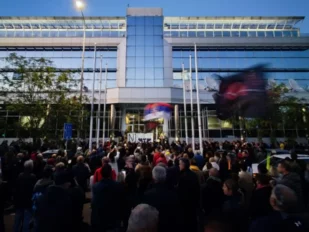
The news had already spread in Serbia before evening. A fight broke out between the socialists and the radicals, although DSS didn't care either. While the National-Socialist option screamed at "kidnapping", "lawlessness" and "treason", all mentioning Karađorđe, Branković and other mythological heroes, invoking Vidovdan and the Holy Cross, the "legalists" hit on fiscal argumentation and "waving of the blown essence". (S. Winaver). In a public statement, Kostunica immediately raised his head to the sky and called the extradition of Milosevic a "serious threat to the constitutional order of the country", all referring to the decision of the same Federal Constitutional Court that challenged his victory on October 4, and then on October 6 admitted, without admitting anything - except for October 5 - it didn't happen. DOS, for its part, gritted its teeth and stood behind its own decision; the whole, down to the last functionary.
KO TO THE SECOND JAMU KOPA...: In defense of its decision, the Government of Serbia relied on certain constitutional and legal grounds that deserve attention. Namely, the Government refers to domestic constitutional provisions and - consequently, as the next logical step - to the Statute of the Tribunal in The Hague. What is it about? First of all, the Constitution of the Federal Republic of Yugoslavia from 1992 (Zabljački), a joint instant product of Slobodan Milošević, Momir Bulatović and Milo Đukanović, in Article 16 carelessly states that all international treaties, conventions, etc. automatically be considered an integral part of domestic legislation. From the fact (and the persistent claims of socialists during the sanctions) that Yugoslavia (former and present) is a founding and undisputed member of the United Nations, the Government of Serbia draws the conclusion that that country ipso facto obliged to implement the decisions of the UN. Since the federal state of Yugoslavia - in the form of its parliament, prime minister and the Constitutional Court - refused to fulfill those international obligations arising from its precious status as a member of the UN, the Government of Serbia violated Article 135 of the Constitution of Serbia. That 135th article of the Constitution of Serbia, which was passed by Slobodan Milošević in 1990 precisely in order to constitutionally and legally separate Serbia from SFR Yugoslavia and usurp a number of federal competences (from broadcasting to defense and foreign affairs; and more), says that Serbia will to ignore the decisions of federal authorities if it judges that they are detrimental to its national interests. That's how Slobodan Milošević himself fell into the hole he dug for others. Namely, the Government of Serbia decided - since the circumstances provided for in Art. 135 of the Constitution of Serbia - to apply Art. 16 of the Constitution of the Federal Republic of Yugoslavia and acts according to the Statute of the International Criminal Court for Crimes in the Territory of the Former Yugoslavia, otherwise known as the Hague Tribunal.
In art. 8 of the Statute of the Tribunal, territorial jurisdiction (ratio loci) refers to the "territory of the former SFRY", and the temporal jurisdiction (ratio temporis) to "the time starting from January 1, 1991." Article 29, paragraph 2 reads as follows: "States shall, without undue delay, comply with any request for assistance or order issued by a judicial panel, including but not limited to:…
- d) arrest or detention of a person;
- e) extradition or transfer of the accused to the international tribunal."
So he says, in art. 58: "Obligations described in Art. 29 of the Statute will have stronger legal strength from any provision of the national law or international extradition treaty of the respective country that could prevent the extradition or transfer of the accused" (italics ours).
The Government of Serbia relied, therefore, on the direct cause-and-effect logical sequence of its constitutional-legal argumentation ("if - then"). It is understood that this does not mean that there will be no legal disputes and arguments about this. In his latest novel, Single & Single, John le Carré says, “For lawyers, facts exist to be challenged. All the facts. The more obvious a fact appears to the layman, the more persistently a conscientious lawyer will challenge it." That's what lawyers do and that's why they exist.
ILI ON ILI MI: The political argumentation of both sides is more interesting. Zoran Đinđić and even more so Miroljub Labus were bluntly blunt: either this way or we failed completely; or Freedom to The Hague - or Serbia has no future; or extradition - or the isolation of Serbia and the return of the red-black dictatorship, add other DOS leaders. They presented really impressive (or scary) figures in support of their decision, and the general attitude of DOS is reduced to "a lot more of that Sloba; there he is; have you forgotten what he has been doing all these years; he is the past". The National Socialist option, of course, hit the fiddle and whining: Momo Kapor has an inkling that Đinđić will go blind like Karađorđe's godfather Vujic from Radovanja; clerofascists blow out candles upside down and throw anathemas; socialists and Marija Milošević whine and accuse Hungarians, Muslims, Cincars, Turks and others (Ivica Dačić) of this white man, revealing his true face (only accusations against Jews are missing, but the neo-Oljotić right wing around "Obraz", the newest ally, took care of that "the left"). Everyone suddenly remembered Vidovdan as if they had been celebrating it all their lives; The new emperor Lazar turned out to be Free, although he was forcibly dragged to The Hague instead of choosing the kingdom of heaven himself. During the public protests called in twos and threes, all kinds of things were shouted, death was demanded for Djindjic and other "traitors", and the beatings were drunk by journalists, which is a topic for a separate analysis. Radicals have completely taken over the few street noises that could be produced from the socialists and JUL, marginalizing the "left", whatever Ljubiša Ristić claims; and that is historical justice - they have a place there. The thesis that Milosevic is "the only head of state who has ever been extradited to someone else's court" has also been advanced; some remembered Bonaparte who, admittedly, was not tried, but was exiled to St. Helena by agreement of the Great Powers. In that sense, Milosevic fared better: he has years ahead of him to argue with Carlo del Ponte in The Hague. After Milosevic, the main loser in this mess is Vojislav Koštunica: Đinđić buried him by publishing the contents of the conversation before the decision itself ("Nedeljni Telegraf"). Đinđić: "Then what should I tell him (Vilje Montgomery, that is)?"; Kostunica: "Okay, don't do it like that. Let's not create a conflict." Đindjić: "Then what should I say to him - yes or no?". Kostunica: "Yes." In other words, nobody believes Kostunica anymore that the extradition of Milosevic took place without his knowledge and approval, even if it didn't, and if it didn't - it's his own fault.
On Tuesday, July 3, the day before July 4, Fighter's Day (will anyone remember that date?), Slobodan Milošević appeared before the court panel of the same Tribunal, angry, elegantly dressed and wearing a tricolor tie (like the flag of the SR Yugoslavia, but also the Netherlands, maybe Croatia). The court called it "false", the indictment also "false"; he refused to hire lawyers (hoping for a forum for political speeches) and in general behaved as if imitating Josip Broz in 1928 ("I recognize only the judgment of my party.") Everything he had to say was not intended for the court, but for Serbia (if not only Miri Marković). In short: they are judging him because he defeated NATO, so now that pact is being withdrawn. Judge Richard May, a horsey and awkward Englishman, was not impressed: he politely and mischievously explained to Milosevic that there would be enough time for political speeches, thank God, but whether he was found guilty of the indictment or not, if he was so kind as to now answer, because the procedure is like that, and would he like to hear the indictment. Milošević then said: "That's your problem!", in the best tradition of his pompous rhetoric ("You spit under my window"; "Malo morgen"; "I wish you peace"; "I love you too"); "Come on bye"). On his way out, he triumphantly stated in English: "Thirteen minutes only". The court then decided to give Slobodan Milosevic the opportunity to think in Scheveningen prison until August 27; they are not in a hurry anymore anyway.
It happened on Vidovdan
1389 - In the battle of Kosovo Field, the Turks defeated the Serbian army. Serbia then became a Turkish vassal state.
1874 - Ilija Garašanin, one of the leaders of the defenders of the constitution, Minister of Internal Affairs and Prime Minister of the Principality of Serbia (1861-67), died. His "Nachertanije" is the first national program of Serbia and was the foundation of Serbian foreign policy until the First World War.
1914 - Gavrilo Princip killed the Austro-Hungarian crown prince Franz Ferdinand and his wife Sofia in Sarajevo.
1919 - The Treaty of Versailles was signed between Germany and the Allies, formally ending the First World War.
1921 - The Constitution of the Kingdom of Serbs, Croats and Slovenes (Vidovdan Constitution) was adopted, declaring the newly formed state a constitutional, parliamentary and hereditary monarchy with the Karađorđević dynasty.
1948 - At the meeting in Bucharest, the Communist Party of Yugoslavia was excluded from the Information Bureau of Communist Parties (Informbiro).
1989 - In Gazimestan, in Kosovo, the six hundredth anniversary of the Battle of Kosovo was marked. The central event at the rally, which was attended by about a million people, was the speech of the then president of Serbia, Slobodan Milošević.
1992 - The Vidovdan Assembly began on the plateau in front of the federal assembly. The rally, which lasted eight days and gathered hundreds of thousands of people, demanded the resignation of the then president of Serbia, Slobodan Milosevic, the dissolution of the National Assembly and the formation of a government of national salvation. In parallel, massive student protests with the same demands were held.
1993 - The second round of negotiations on resolving the crisis in Bosnia and Herzegovina began in Geneva.
1994 - A meeting of Contact Group experts was held in Paris, where the division of Bosnia and Herzegovina was agreed upon according to the 51:49 principle.
1996 - Completed demilitarization of Eastern Slavonia.
About Vidovdan
Vidovdan is the holiday of St. Vid, the patron saint of doctors and pharmacists, boilermakers, the deaf and dumb, miners, actors and dancers, who was called to help in many troubles: with nervous and eye diseases, against the so-called Types of dance (convulsions and twitching of muscles) and falls, in the dangers of lightning and fire, against snake bite, for the preservation of virginity. St. Sam Vid, however, does not have a particularly pronounced cult, and no historically confirmed sources about his life have been preserved, but only legends created around 600 AD and from a later era. Nevertheless, it exists in the oldest church calendars in both the East and the West. In the Serbian Orthodox Church, Vid, Vidoje or Vitus are not mentioned, nor is any service dedicated to that saint. Despite this, he exists in Serbian folk tradition where, as with other Slavs, he assumed the functions of the great Slavic deity, Svetovid, whose main holiday fell at harvest time.
Among the Baltic Slavs, Svetovid was the god of war, the protector of fertile fields and a healer.
In our tradition, the memory of the white Vid, a warrior and horseman, whose attribute is light, has been preserved. His healing powers were mainly transferred to St. Vrače, but the belief that St. Sight cures eye diseases.
In the Serbian folk tradition, Vidovdan is associated with legends from the cycle about the Battle of Kosovo, and that is why there is no singing, dancing or rejoicing on that day.
On April 6, 2001, the Commission for Holidays of the Government of Serbia proposed the introduction of new holidays: the national one - the Statehood Day of Serbia (Sretenje, February 15), two national holidays - Saint Sava (January 27, the day of spirituality, education and culture) and the who died for the fatherland (Vidovdan, June 28).