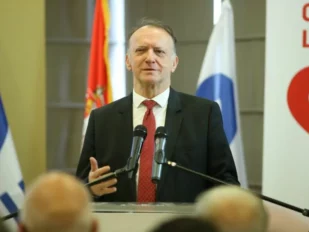
She seems to be a professor at the Faculty of Economics Danica Popovic gave the best possible description of the new finance minister. In an interview with Olja Bećković for NIN from November 2015, prof. Popović described how she felt when she found out that Siniša Mali was accused of plagiarism: "He was my student and he was excellent. When I heard about the problem with his doctorate, my first reaction was: you always hit the best! I angrily said: Come on, don't, I know him! They told me: here you go, read it yourself and see. Then I really became convinced that a person with a brain, value, with great capacity decided to choose a path that is extremely unworthy.
It is not that there is anything immoral, it is immoral when you write on your own, but this is a criminal act. When someone commits plagiarism, the plagiarized party has the right to sue you, in a civilized country where institutions rule, those actions end with the plagiarist having to pay a large monetary compensation and renounce all the titles he acquired based on plagiarism. This is what we are talking about in the case of Sinisa Malog. He is an academic thief.'
And really, there are many indicators that Siniša Mali could have been the best, and from this point of view, the words he said about himself in April 2017 do not sound so unusual: "I could have been the most beautiful and the best if I hadn't done anything, if I hadn't responded to challenges and made decisions, but I understood my mandate as a mandate of change. For the citizens of Belgrade to see that someone is thinking about them."
Judging by the statements of his associates and colleagues, Siniša Mali acquired knowledge and qualifications at a very young age, which were extremely scarce in Serbia after 2000. After graduating from the Faculty of Economics in Belgrade, in 1999 he obtained a master's degree in finance (Master of Business Administration - MBA) at Washington University in St. Louis, USA. Two years later, at the age of 29, he became the Assistant Minister for Privatization in the Government of Zoran Đinđić, and at the end of the same year he became the Director of the Center for Tender Privatization in the Privatization Agency.
Financial karateka
Four years later, in May 2005, the Minister of Finance in Djindjic's government Bozidar Djelic will write an article in "Blic" in which he writes that the most sought-after profession in Serbia is a financial director, and among other things he says the following: "Master's studies are gradually developing in our country, while abroad an MBA has become an obligation for a financier. For those who want to go further there is also a CFA (Chartered Financial Analyst), a multi-year course that is attended part-time and for which increasingly difficult exams are taken regularly all over the world. But it is a universally recognized degree. My esteemed colleague from Altis Capital, Siniša Mali, is today the only CFA with a full title (all three existing degrees, like a kind of fifth day in karate!) in Serbia. He needs to find a company as soon as possible!"
And after Serbia - as "Blic" wrote (again) - in December 2006 became the last country in Europe to pass the Law on Investment Funds, in February 2007 there were only 11 licensed portfolio managers. "It is a sought-after and extremely well-paid profession, without which no investment and voluntary pension fund can obtain a work permit," wrote "Blic", and one of these 11 licensed portfolio managers was Siniša Mali.
Eleven years later, on May 29, 2018, Siniša Mali will become the Minister of Finance in the Government of Ana Brnabić, with so many affairs behind her that one can list at least a dozen "off the top of her head" without any problems, and with an established habit of routinely uttering untruths and "yes don't blink". Two "how" questions arise here:
- How was it possible for "a person with a brain, value, and great capacity" to be argued to be closely connected with family violence, financial embezzlement, concealment of assets, pressure on the court, all kinds of corrupt actions at the highest level, violent demolition in Savamala in 2016. and by plagiarizing a doctorate?
- How was it possible that none of the serious affairs in which Siniša Mali was involved in the last five years did not receive a single court epilogue, and the prosecution simply gave up on many of them?
The answer to the first question is more difficult, and requires us to go back to the period of the "first public career" of Siniša Malog, from the beginning of the 2003s. According to some data, Mali remains in the Privatization Agency until the end of 2003, however, in February 17, "Blic News" writes that Mali was dismissed from the position of Director of the Center for Tenders of the Privatization Agency of the Republic of Serbia, without explanation. "When asked directly if the reason for his dismissal was that he is a member of the GXNUMX plus, Mali first remained silent, and then, with a repeated request not to ask him anything, said: 'Your information is relatively accurate, but I would not to comment since I am leaving for a new position,'" wrote "Blic News".
Anyway, in September 2004, Lukoil-Beopetrol workers went on strike because the buyer from Russia did not pay the money agreed upon through privatization. Ratibor Stojanović, president of the trade union ASNS and Nezavisnost, then gave a statement to "Kurir", in which he said that during the sale of Beopetrol to the Russians, "a classic example of a conflict of interests was created, because after the sale, a special adviser of the Privatization Agency was appointed to the position of investment director, who managed the sale of Beopetrol": "Siniša Mali was an adviser to the Tender Center and participated in the sale of Beopetrol. He explained the offers of Lukoil and MOL to the tender committee, of which I was also a member. Based on his analysis, we decided that Lukoil's offer was better. Now that same Lukoil has appointed him as director of investments," Stojanović said at the time.
Nine years later, in 2013, the Anti-Corruption Council will estimate that the sale of Beopetrol to the Russian Lukoil has damaged the state by around 100 million euros.
A month before the strike in Beopetrol, in August 2004, the auction sale of the Bratstvo wagon factory in Subotica was canceled, because the Ministry of Economy determined "that the buyer of Bratstvo, Branislav Mali, used data that was not known to other participants in the auction sale, and that he could only his son, Siniša Mali, who is engaged in the Privatization Agency, can announce it". After the sale of this company in April 2004, Siniša Mali was appointed president of the Board of Directors of Bratstvo. So, affairs were not the first thing in Sinisa Mali's biography even before the progressive era.
Great comeback
However, after these events (and with some more accusations against Sinisa Malog that he is responsible for "robbery privatization", which came from the company Zdravlje from Leskovac), Sinisa Malog's name disappears from the media. He will return to the public only in 2012, when he becomes an adviser for economic and business issues to the then Deputy Prime Minister Aleksandar Vučić.
Since then, the dizzying rise of Siniša Malog begins, so in 2013 he became the main negotiator with the United Arab Emirates, he was involved in the creation of Air Serbia (and then appointed as the president of the Supervisory Board of this company), and in the autumn of the same year he became the president of the Provisional Authority of the City of Belgrade. after the city assembly was "recomposed" and Dragan Đilas was removed from the post of mayor of Belgrade. After early elections in the spring of 2014, the first in a series in which SNS and Vučić took close to 50 percent of the vote, Siniša Mali became the mayor of Belgrade on April 24, 2014.
Then he gave an interview to the Croatian weekly "Globus", in which he named Andrej Vučić, the brother of the then new Prime Minister Aleksandar, as responsible for the fact that he, Siniša Mali, became mayor. "The thing is - he told me - that Vučić's own brother Andrej and my younger brother Predrag (Peđa) are best friends. And I always helped them. Andrej, by the way, is Aleksandar's gray eminence in the Serbian Progressive Party, who does not appear anywhere in public. He works at the Banknote Production Institute, and otherwise deals with the party and the Red Star Basketball Club. In December 2012, Aleksandar said that it would be good to work together in the Government. At that time, negotiations with the Arabs had already started and Alexander needed a person who would know how to negotiate with the Arabs," wrote journalist Darko Hudelist in "Globus".
Lies and affairs
And then, from the position of mayor, Siniša Mali starts making strong unfounded statements and promises that will not come true: that the value of 100 hectares of land in the Sava Amphitheater before the start of the construction of "Belgrade on the Water" was "zero", that for New Year 2016, 90.000 Bulgarian tourists will come to Belgrade this year, that the construction of the metro will begin in 2016, that "nowhere in the world is a metro built where there are densely populated areas of the city, but where there is a possibility of development and construction of residential and business premises", that Belgrade's debt inherited from Dragan Đilas amounted to 1,2 billion euros, although this statement was denied by the Fiscal Council and Siniša Malog's predecessor as Minister of Finance, Dušan Vujović... (statements from the "Istinomer" website).
However, the first big scandal related to the new finance minister broke out in 2014, when the professor Raša Karapandža argumentatively shows that a huge part of Sinisa Malog's PhD (written and defended at FON in 2013) is plagiarism: "In my career, I have never faced the amount of copying that is present in Mr. Sinisa Malog's doctoral thesis. (...) On almost all pages of the dissertation there is a certain percentage of non-original text, and on more than one-third of the pages of his doctoral thesis, Mr. Siniša Mali copied as much as 33 percent or more of the text!", writes Karapandža on "Peščanik".
Not long after, the German publishing house De Gruyter confirms that the article by Siniša Mali was published in 2013 in the international scientific journal "Organization and Management", on the basis of which Mali gained the right to defend his doctorate - plagiarism. And a good part of that article will later be included in Sinisa Malog's doctorate.
However, the biggest affairs of Sinisa Malog will gradually be revealed by the KRIK portal. In October 2015, KRIK revealed that Siniša Mali, as the director of two offshore companies, during 2012 and 2013 bought 23 luxury apartments in the Bulgarian resort "Sveti Nikola" for an unknown customer, and another in his own name, that the apartments are worth approx. five million euros, and that he bought them from - the director of the Serbian branch of the Russian company Lukoil Srđan Dabić, in which, you remember, Mali was employed after privatized Beopetrol.
Then, KRIK discovered that the company of Sinisa's father, Mali Branislav, illegally received 10 hectares of state land as a gift from the buyer and director of the Alfa Protein company, which was privatized in 2003. Then, in 2009, Branislav Mali transferred the company (and this donated land) to his son Sinisa, who immediately sold the company and the land for half a million euros - to himself, that is, to the company in which he, Sinisa, was the director.
Phantoms in Savamala
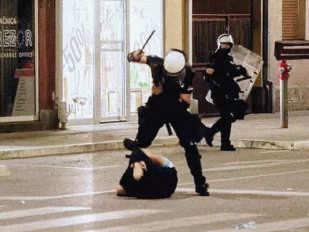
In April 2016, on the night of the parliamentary elections, several dozen people in phantom masks, armed with clubs and accompanied by machinery illegally demolished buildings in Savamala, in Hercegovačka Street. Very soon it will turn out that those buildings had to be demolished by June of that year according to the agreement on Belgrade on water, and since the court proceedings were still ongoing, a solution was found in the suspension of the state of Serbia and its laws for a few hours.
In June 2016, Aleksandar Vučić announced that "behind the demolition in Savamala are the highest authorities of the city government in Belgrade", and the entire action of the police and the prosecutor's office in this extremely simple and easily solvable case provides an answer to the other question - how is it possible that Siniša Mali emerged from all affairs (for now) intact: no one was allowed or wanted to act as the rules of the service dictated.
And then comes the "bombshell": in March 2017, the ex-wife of Siniša Malog, Maria, gives an interview to KRIK, in which she describes in detail the affairs and behavior of her ex-husband, with whom she has three children, who were taken away from her at the time . In this interview, Maria Mali explains that the criminal charges against her ex-husband for psychological and physical violence were dismissed, and that she was fired from her job.
If at least a fifth of all the things that Maria Mali blamed on her ex-husband in this interview, we are talking about years and years in prison: that he physically abused her and grabbed her by the neck in front of the children; that he forced her to falsify a statement given to the Anti-Corruption Agency and to sign that the 95.000 euros in Sinisa Malog's cash, for which he had no cover, was actually her inheritance; that the Anti-Corruption Agency refuses to talk to her for months; that Siniša Mali has several other properties that have not been reported to the Agency; that lawyer Igor Isailović is one of the mayor's closest associates, and also Ana Brnabić's partner in the company they founded together; that Siniša Mali bragged to her that he participated in the demolition in Savamala; that her ex-husband "owns" the judge who will decide who will have the children; that the special prosecutor gave him advice on what to do, and described in detail the mechanism by which rich fathers, with the help of the same people in the judiciary, take children from their mothers...
Very good friends
During the trial between the spouses, it was also revealed that the education of their three children costs 60.000 euros per year, and that it is financed by "close friends of Siniša Malog" from abroad.
And all of these things were not investigated by the prosecutor's office, which is how, in the end, we come to the title of this text. In February of this year, the European Commission published a strategy on enlargement to the Western Balkans, in which it described all the countries in the region as "captive states": "Today, the countries show clear elements of a captive state, including links to organized crime and corruption at all levels government and administration, as well as a strong connection between public and private interests. All this gives a feeling of impunity and inequality," writes the Strategy.
Everything written so far supports this assessment. But once the country is liberated, ie. comes out of captivity, "insiders" will be needed to describe in detail what connections there were with organized crime and corruption. As someone who participated in all major potentially highly corrupt affairs of the progressive government, the new finance minister would be that perfect insider, that is, a witness-collaborator.
"Time" number 1430, May 31, 2018.
Read daily news, analysis, commentary and interviews at www.vreme.com