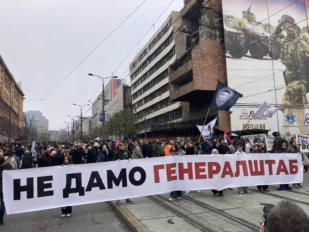
For two months, Serbia has been in increasing turmoil, and the number of terms used to answer the question: what is happening is increasing. It started with fifteen minutes of pious silence, which the students first turned into a protest, and then into a blockade of their faculties, and even entire universities, after which they started talking about civil disobedience, and finally a call for a general strike was heard.
Except for the general strike (which, as it is rudimentarily and anachronistically regulated by Article 3, Paragraph 3 of the Law on Strike back in 1996, is completely inapplicable today), each of these terms can be used to explain some of the phenomena we are witnessing today, but actually the broader picture of current events in Serbia is missing. Coming to grips with that unpleasant void, I would say that a part of the citizens in Serbia today is trying to cancel the achievements revolutionary rotations (2000-2012) in a way that would make it possible to finally do everything that was missed after October 5, 2000.
"Revolutionary rotation"
But what does "revolutionary rotation" even mean?
Few people today, except historians of political ideas, know that the term "revolution" was borrowed from astronomy, where it was used to denote the circular - revolutionary or rotational - movement of the heavenly bodies. The first theory of political revolution was given by the English philosopher Thomas Hobbes in a book Behemoth from 1679. It contains the stormy events in England in the period 1640-1660. explained as the circular movement of usurped power - from the hands of the deposed and executed King Charles I Stuart, through the hands of the two usurpers, Oliver and Richard Cromwell, back to the hands of the legitimate heir to the throne, James II (Charles' eldest son). For Hobbes, revolution was the "natural" movement of usurped power - like the movement of the heavenly bodies - which can only end by returning to the beginning.
If it seemed that way to Hobbes and many of his contemporaries in 1679, they changed their minds very soon after the arrival of Charles' younger son, Charles II, who ruled as absolutist as his father. Just nine years after it was published Behemoth, seven distinguished Englishmen - six politicians (from both parliamentary political parties) and one bishop - invited the Dutch head of state, William III of Orange, to come to England and resolve disputed matters related to the reign of Charles II. The Dutchman did come to England – but with his elite troops – and, limiting himself solely to a show of force without resorting to violence, did what was expected of him.
His real goal, of course, was to get hold of the English treasury and finance the war of the European coalition against the king of France, Louis XIV, with huge amounts of pounds. However, regardless of his own interests, Orange did an excellent job in England: he calmed political passions, politely escorted Charles II and his entourage to the ship on which he dispatched them to France, and finally made it possible for the Bill of Rights of 1689 ( the so-called Fourth Charter of Rights) shaped the so-called The "English Constitution" which will be considered the most advanced in the world almost until the very end of the 18th century. It is certain that without him, England would not have been able to carry out the Industrial Revolution until 1789, when France, significantly set back by the persistent absolutism of the kings from the Bourbon dynasty, had just stepped onto the path of political revolution.
Lessons from mistakes
The lesson of this historical story is very simple. Already in the 17th century, the political and intellectual elite of England was too civilized to tolerate the autocracy of the two Stuarts, and that's why they looked for a way to oppose it: the first time with weapons, and the second time with diplomacy.
The first way was "revolutionary" in Hobbes' sense of the word - it took things back to the beginning, where the "revolution" began. The movement, however, did not stop there. The new engagement of the political and intellectual elite once again moved England towards the constitutional arrangement necessary for the stabilization of the country and its prosperity. That's why the English revolution did not end unsuccessfully, with the rotation of 1660, but successfully, in 1689, by consolidating the achieved achievements in the protection of human rights, necessary for further political, social and economic development. After all, the "Glorious Revolution (Glorious Revolution)" which will quickly erase from memory the unpleasant "rotation" from 1640-1660. and which will serve as a bright example for countless revolutionaries of the following centuries (while the "police understanding of the revolution" - commotion, violence and chaos - will gradually suppress what was most important to the English in that term: effective constitutional protection of human rights without a single drop of spilled blood) .
The Failures of the Fifth of October
In a series of works that I published in the first years of the 21st century, I claimed, and I still claim today, that post-October 1640 Serbia unfortunately also took the wrong path - the one taken by England back in XNUMX.
The rotational path of the revolution was ensured on January 27, 2003, when the last (Third) Yugoslavia was finished and, as it turned out, with the sole purpose of removing the Montenegrins from the power grab that was being waged in Serbia between Zoran Đinđić and Vojislav Koštunica, as well as their a supporter. Instead of directing most of their efforts towards fulfilling the first on the list of their own pre-election promises from September 2000 - which was supposed to be overcoming the constitutional chaos inherited from Slobodan Milošević - they introduced the October XNUMX revolution directly into a rotational movement with skirmishes and banter.
The constitution, which was hastily concluded in September 2006, entered into force illegal and illegitimate On November 8 of the same year, it was just a funny decoration thrown over the political battlefield where everything that was important happened outside the institutions provided for in that Constitution. The meaningless of institutions was not, by the nature of things, limited only to the political sphere. Serbia was slowly but surely turning into the Eldorado of the "Wild East" in which all "papers" became devalued: from the Constitution, through laws and by-laws, all the way to elementary professional practices. That's how it could happen to us according to the model of the 2006 Constitution. and buildings began to speed up and be used arbitrarily (without a use permit), potentially endangering each of us.
The roads of criminal responsibility lead to Vučić
It was only a matter of time before the rotation of the October 2012 revolution would describe a full circle. That finally happened in 20. Political power did not, in truth, return to the hands of someone from the Milosevic dynasty; it did not even end up in the hands of one of his party children. Those who in the nineties of the XNUMXth century were high-ranking members of its main coalition partner, the Serbian Radical Party, now only renamed the Serbian Progressive Party, came to power, legitimately, on the wave of deep disappointment of the citizens with the post-October XNUMXth political elite.
After the completed rotation, elements of Milošević's rule began to be restored little by little, as could be expected: the concentration of power in the hands of one man, election manipulations, turning the largest part of the media space into a political propaganda machine, (counter) rallies with paid participants , party eligibility as the primary criterion for employment and promotion (with disastrous consequences for the entire economy), etc.
In one respect, however, Vučić's Serbia has advanced compared to Milošević's - in the arrogance of the government, which has taken on caricature proportions in recent years. A good example is the preparation of the ground for the construction of Belgrade on the water. After the night of April 24 2016. a group of masked men, with the passive support of the police, leveled the last obstructing objects in Hercegovačka street with excavators, Aleksandar Vučić (then "only" the prime minister) declared that only a "complete idiot" could have ordered such a thing. In 2023, the same Vučić celebrated the seventh anniversary of the described event by proudly confirming what many immediately suspected - that the "complete idiot" was himself. At the same time, he forgot that the case is still in the Public Prosecutor's Office and there are no longer any doubts that the only reason he did not move beyond the pre-investigation procedure for seven years is that there is "obstruction of an official in the performance of an official act", incriminated by Article 322. Criminal law.
There are two reasons for this arrogance.
The first lies in psychology: unlike the "apparatchik" Milosevic, who was made cautious by the experience of countless differentiations in the ranks of the communists, Vučić is a leader of fans. For him, the President of the Republic is the one who communicates exclusively with the fans ("Serbia") and organizes them for the team playing the game (the Government), while it is quite "natural" that the "bravest" part of the fans also has additional roles - behind the stands, regardless of fair play and with the possibility of achieving special pleasure.
Another reason is that, unlike Milošević, Vučić is not threatened from the outside. External pressure he managed to alleviate to a large extent (lithium?), although not to eliminate it - which is the only reason why (still?) the state of emergency has not been imposed in the country. The student demands, and above all the first one related to the documentation of works at the Railway Station in Novi Sad, provoked a dire situation in which we are all caught: the criminal-legal and political Pandora's box is open, Aleksandar Vučić is in confusion (until the counter rally in Jagodina on 24 (on January XNUMX, he continuously claimed that all the students' demands had been fulfilled, and the very next day I ordered the publication of the missing documents, thus admitting that the first demand of the students had not been fulfilled all along) and it is clear to everyone that nothing will be like before, but not how the heating up political crisis will end.
In that context, the testimony of Acting is particularly significant director Infrastructures railway Jelena Tanasković of Serbia at the hearing at the Public Prosecutor's Office on December 16, 2024 (as she herself reported it in the media), which created suspicion that the death of 15 people as a result of the fall of the canopy at the railway station in Novi Sad resulted from a criminal offense provided for in Article 322 of the Criminal Code, in the execution of which not only the Minister of Construction, Transport and Infrastructure, but also the President of the Republic participated. How will Aleksandar Vučić manage to remove that doubt, when he recently boasted that he started interfering in construction works in 2016, implying that this is the reason that the Public Prosecutor's Office cannot progress in the investigation of the illegal demolition of buildings in Hercegovačka Street? That suspicion alone - regardless of how it will be criminally prosecuted - will not stop weighing on the political life of Serbia, even if in the meantime he has become ready to sacrifice individuals from his environment in order to remain in power.
Can October 6, 2000 finally dawn in Serbia?
If this case is placed in a wider socio-political context, then it becomes clear how the concept of "revolutionary rotation" can help in gaining an adequate insight into the existing situation in Serbia.
During the last 25 years, Serbia has not only come full circle (2012) but has finally returned to where it was on October 5, 2000. The aforementioned tragedy in Novi Sad would not have triggered such a rebellion as expressed by many citizens of Serbia today if it did not exist in their country. - more or less articulated - the awareness that we have been sent back 25 years. Students would not be the first to rebel if they did not have a - more or less articulated - awareness that if nothing changes in Serbia, (at least) the next 25 years of their lives will be ruined. The educators wouldn't be on strike if they didn't have a - more or less articulated - awareness that they are becoming a marginal group in Vučić's Serbia of masked thugs and pauperized visitors to counter rallies for whom even one burger is enough to cheer and clap, happy and cheerful. After all, even the political opposition would not be so passive today if there was not a - more or less articulated - awareness that they are complicit in Serbia's arrival in the situation it is in today.
The question was raised: is it possible to cancel the achievements of the revolutionary rotation in a way that would allow to finally do everything that was missed after October 5, 2000. Could October 6, 2000 dawn in Serbia?
I think it is clear to everyone who wants to torture themselves with such a question that we are currently still far from that.
First, just like in England in 1688 - but, we should not forget, like in Serbia in 2000 - no changes will be possible without increasing external pressure.
Second, no changes will be possible without the active contribution of the political parties that are currently at the tail end of events.
Thirdly, no changes will be possible if the "saving of Serbia" is left to political parties. Not long after October 5, 2000, the youth organization "Otpor", which had the same credit for overthrowing Slobodan Milošević's regime as the opposition DOS, raised the slogan "We're just watching you!", aware that the revolution was turning in the wrong direction. That was a big mistake that should be learned from: politicians in Serbia must not be "just observed" since they mostly correspond to Max Weber's definition of a "voting group" that passively implements decisions made in opaque party tops.
If we want what the English political and intellectual elite managed to achieve in 1688-1689. we need a Constitution whose institutions will be filled with life and which will enter into the lives of the people - those who hold power no less than those who do not.
And if we have entered a political crisis that will greatly burden not only Vučić's government but also society as a whole in the coming period, then perhaps we should start thinking (again) about an initiative that would establish a social consensus at the constitutional assembly. All political parties in Serbia have shown in the 21st century that they harbor animosity towards that institution. Maybe it's finally time to change that?
The author is a full professor at the University of Belgrade