

News
EPS: The biggest debtors are Železara Smederevo, Resavica, GSP, MUP
State companies and ministries are among the 50 largest EPS debtors. They owe a total of 176 million euros

The President of the country, Aleksandar Vučić, says that the country is under attack from outside and inside. Right, but which one? A "prerogative" state was attacked, which, according to what we can find out from the media, is headed by Andrej Vučić. What does that mean?
Friday, January 31, 2025 represented the biggest reach in the absurdity of the political situation in Serbia so far.
There are three reasons for that. First, on that day, the President of Serbia started an (election?) campaign in villages and towns, gathering several hundred people in small halls and explaining to them (specifically at a meeting in Ćićevac) that "our country is under attack from the outside and the inside". He said that "we will know how to fight" and "save the country", but also that they will "ask for conversation and dialogue".
This is where the core of the absurdity is hidden: what will the president of Serbia do in Ćićevac if Serbia is attacked and what does "seeking dialogue and dialogue" with the attackers mean if the survival of the country is at stake?
Secondly, in complete contrast to this image, was the welcome of Belgrade students in Novi Sad, which was attended by tens of thousands of people and which served not only to honor those who died in the fall of the canopy at the railway station there, but also to send a message that the request there is no alternative to determining responsibility for that tragedy.
These two events are connected by a third one: KRIK journalists published part of Europol's investigative documentation, which partly refers to the so-called "construction mafia" and which reveals the link between SNS, tycoons and criminals, which is arbitrated by Andrej Vučić, the brother of the President of Serbia. To make everything more interesting, the fact that Europol sent this documentation to Serbia a year ago, but that the police and the prosecutor's office did nothing about it, was also presented.
Dual state theory
How to fit these three events into one meaningful whole?
The first thing that comes to mind is the ballad with which Brecht ends Opera za tri groša, dedicated to the connection between government, business and crime:
"For some are in darkness,
And the other in the light of day,
And only those in the light are visible,
While the others are obscured by darkness."
In this text, however, we should go further than poetry and turn our attention to the president's statement that the country is under attack from outside and inside. Which country?
The president is a law graduate and had in mind a minimalist legal arrangement of the state, which consists of government, population and territory. Since we do not see any attack on the territory of Serbia or its population, it is obvious that the president was referring to the government.
What is the government like in Serbia?
The law no longer helps us here, and we have to ask for help from political science. How, then, to understand politically the government that today in Serbia is under attack from outside and inside (but is willing to "seek conversation and dialogue" with the attackers)?
The best answer to that question, in my opinion, is given by the theory of a dual or double state, which was put forward by the German lawyer and political scientist Ernst Frenkel (at that time as an emigrant in America) as far back as 1941. Based on everything he could directly observe and experience in the Third Reich, Frenkel presented a theory that was applicable to all totalitarian states of the 20th century.
According to Frenkel, the biggest novelty of the totalitarian state consists in the fact that it is divided into legal and "prerogative" and that it functions according to strictly different rules that apply in one state and in the other. Since every state needs legal certainty - people always and everywhere have to marry and marry, sell and buy, sue and defend themselves, etc. - and the party establishing a totalitarian state is forced to maintain the rule of law, inherited from the previous regime, which it violently - "revolutionarily" - overthrew.
Along with the rule of law, the ruling party is now systematically building a prerogative state ruled by the principle of political expediency: everything that strengthens and expands the existing government is done in it.
This is how the biggest problem of a totalitarian state arises. As a dual state, it always has to somehow hold together the legal and prerogative state, to justify their existence with revolutionary ideology, but also to somehow fill the gap between them with empirical pragmatism.
The concept of prerogative
Here it is necessary to refer to the concept of prerogative, which belongs to the old regime history of the monarchical state. The prerogative encompassed the domain in which the king could act unbound by any law and which was legitimized by the divine origin of monarchical authority. John Locke is still in the bible of liberalism, The second debate on government (1690), felt the need to leave a place for prerogative power in his ideal state, basing it in general natural law and limiting it to cases when the generality of the law does not allow action in favor of the common good.
In the later conception of the democratic constitutional state, the prerogative will, of course, disappear and the demand will be raised that all authorities - just like ordinary citizens - act within the framework of a single and unified constitutional order.
When it comes to Serbia, it is necessary to take a step back in time and remember that it was part of a wider totalitarian state that built a prerogative state in complete opposition to both the letter and the spirit of the FNRJ Constitution from 1946. That prerogative state survived until the very end of the Second Yugoslavia, although it must be admitted immediately that its scope and violence gradually decreased.
However, very soon after the death of the undisputed leader Josip Broz, an extremely serious innovation occurred: criminals began to be recruited into the prerogative state and to do dirty work for the sake of defending the achievements of the communist revolution. This is an asset that Slobodan Milošević also took over, so that criminals also started to fight for a state that nominally distanced itself from the communist revolution - and ideology.
Considering the political lukewarmness, ideological disorientation and, in general, the lack of seriousness shown in the construction of a democratic constitutional state, which was shown by the parties united in the DOS in the period 2000-2012, the prerogative state has survived until today and information about its existence and functioning have been leaking more and more to the public in recent days.
The icing on the cake is the secrecy of the prerogative state, which has been built in Serbia for the last thirteen years and which, therefore, has been left without any legitimation possibilities. The divine right to rule was long forgotten, and with it the communist revolutionary ideology, so that in the end only the naked egoism of those who possess political and economic power in Serbia remained.
And criminals, of course.
Aleksandar Vučić's perception
Thus, we come to the opportunity to discover the truth in Vučić's statement that today in Serbia the state is under attack from outside and inside. It is indeed true: she was attacked prerogative a state which, according to what we can find out from the media, is led by Andrej Vučić and which has taken over a good part of the institutions of the rule of law.
And still, it is really true that she was attacked and power Aleksandar Vučić, who generously left the lion's share of the rule of law to his brother.
After all, it is also true that the attack is coming from the inside, since now there is no longer any doubt that the demands to determine responsibility for the tragedy at the railway station in Novi Sad strike at the very heart of the dual or dual state in Serbia (we still know nothing about an external attack, although the indicative fact is that Europol is in possession of data that points on Serbia as an important stronghold of international crime).
What is still uncertain is what the Vučićs - since it is clear that both of them are in power in Serbia today, each at the top of their own state - have to offer in "seeking conversation and dialogue". No one who built a dual state thought that one day he could be left without a prerogative state and answer for what he did exclusively within the framework of a legal state, or, even worse, a democratic constitutional state.
In this context, Vučić's message finally becomes comprehensible: "There will be neither a transitional government nor an expert government, I guarantee you that with my life." Here we have the opportunity to look into the psyche of Aleksandar Vučić, who during the past years in countless interviews and television appearances mentioned the possibility of being killed (which is already indicative in itself, since, from Xenophon's work Hierophon or on tyranny, it is known that the most striking feature of tyranny is fear for life in one's own country, which the tyrant observes as full of his personal enemies).
Since he long ago identified his survival in power with his life, it is completely "normal" that he essentially perceives everything that is happening in Serbia today as attack on the life of Aleksandar Vučić from outside and inside.
The author is a full professor at the University of Belgrade
State companies and ministries are among the 50 largest EPS debtors. They owe a total of 176 million euros
"The contract on termination is in the formalization procedure and it is expected to be completed at the beginning of next week, about which the public will be informed", announced the Ministry of Construction, Transport and Infrastructure and confirmed the earlier writing of "Vremen"
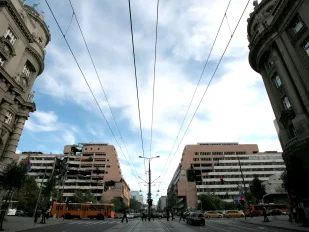
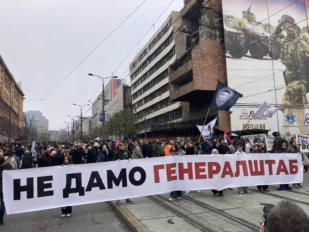
Serbia and Jared Kushner's company waived all possible mutual claims upon the termination of the contract for the General Staff, claims "Vremena" source from the Government.

A group of individuals has created two websites where public procurement of the Telecom and IT sectors can be searched and compared. They invite the media, experts and citizens to review the documentation and submit reasoned observations

Very soon it could become obvious whether Milan Radoičić has left Serbia or not

At the moment when the institutions of the Republic are destroyed, when Vučić's octopus is still alive, when people are disgusted by the injustice and the stench left behind by the Essenes regime, we have, as Machiavelli said, only civic virtue as the fuel with which we can return to the beginning

The four independent members of REM are an example of perseverance and civic responsibility. Rodoljub Šabić even, upon leaving the premises of REM, after the sentencing of the Informer, experienced that the Essenes insulted him, hit him with their hands and feet. But that too will soon be over

Vučić pardoned the batterers and Dijana Hrkalović. The election winners should abolish the sultan's power that allows one man to run afoul of the entire judicial system

Interview: Branko Stamenković, public prosecutor of the Supreme Public Prosecutor's Office
A black picture and the breakdown of the rule of law subscribeThe archive of the weekly Vreme includes all our digital editions, since the very beginning of our work. All issues can be downloaded in PDF format, by purchasing the digital edition, or you can read all available texts from the selected issue.
See all



