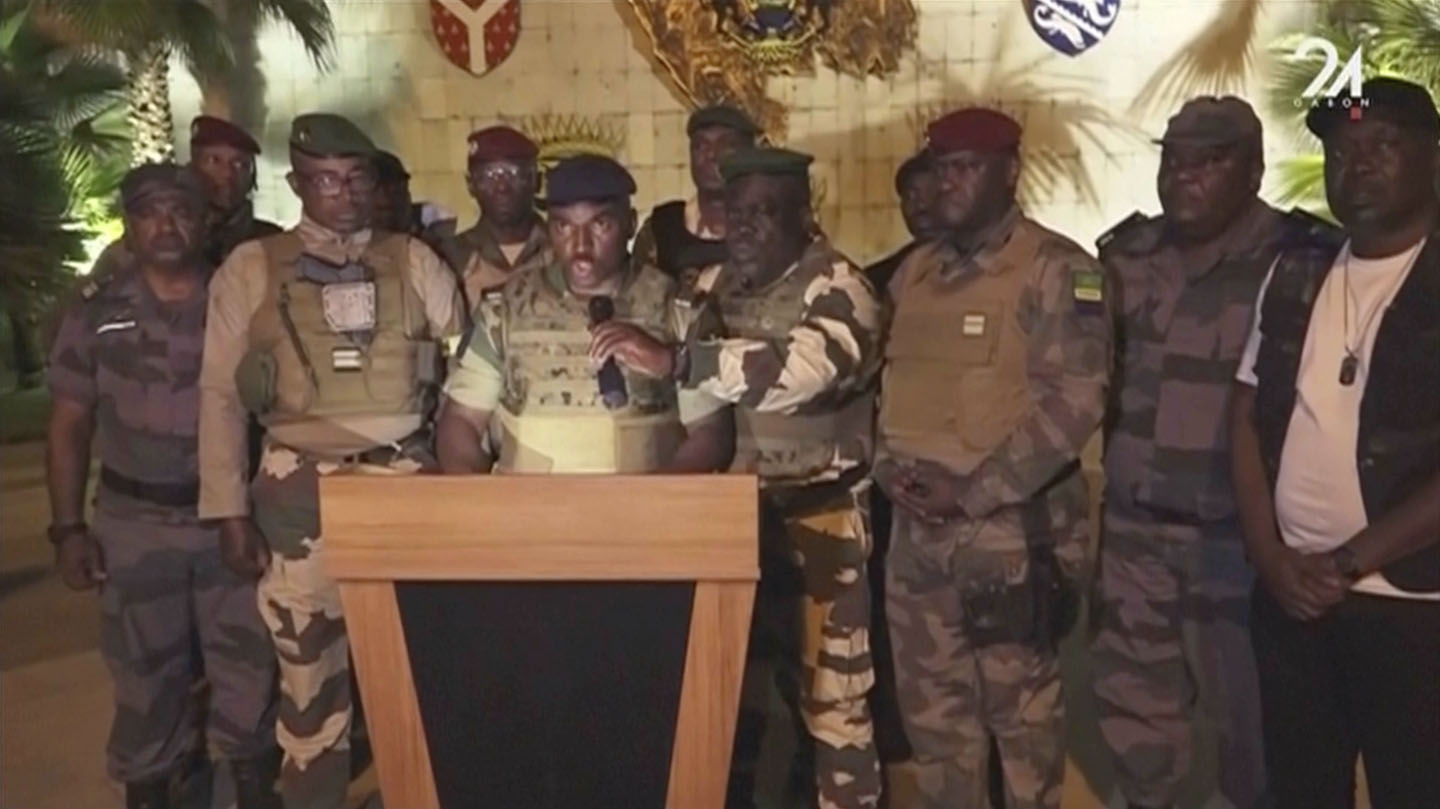
A group of Gabonese military officers appeared early this morning on national television and announced that they had taken power in the country, reports RTS.
Twelve soldiers stated on TV channel Gabon 24 that they represent all the security and defense forces in this Central African country, and that the election results have been annulled. They announced the "end of the regime", the dissolution of institutions and the closing of borders.
"On behalf of the people of Gabon, we have decided to defend the peace by putting an end to the current regime - to irresponsible, unpredictable governance that results in a continuous deterioration of social cohesion and risks leading the country into chaos," said one of the soldiers.
The announcement of the coup followed the announcement of the official results of the presidential election on Saturday, in which the current president, Ali Bongo Odimba, won a third term with 64,27 percent of the vote.
Ali Bongo: Re-elected President
Since gaining independence from France in 1960, Gabon has been ruled only by father and son - Omar Bongo Odimba and Ali Bongo Odimba.
Omar Bongo ruled for more than 40 years, from 1967 until his death in 2009.
Then his son Ali Bongo came to power, who has been in power for 14 years.
After Saturday's election, he was re-elected as president, angering the opposition who wanted to bring change to the impoverished country.
The main opposition candidate, Albert Ondo Osa, complained that many polling stations were missing ballot papers with his name on them, reports the BBC.
According to the world media, Bongo is currently under house arrest.
A big question for Europe
Last month in Africa also happened coup in Niger, when a group of soldiers deposed President Mohammed Bazum after they blockaded his palace and kidnapped him in the capital, Niamey.
After that, the European Union supported the Economic Community of West African States (ECOWAS) and announced that it would not recognize the new government.
The head of European diplomacy, Josep Borrell, announced at the time that all financial aid and security-political cooperation had been suspended until further notice. Now the question arises as to how Europe and the entire International Community will react to the unrest in African countries.
Commenting on today's coup, Borelj said that it is a "big question" for Europe.
"The whole region, starting with the Central African Republic, then Mali, then Burkina Faso, Niger, now Gabon, it is a very difficult situation and certainly the ministers must think carefully about what is happening there and how we can improve our policy in relation to these countries".
French Prime Minister Elizabeth Bourne said she was monitoring the situation in Gabon, and French government spokesman Olivier Veran called for respect for the election results.
AE/RTS/BBC
Read daily news, analysis, commentary and interviews at www.vreme.com