
Read daily news, analysis, commentary and interviews at www.vreme.com
 Photo: AP
Inflation that has no end in sight and the poor reaction of the state and the president to the consequences of the earthquake are the main trump cards of the opponents. Experts claim that Erdoğan can be hit on the head in May because there is no longer even a "d" from democracy in his rule
Turkey will get a new president on May 14. The current first man of Turkey, Recep Tayyip Erdoğan, trusts in his long-standing voting core in the country, but also in the voters who live in Europe. Opponent Kemal Kilicdaroglu has an almost two percent advantage over Erdogan in all polls in recent weeks, and it is to his advantage that inflation has almost driven the "ordinary" citizens of Turkey who are crying out for change crazy. Can Kilicdaroglu defeat Erdogan, who has also had health problems in recent days?
About 64 million voters will go to the polls on May 14, just three months after the devastating earthquake that literally disfigured part of the country. More than 50.000 people died then, while around two million residents were left homeless. People are still affected by natural disaster accompanied by all the time and high inflation.
The trump cards of the opposition are inflation and the state's poor reaction to the consequences of the earthquake
Even before the earthquake, Turkey was in a difficult economic situation. According to the data of the state statistics agency TUIK, the inflation rate in February was 55,1 percent. Independent economic researchers even see real inflation of more than 120 percent. In addition, there is high unemployment, and many young people do not see any prospects for themselves. In addition, Turkey receives more refugees than any other country in the world. According to the United Nations Refugee Agency (UNHCR), there are currently more than 3,6 million people displaced by the civil war in Syria and almost 320.000 people seeking protection from other countries, mostly from Afghanistan and Iraq.
Recep Tayyip Erdogan, who has been in power in Turkey for two decades, is running with his Islamic-conservative AKP party in alliance with the ultra-nationalist MHP and the small nationalist-religious party BBP. His biggest social democrat challenger, Kemal Kilicdaroglu, who represents the CHP party, has gathered most of the opposition with him in an alliance of six. The third candidate for Turkey's highest office is Muharem Inze, the leader of the newly formed Memleket (Fatherland) party.

Erdogan, as the German portal deutschlandfunk.de points out, is no longer on the winning wave of rule. His style of government has become more and more authoritarian over the years, to the extent that mass protests against the government in 2013 were bloodily suppressed. After the coup attempt in 2016 when a state of emergency was declared, parliamentary democracy was suppressed in 2018 in favor of a strong presidential system in which the leader can command the people unhindered. Erdogan's AKP party has been in power since 2002. Then she promised the democratization of the country, of which not even the "d" from democracy remained.
In the meantime, Erdogan (69) took control of almost all areas of social life, the administration and the state apparatus, and he filled important positions with his favourites. Much of the country's media is also under his control, as are the judiciary, the military and the police. Contradiction and criticism are suppressed. Erdogan is a populist with a penchant for nationalism and no scruples - but at least some of the population still see him as a strong man who vigorously represents Turkey's interests internationally.
Looking at Turkey's current political constitution, it is hard to understand why Erdogan's party once raised high hopes for democratic reforms, EU accession, peaceful relations with neighboring countries and greater prosperity when it won the 2002 elections.
That has gone well in a country wracked by a savage war against the Kurds, widespread corruption, unstable coalition governments and military rule. But over time, good intentions turned to the contrary, and maintaining power became central to Erdogan's thinking. Not much remains of the initial achievements - official accession negotiations with the EU, the peace process in the Kurdish conflict, a drastic increase in the average income per capita.
A reserved intellectual pleases the people
For a long time it seemed that the opposition would be largely united against Erdogan. The opposition alliance of six parties agreed on the candidate Kemal Kilicdaroglu. The reserved intellectual is the president of Turkey's largest opposition party, the social democratic CHP. In addition to the CHP and the national conservative Iji party, four smaller parties belong to the six-party alliance, including the Geleçek Partisi (Party of the Future) of Erdogan's former running mate and former prime minister Ahmet Davutoğlu. for the highest office in Turkey. Ince lost to Erdogan in the 2018 election – still in the running by the CHP at the time – and then disappeared from the scene. Now he wants to be president for the second time. Ince's impassioned speeches and combative personality were reminiscent of Erdogan's style in 2018, drawing crowds during the election campaign. His supporters had high hopes for him - all the more disappointing after his clear defeat by Erdogan in the first round.
The leader of the opposition, Kemal Kilicdaroglu, is a counterpoint to Erdogan: a deliberate intellectual with rimless glasses, an avowed populist. The economist, who headed Turkey's social security service for many years, sees himself as a "quiet force." Also quite petite, Kilicdaroglu took time to find the right tone in his speeches, which many felt were not decisive enough. Critics say he simply lacks charisma. But over the years, the opposition politician gradually managed to make his voice heard in the public debate. In the repressive climate after the 2016 coup attempt, Kilicdaroglu undertook a 2017-kilometer march from Ankara to Istanbul in 420 to protest the jailing of CHP deputies. In 2019, the CHP captured mayoral offices in several major cities, including Istanbul and Ankara, ending a year of rule by Erdogan's AKP.
Emboldened by these victories, Erdogan's challenger has upped the ante. "This is my fight for your rights. The rich became richer and the poor became even poorer," he said in 2022.
 Photo: AP Photo/Khalil Hamra
What are the opposition's chances in the May elections?
Short and clear - good. Compared to previous elections, the opposition actually has a good chance of defeating Erdogan this time. Due to the country's high cost of living and poor management of the state of emergency during the rescue and post-earthquake relief, Erdogan is struggling with declining approval ratings. He is also concerned about allegations of corruption.
The goal of the opposition alliance is to turn the country back into a parliamentary democracy and to abolish the presidential system. More democracy, more freedom and more justice are on the agenda. However, Turkish political scientist Cengiz Aktar warns against placing too much hope in the change of government. "Specifically, the risk is the participation of nationalist forces in the opposition alliance," he emphasizes. Observers doubt whether the elections will be free and fair and whether Erdogan would even admit a possible defeat. If he loses the election, he and his family could face corruption charges. "This regime will do everything to win the elections. And even if he loses, he will not hand over the power peacefully - to any successor", says Akhtar. Political scientist Dimitar Bechev, who teaches at Oxford, agrees that Erdogan cannot afford to give up office: "If he leaves, he has two options: exile or prison." So everything is on the line for him and he will try to stay in power no matter what and at what cost. In the long term, however, it will be difficult for the AKP to stay in power because Erdogan has no successor. His rule is based on a personalized system", believes Bečev.
The American expert on Turkey, Nicholas Danforth, is much less optimistic in his assessment. "The return to democracy will be long." "Even in the best-case scenario, Erdogan's replacement, the 'ultranationalist and anti-Western' climate created by the president will continue to plague the country," Danforth says.
I.Đ./Deutschlandfunk
Read daily news, analysis, commentary and interviews at www.vreme.com

Columns of citizens headed towards Slavija from six directions - from Novi Belgrade, Zemun and Čukarica, and a little later, columns also started from Studentski trg, from the building of the technical faculty on Bulevar Kralja Aleksandra and from Autokomanda.

The famous Hungarian sociologist Balint Magyar talks about the mafia state for the new "Vreme". How the new election winners can overthrow that system

The message of the last gathering of the Student List before the elections on October 25 is: It's over! It's a little retro, but considering who it's related to, it hits the spot

The "Students are winning" list held a final pre-election rally on Belgrade's Trg Slavija ahead of the extraordinary parliamentary elections scheduled for Sunday, October 25.
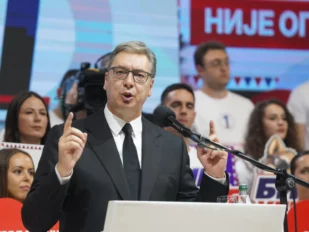
"They tried to destroy our country on an external order. Huge money entered the country and that's why this is the most difficult battle, because they attacked us with billions of euros, and we defended ourselves with purity, our program and love for the homeland," said Aleksandar Vučić at the final pre-election meeting in Belgrade's Hall of Sports

There is, literally, no difference between the one who claims it is day in the middle of the night, or the one who claims to be a giraffe, from the claims we read on billboards: that Vučić is working to unify Serbs and that Serbia is doing better and better day by day.

The pre-election arrests due to the alleged "overthrow of the state" testify to the regime's panic. The bad news for them is - they can't arrest the whole people who decided to defend themselves from progressive beatings and election theft

The ring that tightens around Ćaciland Student list is getting narrower. Because there are more and more spoiled people who see the false prophet for what he is: a street obscener who is fighting Serbia

The archive of the weekly Vreme includes all our digital editions, since the very beginning of our work. All issues can be downloaded in PDF format, by purchasing the digital edition, or you can read all available texts from the selected issue.
See all


For reciting the lines "mosques are our barracks, minarets are our bayonets, and believers are the army", Erdogan was sentenced to ten months in prison in 1999, because the court considered that he was spreading religious hatred with that song. He served four months. The Party of Welfare and the Party of Virtue, in which he was politically involved, were banned because of their Islamist views. In 2001, he founded the Justice and Development Party (AK) and since then he has not lost an election. A believer who does not drink alcohol or smoke, Erdogan has established himself as a global player and the voice of Muslims around the world


