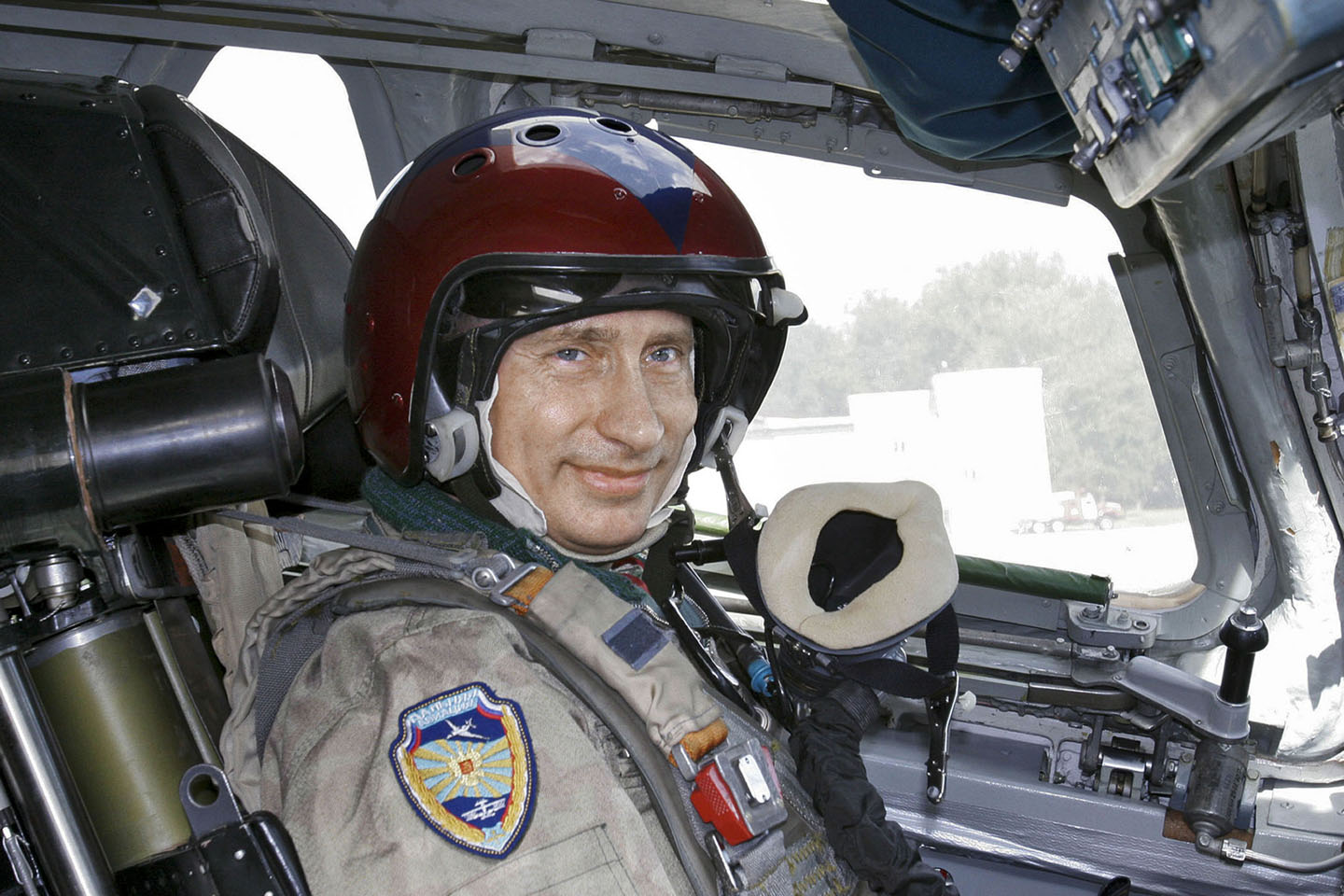
While Carlson was walking around Moscow like a real celebrity, the police detained and interrogated more than 20 journalists outside the Kremlin walls, including Western media correspondents, who reported on the protest of soldiers' wives who openly criticized the war in Ukraine.
Trump's favorite conservative and propagandist, former Fox News political analyst and prominent representative of the American hard right, Tucker Carlson, raised dust in the world public after he interviewed Russian President Vladimir Putin in Moscow for his show on the X social network. It turned out that the interview was watched by more than 200 million people. Experts in political communication claim that Putin's messages are addressed primarily to the American public, and not to any, but primarily to those who support the Republican Party and express admiration for both Trump and Putin.
But the interview was not conducted by any American journalist, but by Tucker Carlson, who is known to have glorified populism, conspiracy theories, and propagated negative attitudes about migrants, women, feminism, and even the Russian-Ukrainian war in his former show on Fox News. Putin used the interview, as well as the reach of the platform, to highlight his main arguments about the war against Ukraine and justify Russia's actions, by presenting Ukraine as a "victim of the West's false promises" and Russia as a party that was harmed in that war. One political analyst summed up the message of the interview with Putin well: "The result of Putin's interview with Carlson is that several million Americans say 'OK, Putin is for peace.' And Trump is for peace. Only Biden and Zelensky are for war... so we should vote for Trump, and against Biden, and then peace will reign and there will be no threat of nuclear war'."
The interview with Putin opened an important question among the public - should Putin have been interviewed at all? Is it professional journalism? Is it in the interest of the (American) public to hear what the Russian president, in the middle of the war with Ukraine, has to say about national interests and to justify his actions? These questions are interesting and important, especially in the context of political journalism, world conflicts and the current debate about whether autocrats, dictators or terrorists should be interviewed, who interviews them, for which media, whether they represent the "other side" and why.
Carlson himself answered these questions first: "I interviewed Putin because that is our job. We are engaged in journalism. Our job is to inform the citizens". "Politico" writes that Carlson infuriated American and Russian journalists because in his "monologue" before the broadcast of the interview, he harshly criticized the Western media, accused them of only caring about what Ukrainian President Zelensky had to say and explained how they really did not made an effort to "hear Putin's side of the story". Quite a number of journalists responded to him on IX, writing that a lot of professional media had interviewed Putin before, that many had been asking for an interview since the beginning of the war, but that this conversation with Carlson was different because "he is not a journalist, but a propagandist who helps autocrats to mask corruption ". It is interesting that the fact-checking newsroom within "USA Today" joined the debate, which deemed Carlson's claim - that no journalist from the West has so far bothered to interview Putin as the president of "another country" in conflict - as incorrect. Namely, according to USA Today, including the Kremlin itself, it has been confirmed that since the beginning of the war, many media and journalists have asked for an interview with Putin, but they have not been granted an interview. Among them is the famous Christiane Amampour, who briefly posted on her X account: "Does Tucker really think that we journalists have not tried to interview President Putin since the first day of the invasion of Ukraine? That's absurd!” Karlsson's allegations were denied by AP, BBC and other world media.
photo: ap...
INSTRUMENTALIZATION OF THE MEDIA AS THE MOST IMPORTANT STEP
Authoritarian regimes around the world always have a need to explain to the public why they are desirable as a government. This desire to justify and legitimize autocracy is present in many non-democratic political regimes, from Burma, through Cambodia, North Korea, China, to Russia. In his extensive research on the concept of the authoritarian public sphere, Alexander Dukalskis found that the justification of autocratic rule is sometimes derived by leaders claiming that they need a non-democratic form of government and power to save the state from economic ruin or to protect the people from external enemies. Many autocratic rulers legitimize their vision of the state and society through the media as one of the best instruments that read the regime's power and control. Precisely by controlling the public sphere and legitimizing autocratic ideology through the media, dictators consolidate their power and, more importantly, "influence the way citizens think and talk about politics", writes Dukalskis in his book and adds: "If people believe in the messages of the ruler, then it is easier for him to maintain his power, and it costs him less because he does not have to use violence to make them obey".
How do the media and public communication that serves to justify war, conflict, authoritarian rule and the like help in legitimizing the messages of autocratic leaders? First of all, it is a huge field of media and communications that are used to, on the one hand, confirm the power of the regime, but also to distort the narrative and push it in a certain direction. This is served by televised broadcasts of official speeches, propaganda in radio and press appearances, televised addresses to the masses, official ceremonies that show the power and ideology of the regime, and even interviews with dictators. In the academic literature, messages that legitimize the power of authoritarian government belong to the domain of the authoritarian public sphere, which differs from the democratic public sphere in that it does not allow open political discussion, uses manipulative media and communication techniques, and above all emphasizes the role of the state and its absolute control over the main narrative in the public from which any different, alternative views or perspectives are excluded. Dukalskis explains it well: "An authoritarian public sphere limits political discussion, distorts political discourse and strengthens pro-regime voices so that the power of arguments against the regime and alternative options is actually reduced."
Apart from traditional media, there is more and more talk about the authoritarian control of the online sphere, especially influential social networks. One of the most obvious examples is state-sponsored digital journalism in Cambodia. It arose from the collapse of independent media, as the government established its own, fully controlled online world through the Facebook platform "Fresh News". The task of this media was to fill the void left in the Cambodian public sphere after the collapse of the independent media. "Fresh News" helped the government and its decades-long Prime Minister Hun Sen to deal with the political opposition, launch fake news, run unscrupulous negative campaigns and silence those voices in the public who would dare to criticize the regime. In Phnom Penh, meanwhile, the American Radio Free Asia, Voice of America, and others were shut down, and just five years ago, the relevant ministry closed 330 print media outlets because, allegedly, they were not active. It is interesting that this main Cambodian state media platform itself called Hun Sen a dictator, but in the positive context of a strong man whose rule resembles the current Chinese and Russian presidents, and who, also in a very positive sense, opened a new chapter of Asian authoritarianism. The now former Prime Minister Hun Sen gave interviews during his long reign, but exclusively to domestic media that were favorable to him and that did not question the relations between China and Cambodia, nor the relations with the world.
The same is the case with Chávez in Venezuela, Fujimori in Peru, Mohamad in Malaysia, Correa in Ecuador, Orbán in Hungary - these authoritarian statesmen are also called "information" autocrats, whose originator is still considered to be the first Singaporean Prime Minister Lee Kuan Yew, who, as the authors Gurijev and Treisman write, he perfected the unobtrusive management of private media and showed his "colleagues" from Malaysia and China how to use the media to rule. But what is it that makes these 20th and 21st century regimes, including President Vladimir Putin's Russia, "information autocracies"? Similar to the populists, they want to "separate the people from the opposition-oriented elite, but while the populists openly attack the elites, the information autocrats do it quietly to co-opt or censor them". The media is used as one of the main instruments for achieving that goal.
photo: ap...
FLATTERING AS A RED FLAG
Another interesting perspective that can shed light on the context we are talking about - the instrumentalization of the media in glorifying authoritarian regimes, especially those that initiate conflicts and carry out violence - is the concept of positive meta-pragmatics, which Dr. Ronnie Danziger from the University of Lancaster works on. In her book, which was published a month ago by Cambridge University Press, she deals with issues of positive communication and the dark side of sociability and various social activities. In his interesting research, Dr. Ronnie Danziger, for example, examines the role of flattery and positive communication in an inappropriate and unacceptable social context using the Israeli-Palestinian conflict as an example. Flattery, as a linguistic construct, is much more common in political discourse in which political systems are moving in the direction of authoritarianism or are already deep in it. The dominance of flattery and flattery as the main method of dealing with a political leader can be one of the interpretations of interviews with authoritarian leaders, but also a warning sign of authoritarian tendencies in a political system whose goal is to conquer the media and control the narrative.
However, in order to understand the connection between media, journalism and authoritarian regimes, New York University professor of history and Italian studies Ruth Ben-Guyat believes that one must go back to the 20s, the period in which, under Benito Mussolini, the so-called " instruction for authoritarianism". In her interviews and works, she points out that the "rules of the game" of then and now authoritarian leaders are reduced to (media) propaganda, violence, corruption, machismo and the myth of national exceptionalism, and that the interconnectedness of these elements helps in reaching and maintaining power. . Professor Ben-Giyat points out the public depictions of Mussolini and Putin with bare chests as "strategies for political legitimization and an important element of authoritarian rule." In this sense, the role of the media is not only instrumentalized to convey and maintain that narrative, but also to be a punching bag that should help the success of their government. For example, writes this author, Berlusconi, Putin and Trump, otherwise all under investigation for corruption, have attacked the media since the beginning of their reign, but if by chance, while they are in power, information about an investigation for corruption, theft and the like appears, " then they need the public to convince them that the media is extremely biased” and that what they report negatively is actually incorrect.
LESSONS FROM GOOD JOURNALISTS
Mussolini was interviewed in 1929 by Professor Charles Sarola. American "News Chronicle" journalist Jay Allen interviewed General Francisco Franco in Spain in July 1936, who then said that he was ready to kill half of Spain in order to win. George Sylvester Virek interviewed Adolf Hitler for "American Mantle" in October 1923 in Munich. In that interview, which is also available online today, Hitler propagates his program of unity of mind and body, moral and physical health, and utters the sentence: "We must regain our colonies and expand to the east." In August 1932, Hitler was also interviewed by Hans W. Kaltenborn, a radio host and expert on international affairs from Wisconsin, USA, whom Hitler gave the last interview before he became Chancellor of Germany in January 1933. This interview is interesting because of that. which does not begin with flattery or justification of the rise of the Nazi leader, but with a journalistic description of Hitler as a "restless and untrustworthy" man who does not like to talk to strangers, and especially not with people who don't agree with him, and who instead of answering questions, makes rambling and long speeches. Let's not forget that the famous William Hearst visited Hitler in Berlin in 1934, after which he had to take pictures with Nazi officials and publish Hitler's columns in his newspaper. Historians claim that Hearst's media industry sent filmstrips to Germany and in return received official Nazi films which were then distributed across America.
It is also interesting that at the end of last year, in a popular American podcast, the author Lex Friedman talked with fellow journalists about whether they would interview Hitler as "the other side". Friedman was most interested in whether a distinction could be made between interviewing those with whom we disagree in principle and interviewing those we consider immoral and evil. What is the role of journalists here? Part of the conversation went like this:
Andrew Revkin, journalist: “I talked to very bad people. When I wrote about the murder of an environmental activist in Brazil, I interviewed his killers. Some of them were farmers, in prison, they had their own attitude... But if I didn't talk to them, it wouldn't be journalism".
Friedman: "While you were talking with them, with the murderers, did you sympathize with them or did you oppose them? That is the key question. If you talk to Hitler in 1941, do you sympathize with him, understand him, or oppose him? Because the majority of journalists would oppose and thereby send a message to their fellow journalists and the audience at home that they are actually on the right side... Journalists who want to preserve credibility and common sense cannot agree with a dictator, a murderer. Are we ready to take our professional ideals to the extremes?”
photo: apIN SELECTED SOCIETY: Prime Minister of Serbia A. Brnabić and T. Carlson
The famous journalist Jorge Ramos Avalos, better known as the "Walter Cronkite of South America", once interviewed Nicolas Maduro, the Venezuelan president, and after that interview published a text on how to interview a dictator. Avalos is actually doing the exact opposite of Carlson - he's taking the position that it's his duty to stick to professional and personal principles and asking tough questions of a man accused of embezzlement, theft, corruption, murder and torture. Thus, this "interview with the dictator" begins with a question that Avalos sets the tone of the interview: "You are not a legitimate president." How should I address you?" In explaining the flow of communication with Maduro, Avalos writes that his main job during the interview was to reveal to the public that Maduro is a dictator, while Maduro's main task was to convince Avalos why he is the legitimately elected president of Venezuela. Maduro, by the way, came to power by stealing elections on two occasions and usurping power in Venezuela, arresting opponents and ordering the murders of many.
"Reporters should never interview a dictator the way they would interview a victim of that dictator," Avalos said in an interview later. And what techniques did Maduro use to humiliate the journalist across the street? He discredited his sources, insulted and threatened him. Annoyed, after just 17 minutes, Maduro ended the interview and his information minister confiscated cameras and memory cards containing the interview before the entire TV crew was deported from the country a day later. Parts of the interview were returned through "confidential sources", but not the entire material. In 2007, Diane Sawyer interviewed Iranian President Mahmoud Ahmadinejad for the ABC network in Tehran, and then two years later in Copenhagen.
The other day, in defense of Tucker Carlson, a list of media outlets that have given voice to terrorists, dictators, and authoritarian leaders in recent years was published. Among them are Hedley Gamble from CNBC, Keir Simmons from the NBC network who interviewed Putin before the attack on Ukraine, as well as the interviews of the Associated Press media company with the Russian president in 2013. Also, in 2013, the "New York Times" published an author's text by Vladimir Putin. in which he asked that "the USA and the UN refrain from bombing Syria". This text also states that in 2020, the British "Times" published an author's text, a column by a high official of the Taliban terrorists, and it has long been known that in 1997, CNN interviewed Osama Bin Laden in the caves of Afghanistan.
Finally, we should add this - while Carlson was walking around Moscow like a real celebrity, the police detained and interrogated more than 20 journalists in front of the Kremlin walls, including Western media correspondents, who reported on the protest of female soldiers who openly criticized the war in Ukraine. .
The author is an associate professor at the Faculty of Political Sciences at the University of Belgrade
What is happening in the country and the world, what is in the newspapers and how to pass the time?
Every Wednesday at noon In between arrives by email. It's a pretty solid newsletter, so sign up!
"Now they are talking about the threat from Russia and the beginning of preparations for war with Russia, which, in my opinion, is a kind of political schizophrenia," said Russian President Vladimir Putin
For the first time in almost two years, the opposition in Venezuela took to the streets across the country to demand elections by July 2027. The government organized its own march in the same square on the same day
France is preparing for Saturday's protests with a series of bans on gatherings and an increased police and military presence. The courts have already overturned one ban in Paris, and unions and students are calling for peaceful demonstrations
The richest man in the world responded with a threat to the news that Democrats are preparing investigations against him if they win the congressional elections. Musk said that whoever initiates a conflict with him should know that "they will find out who is actually pulling the strings."
A New Mexico court ordered Meta to pay $25 billion for misleading Facebook users about their privacy. State Prosecutor Raul Torres said that the verdict is a signal to the entire Silicon Valley.
There is, literally, no difference between the one who claims it is day in the middle of the night, or the one who claims to be a giraffe, from the claims we read on billboards: that Vučić is working to unify Serbs and that Serbia is doing better and better day by day.
The pre-election arrests due to the alleged "overthrow of the state" testify to the regime's panic. The bad news for them is - they can't arrest the whole people who decided to defend themselves from progressive beatings and election theft
The ring that tightens around Ćaciland Student list is getting narrower. Because there are more and more spoiled people who see the false prophet for what he is: a street obscener who is fighting Serbia
The archive of the weekly Vreme includes all our digital editions, since the very beginning of our work. All issues can be downloaded in PDF format, by purchasing the digital edition, or you can read all available texts from the selected issue.