The White House announced that the killing of James Foley was a "terrorist attack against the United States." Barack Obama called the Islamic State "a cancer" and said that "IS kidnaps women and children, tortures, rapes, enslaves and kills people", that "its main target is Christians and other minorities, and the ultimate goal is genocide".
The video did shock the world, although there was no room for surprise due to the brutality of jihadists in Syria. The war in this country has long since reached a morbid level where public executions like Foley's are almost routine, and members of jihadist groups spread videos of their atrocities online. In May 2013, a video emerged of a leader of one of the rebel groups, named Abu Shakar, cutting out the heart of a dead man and then beginning to eat it, saying: "I swear we will eat your hearts and livers, you Bashar's dogs." Abu Shakar is later gave statements to various media outlets describing other crimes in which he participated, such as sawing a member of the Shabiha, a pro-government Syrian militia, with a chainsaw. Not long after, "Time" published photos showing members of the Islamic State of Iraq and Syria (ISIS, as IS was then called) publicly beheading a young man in Aleppo, and the photographer, whose name "Time" did not publish for security reasons, said that photographed four decapitations in one day, that the crowd "waved guns and cheered". In one video, a group of several hundred men, women and children shout "Allahu akbar", while the executioner cuts off the head of the first victim with a saw, and then the second victim with a knife. In July of this year, Kosovo Albanian Lavdrim Muhadjeri, a member of the IDF, cut off the head of a young man in Syria and posted the video on his Facebook profile. He told critics on his profile that he did the same thing that the KLA did in Kosovo and that traitors deserve such a fate.

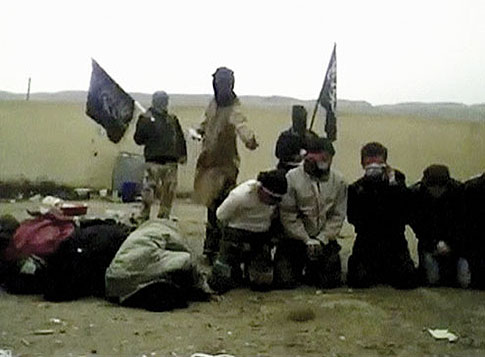
photo: reuters…and the shooting of prisoners
EXECUTIONS AND THEIR SPECTATORS: Outrage around the world followed each of the public releases of similar footage, but that outrage was somewhat low-intensity and would quickly be buried by other news, most often about the atrocities committed by Assad's forces. The cruel murder of Foley is the first news of this kind that haunts the world's media and politicians for a long time, and one cannot escape the impression that the reason for this is not only the morbidity of the act. First, Foley is the first American killed by IS since the outbreak of war in Syria in March 2011. In addition, only in the last few months, with the advance in Iraq, IS has become the arch-enemy of Western powers and neighboring countries, such as Turkey and the Sunni monarchies of Persia bays. Before that, the interests of the jihadists and the mentioned countries in Syria coincided, both sides wished for the end of Assad. It is telling that Foley was kidnapped in the Syrian city of Idlib two years ago, that it was known that he was kidnapped by IS members, just like Steven Sotloff a year ago, as well as dozens of other citizens of Western countries, and that it was almost never reported. not even a word until Foley was executed.
Along with the outrage over the beheading of Foley, in many reactions there is a thesis that nothing else can be expected from Islamic fanatics, with emphasis on "Islamic". At first glance, there seems to be something to it. Those familiar with the situation in Afghanistan know that many of the country's residents have mobile phone videos of brutal rapes, massacres and beheadings carried out by the Taliban; except in Syria and Iraq, cases of beheading of prisoners were also recorded in Pakistan. Only in some Muslim countries, such as Saudi Arabia, are death sentences carried out by public beheading. However, all this belongs to human pathology, which has nothing to do with religion, and even with Islam. Not all Afghans enjoy such videos, nor is it illogical that in a country that has suffered the horrors of war for forty years, a certain number of people become numb and begin to understand the morbid everyday life as normal, and it is not only Muslim countries known for brutal decapitations (See box "Balkan Rules") .
In addition, public murders are not only enjoyed in the East, the dark side of human nature has not changed much since the Middle Ages, when mobs in the squares rejoiced at executions, only in the new age television and the Internet have made the audience much larger. If it were not so, the video of the hanging of Saddam Hussein that was "accidentally leaked" would not have caused so much attention around the world, just like the video of the lynching of the half-dead Muammar el-Gaddafi in 2011, which was played on all the world's televisions for days. Contrary to the mentioned examples, when the American ambassador Christopher Stevens was killed in Benghazi on September 11, 2012, the images of his mutilated body were quickly removed from the world media at the request of the American administration, just as the news that Stevens had been exposed before the murder quickly disappeared sodomy; there was little talk about the fact that the radical Islamists, who carried out the aforementioned murder, were the US's allies in the war against Gaddafi.
HEAD ON SHOULDER AND LIVES LOST: Even in modern countries where heads are no longer beheaded, severed heads are sometimes accepted as evidence. In June 2002, a box sent by CIA agents from Afghanistan was delivered to Washington by plane. Inside the box was a head given to the agents by some Afghans in Kabul, claiming it belonged to bin Laden's aide Ayman al-Zawahiri. The said Afghans demanded a reward of 25 million dollars, which the US government promised for the information (or the head) of the terrorist. The reward was not paid, DNA analysis showed that the head still belongs to someone else.
Zawahiri's head remains on his shoulders to this day, but another senior al-Qaeda official, Abu Musab al-Zarqawi, was not so lucky. He was killed in 2006 by a missile fired from an airplane, in an action that everyone hailed as perfectly organized and precise, with only a passing mention that a young woman and a four-five-year-old girl were also killed with Zarqawi. This kind of "depersonalized" death, when liquidations are carried out from the heights of heaven, was brought to perfection by the actions of American drones in Pakistan, Yemen, Afghanistan. It is no longer necessary for the pilot to be above a certain place, it is enough to press the hand on the joystick somewhere far away and the drone performs the task. Only the number of victims (thousands of them in recent years) is noted, with the obligatory indication that they were extremists from Al Qaeda, IS, the Taliban; specific names are rarely mentioned, the "collateral damage" of the action, which includes women, children, civilians, is even more rarely acknowledged. The fear of an invisible enemy from above must be tearing everyone in the areas where drones operate.
On the other hand, brutal murders like the one perpetrated by IS on Foley are not solely the result of fanaticism, but cold-blooded planning aimed at sending a message that also instills fear. It was not by chance that part of the speech of Foley's executioner was "if you bomb us, we will light up like this", it was not by chance that the victim was wearing an orange jumpsuit, like the one worn by prisoners in Guantanamo. Modern technologies have made such messages easily and quickly reach every point in the world.
That the murder of the American journalist has another aspect is also shown by the news that IS members demanded a ransom of 132 million dollars from the US in exchange for Foley's release, which was published by the "New York Times", citing a source from Foley's family. Washington has refused to pay the requested amount, because the principled position of the US government, as well as the UK authorities, is that paying ransom for hostages is a "wrong policy" that provides funds for terrorist organizations. For such organizations, in which it is difficult to separate the ideological-religious and classic bandit lines, the kidnapping of foreigners is a profitable business. The "New York Times" stated that European countries have paid at least 2008 million dollars to the kidnappers of their citizens since 125, of which 66 million were paid last year alone. Foley's murder is also a message to those who are still thinking about paying the ransom.
THE NEW ARCHENEMY OF THE WEST: Anyway, the coexistence and cooperation of Western powers and Iraq's neighbors with extreme jihadist organizations is currently being swept under the carpet. US forces launched new attacks against IS positions in Iraq after the release of the video. After three years, Turkey closed its border with Syria to the unimpeded entry of forces opposed to Assad, most of whom were jihadists from all over the world.
All kinds of things are heard about ID these days. It is claimed that it is worse than al-Qaeda, that it is the richest terrorist organization in history. IS leader Abu Bakr al-Baghdadi is being declared the new terrorist icon, even bigger than Osama bin Laden. US Defense Minister Chuck Hagel described the Islamic State as a dangerous threat to the US and Europe, General Dempsey believes that it will be necessary to form an international coalition to oppose IS. It is difficult to escape the impression that the danger posed by the Islamic State to the Western world is being deliberately exaggerated (although the residents of the areas where the jihadists operate are in a panic for a reason), but also that this suits many parties in the conflict: the extremists themselves, because they are growing in their own eyes. future followers and sympathizers; Kurds, because as the only alternative to jihadists, they are never closer to recognizing their state; Assad, because the aforementioned coalition against IS cannot exist without cooperation with him; To the West, because he found another arch-enemy.
All kinds of things have been heard about IS, except for the recognition that support for any kind of extremism backfires, mostly on the domestic population, because extremists and criminals end up getting their way, in their own home or somewhere else. It was not even heard that news about innocent victims, mostly without pictures, which have been arriving for years from Afghanistan, Iraq, Libya, Pakistan, for which Islamic extremists are not the only ones responsible, is no less shocking than beheadings.
The shock in the West, especially in Great Britain, was caused by the knowledge that James Foley's executioner was most likely a British citizen. The first doubts arose because of his emphasis, then a similar claim was made by the French journalist Didier François, who was a prisoner of ISIS together with Foley, and was released in April. "Daily Mail" announced that the investigation of the suspects narrowed the circle to three young British Muslims. One is Abdel Majed Abdel Bari, 23, a former London rapper whose songs have been played by BBC Radio 1, who left his £500m west London home to join the extremists. Barry has already uploaded a picture of himself with the severed head of a Syrian soldier on the Internet. The second is Abu Hussein al-Britani, a computer hacker from Birmingham, the third is Abu Abdullah al-Britani, born in Portsmouth. According to British government estimates, there are around XNUMX British jihadists in Iraq and Syria. Some of them took to social media to celebrate Foley's killing and make jokes, one woman volunteering to kill the next British and American POW.
Throughout history, the beheading of an enemy, either as a trophy or as proof of a battle won, was a common occurrence on all meridians. Enemy heads were displayed in visible, public places, such as squares or city ramparts. Severed heads were often sent to rulers as proof of loyalty or a completed task: the heads of four Belgrade dahi, who were killed by Serbs and Turks together on Adi Kale, were skinned and stuffed with wool and taken to the Belgrade vizier, who had bad relations with the dahi. Miloš Obrenović sent Karađorđe's head to the Sultan in Istanbul. There are many sayings related to the customs of that time - The head goes., Head in the bag, Head to head. Beheading of enemies became rare in the Balkans from the second half of the nineteenth century, but some cases were also recorded during the Balkan wars in 1912.
In recent years, beheading opponents has become a common part of the fight among drug cartels in Mexico. Velibor Bakić and Miloš Rašić are accused of beheading Smailo Tarić with a machete in 2008 in Belgrade, due to unsettled accounts in the drug trade.
In recent times, the largest number of decapitations, about one hundred, was recorded during the war in Bosnia and Herzegovina from 1992 to 1995, mostly of prisoners. In the files of the International Criminal Tribunal for the former Yugoslavia, you can find data on actors and victims and descriptions of crimes. For example, several cases of beheading of Serbian prisoners by the "El Mujahid" unit, made up of volunteers from Islamic countries; the hanging of the severed heads of Bosnian Muslims at the "open market" in the municipality of Kiseljak, by members of the "Special Purpose Unit 'Maturica'", part of the Croatian Defense Council; the killing of Bosnian Muslims in July 1995 near the UN base in Potočari by a dozen soldiers of the Republika Srpska Army, by "taking these people to a kind of scaffolding, where they chopped off their heads with a machete and threw them on a pile". The signatory of these lines was told by a friend, a participant in the war in Bosnia, that he saw a man who kept the severed head of a Muslim impaled on a stake in front of his tent, which he mockingly greeted every morning. The aforementioned executioner was a multiple murderer before the war, and at the beginning of the war he was released from prison on the condition that he go to the front.
In the indictment brought by the EULEX international prosecutor against members of the Drenica group Sabit Geci and Sahit Jašari, the two are accused of physically harassing and killing police officer Ivan Bulatović in Glogovac in 1998, and that, according to the testimony of a protected witness, Geci beheaded him with a chainsaw Bulatović's head.