The Convention on the Status of Refugees from 1951 defines a refugee as a person who, due to a justified fear of persecution due to his race, gender, language, religion, nationality or belonging to a certain social group, or because of his political beliefs, is not in his country of origin and is not able, or because of that fear does not want to place himself under the protection of that state, as well as a stateless person who is outside the country of his habitual residence and who cannot or because of that fear does not want to return to that state.
However, when was the last time you heard of the term climate refugees? Climate change, ways to get in its way and its consequences are talked about, however, much less about the people who truly feel those consequences on their own skin. However, non-reporting and lack of raising awareness about this category of refugees does not reduce their number.
THREE CATEGORIES OF CLIMATE REFUGEES
Migration caused by climate change is not new. From the beginning of the world, through the nineteenth century and the great famine in Ireland, caused by the potato infection, from which almost a million people die, until today, they exist. However, the definition of climate refugees has been waiting for a very long time. The first to seriously address the topic was the Egyptian Essam el Hinawi, director of the United Nations environmental protection program. According to his definition from 1985, climate refugees are individuals or groups of people who, due to sudden or gradual changes in their environment, which affect their life or way of life, are forced to leave their place of residence or decide to do so, temporarily or permanently, and move within their own country or abroad.
Additionally, Essam el Hinawi notes that there are three categories of climate refugees. The first category includes those persons who temporarily move due to environmental disasters (natural or man-made), but who have the opportunity to return to their homeland. The second category consists of refugees who are forced to leave their homes permanently due to serious environmental disasters (natural or man-made). The third category includes people who emigrate temporarily or permanently because their lands have become barren due to environmental disasters.
From today's point of view, it seems that all the effort that Essam el Hinawi put in is just a dead letter. Climate refugees are still in legal limbo. What puts them in that situation is the fact that they are not running away from the war or the injustice that threatened their lives. Nevertheless, the efforts of the UNHCR and the UN Human Rights Committee to prohibit the return of "climate refugees" as persons at risk from the consequences of climate change and natural disasters are visible.
The explanation given by theorists is that this limbo is partly caused by the fact that, in practice, it is very difficult to draw a line between economic migrants, who are fleeing poverty, and those whose lives are really in danger due to climate change. In addition, it is pointed out that, if the definition of refugee is extended to include climate refugees, international organizations and states will be forced to make additional investments. It is clear that collective awareness needs to be raised about climate refugees, about people who die of hunger due to droughts and flee their homes in search of food. It is important to point out that when we talk about the reasons why climate refugees leave their homes, the responsibility is shared among all countries of the world.
SELECTIVE PROTECTION

Nigeria Floods A Family's JourneyUNCERTAIN FUTURE - ETHIOPIA, SUDAN, SOMALIA...: Climate change, violence and lack of protection and aid
However, the current situation does not contribute to raising awareness. If we make a retrospective of the past year, the image is created that there are currently only refugees from Ukraine. What that conflict contributed to was the application of temporary protection. It is a mechanism that, in times of severe refugee crises, effectively solves the problem of refugee protection. The question arises why this mechanism was not considered in 2015? Why was this mechanism never considered for refugees from Afghanistan or Syria, even though those two countries are considered "refugee factories"? It seems that today, in order for someone to be immediately recognized as a refugee, he must be from Europe and must be fleeing war. According to the statistics of the Kiel Institute for the World Economy, in the period from January 2022 to January 2023, when the ten largest donations are added up, weapons worth 64,3 billion dollars were donated to Ukraine. During his visit to Ukraine in February of this year, President Biden announced additional aid worth half a billion dollars. This kind of policy certainly contradicts the view of the doctrine that the eventual recognition of a new category, climate refugees, would mean additional investment.
At the same time, on the same planet, the World Food Program on its website, in addition to Ukraine, recognized 14 other countries as threatened. At the moment, the events in Ethiopia, where food donations for the most vulnerable were completely suspended at the beginning of June, are completely ignored. Namely, the suspension took place gradually, first in March 2023, donations were suspended for Tigray, where due to the consequences of the war, 5,4 out of six million people were brought into a situation of dependence on food aid. In June 2023, the suspension spread to the entire country. According to the UN, the suspension is due to the discovery of wheat theft. The suspension measure affects 20 million people. In a statement published by the UN on June 14, 2023, it is stated that in Tigray, the number of children admitted to hospitals due to malnutrition increased by 196 percent.
AND WAR AND CLIMATE
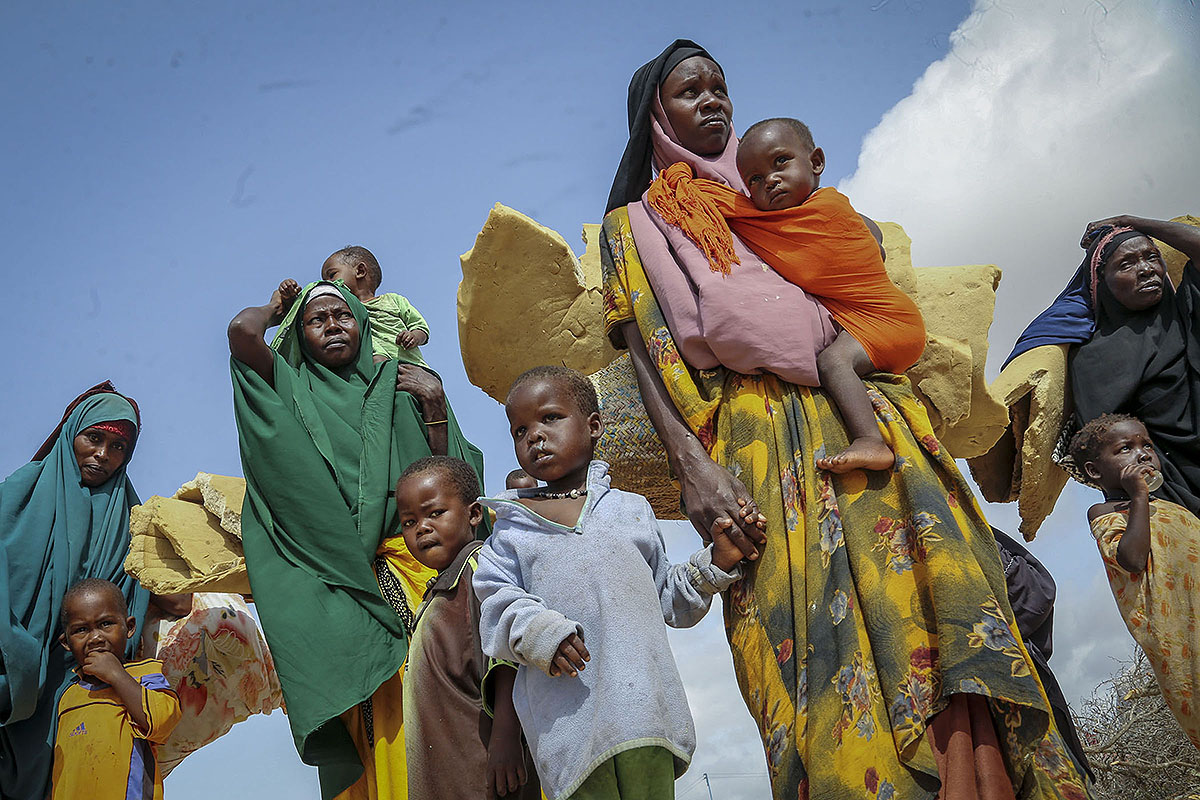
Somalia Drought...
Sudan and Ethiopia, located in the Horn of Africa, have long struggled with the consequences of climate change. Rising temperatures, erratic rainfall patterns and recurring droughts have significantly affected agricultural productivity, making it difficult for communities to secure enough food for their needs. These adverse climatic conditions disrupted traditional agricultural practices resulting in crop failure and loss of livestock, ultimately leading to widespread famine. In addition, climate change, lack of resources, and an increase in the number of hungry people have only further aggravated the existing tensions in those countries.
A similar situation is happening in South Sudan, which has been facing chronic food insecurity for years. Armed conflicts and economic instability have seriously hampered food production and distribution. Millions of people in South Sudan suffer from hunger and malnutrition. Prolonged droughts further exacerbate the situation by making it increasingly difficult for communities to grow enough crops and livestock. The consequences of hunger especially threaten vulnerable categories, namely women, children and the elderly. Children are most often victims of malnutrition, and there is also a high risk of developmental disabilities. According to Food and Agriculture Organization estimates from 2015, in order to eliminate hunger in the world by 2030, it was necessary to invest 237 billion dollars annually.
It seems that at the moment war is more important than hunger, such a situation only makes it even more difficult to get to know climate refugees. It is clear that there is currently no resolution to overcome the problem of climate refugees and the hungry. There, the solution is much easier to find than the one for resolving armed conflicts. The billions sent to Ukraine for weapons could have stabilized the situation in Ethiopia, South Sudan and Sudan.
East Africa Drought...
It is additionally worrying that, when reporting on the subject of refugees, information is filtered and sensationalism is sought, which certainly has no place in this subject. Also, what talks about war and conflict, compared to hunger, is much more widely read today. In addition, the fact is that there is currently no separate international agreement that explicitly talks about the concept of "climate refugees" or provides a comprehensive legal framework for their protection. The existing international legal framework, in the form of the 1951 Convention and the 1967 Protocol, mainly focuses on refugees who are forced to leave their countries due to persecution, conflict or human rights violations.
In the legal sense, we must hope for a new year of 1967; it was the Protocol that was adopted that year that made a significant step forward in the protection of refugees. With the adoption of the Protocol, time and geographical restrictions are abolished. We remain hopeful that something revolutionary will happen with regard to climate refugees, that is, that perhaps some new protocol will bring clear guidelines and criteria for granting protection to people fleeing due to climate change.
Climate refugees are a reality, and taking into account the way we treat nature, climate refugees have a guaranteed place in the future. "We do not inherit the earth from our ancestors, but lend it to our children." It is this thought of Antoine de Saint-Exupéry that should serve as a reminder that we are in charge of future generations.
The author is a lawyer at the IDEAS Research and Development Center