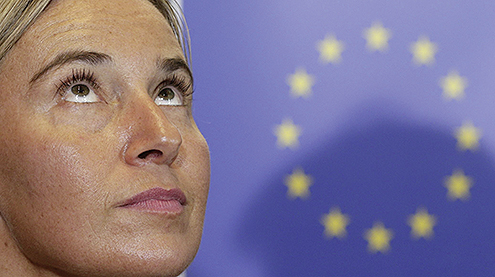
At the summit in Milan on August 30, European Union leaders nominated Polish Prime Minister Donald Tusk to succeed Herman van Rompuy at the head of the European Council, while the position of European High Representative for Foreign Policy and Security, British Catherine Ashton, will be succeeded by Italian Foreign Minister Federica Mogherini. It's a bold move by Italian Prime Minister Matteo Renzi: Mogherini has the analytical knowledge, but no operational experience to lead an institution of 3400 employees and an annual budget of 800 million euros, let alone try to create something that could be called a recognizable EU foreign policy.
Za "Time" from Rome
Crisis in Ukraine; the advance of the Islamic State (IS) in Iraq; chaos in Libya; current tensions between Israel and Hamas; relations with Iran and the nuclear issue and less than two weeks until the Scottish independence referendum - admittedly, no one in Brussels is sure anymore whether this belongs to common issues or just internal British ones, but...
Federica Mogherini's newly appointed "Mrs. European Common Security Policy" priority list is already full of hot topics. Having only been Italy's foreign minister for six months (the highest state office she has ever held) she is now in for very difficult times.
Federica Mogherini is young: she was born in 1973, and the seriousness of her smiling face largely represents the attitude of Italian Prime Minister Matteo Renzi, who arranged for her to replace the often too weak Baroness Catherine Ashton. Lady Ashton has often been criticized for being incapable of advancing a real common foreign policy while, to keep to the significance of her title, she was essentially not a real foreign secretary, but only the head of the European External Action Service, as that European body is officially called. . She only managed the diplomatic service of the European Union, and did not manage European foreign policy, since it does not exist in practice, given the fact that all major EU countries want to keep this political department for their state bodies. The new composition of the European Commission should strengthen the common foreign policy and should (which does not mean that it has to) strengthen the EU institutions in relation to the member countries, at least when it comes to relations with the rest of the world.
However, this is just a theory. As usually happens in the EU - especially in times of political, economic and legitimacy crises - the common institutions seem weak and unable to overcome the national resistances coming from all major countries: Germany does not want to give up its influence in the economy; France and Great Britain do not want to give up their "power" status; the northern countries do not want to be dragged anywhere near the Mediterranean vortex, while the southern countries - Italy in the first place - try to hide behind the curtain called "We need a common European policy", because they have neither the strength nor the idea how to solve the current crises that occur outside their borders.
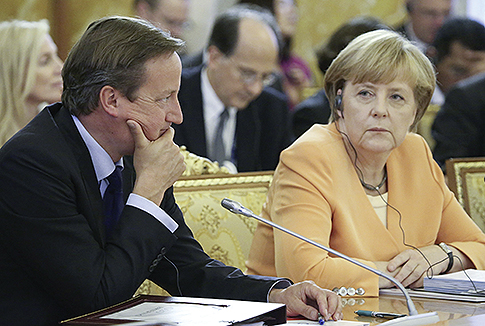
KEY PLAYERS: British Prime Minister David Cameron and Chancellor Angela Merkel;…
NO EXPERIENCE: The decision to push Mogherini into such a political context was made by Renzi personally. The decision, which some state and party officials say is somewhat brave, but also poorly calculated. Critics say - quietly and unofficially - that a more experienced person would be a better choice for both Italy and the European Union.
Why? Federica Mogherini is well informed and competent in international relations. Since 2008, she has been a member of the Parliamentary Defense Committee, where she closely followed some of the biggest international crises: from Afghanistan to the wave of revolutions and protests in Arab countries. Before that, and after studying political science, she worked in the Committee for International Relations of the Democratic Party (PD), where she closely followed all the changes that diplomacy went through in the last few years when non-state players appeared (from NGOs to terrorist networks) as primary factors of foreign policy which was once reserved only for state power.
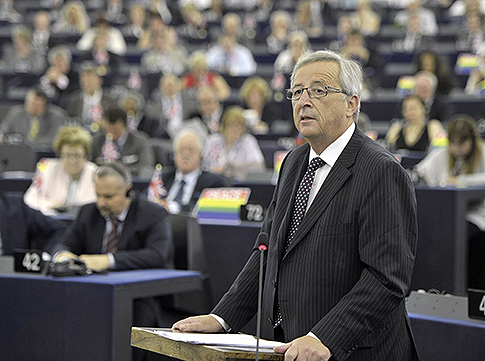
...the new president of the European Commission, Jean-Claude Juncker
On the other hand, her experience is more analytical than operational: while she was an MP, she was willing to engage in dialogue with civil society and non-governmental organizations, she listened to their views on the foreign policy of Italy (and Europe and NATO), participated at meetings and conferences. However, its initiative was rather weak, so the dialogue with spontaneous movements and civil society did not bring much, except for good intentions and a few declarations.
Even towards Afghanistan, a country whose situation it has followed for years, Italian policy has not changed much despite its commitment.
But more recently, since becoming foreign minister, her stance seems to have changed somewhat: she has been vocal in advocating for stronger sanctions against Russia over the Ukraine crisis, and during the conflict between Israel and Hamas, she flew to Cairo to support the Egyptian government's ceasefire efforts. She even openly demanded that European weapons and equipment be sent to the Iraqi Kurds in order to defend Iraq against the advance of the jihadists.
On the other hand, as Italy's presence on the international stage is quite weak, most of its actions happened because it "had to" react; there was no long-term vision or well-thought-out strategy, which is really not her fault, but the result of the long-term crisis that Italian diplomacy is going through.
Since the outbreak of the financial and economic crisis in 2008, Italy has been completely preoccupied with its domestic problems and very little attention has been paid to events beyond its borders or beyond the Mediterranean. All the responses to the crisis were just that: reactions at best, emergency measures at worst. For the most part, Italy just followed what other countries, like Great Britain or France, did or said. And, in this scenario, the European Union was a Godot to wait for.
CONFIDENTIAL PERSON: So, there are two questions that need to be answered: where did the Italian woman in Lady Ashton's armchair come from? And where did Mogherini come from?
The answer to the first question lies somewhere between Brussels, Berlin, London, Paris and Rome: whenever a new composition of the European Commission is chosen, there is an unwritten rule according to which big countries have the strongest positions, but so as not to steal too much from small countries. To put it politically correctly: the European Commission should be "representative". Considering that the Italian Mario Draghi leads the European Central Bank, Italy could not hope to get any "big" economic department (it would be really ironic if the European economy is led by the country with the weakest economy of all the big countries) so, in essentially, the only senior position left was the one held by Ashton. The Italian government reacted quickly and moved to get it.
Now comes the second question. More than anything else, Renzi wanted Mogherini purely for domestic reasons. The name of Emma Bonino was mentioned, already with the experience of a European Commissioner and a high reputation in international politics. Or even the name of former Prime Minister Massimo D'Alema (the one who headed the Italian government in 1999 during the war against Serbia over Kosovo). D'Alema was an excellent foreign minister before proving himself a desperate prime minister and his experience was not in doubt. Enrico Letta, the former prime minister succeeded by Renzi, could have been a wise choice given his excellent network of personal contacts around the world, as well as being an economic expert. Moreover, his appointment could heal the wounds in the Democratic Party caused by the growing dissatisfaction of a part of the membership due to Renzi's "bullying" leadership.
In fact, the choice of Mogherini served Renzio in two ways: to have a trusted person at the heart of the EU machinery and to show the Italian media and public that Rome is still wondering about consensus in the Union. It doesn't really matter that "Ms. PESC" (Italian for Common European Security Policy) won't be asked much in Brussels. Finally, Mogherini's "dialogue experience" will be valuable in Brussels where the "external action service" actually has very little action and much more sweet talk "toward the challenges and opportunities ahead" - to use common EU slang.
Renzi got his way because his Democratic Party has the strongest delegation within the caucus of socialist and social democratic parties and because it is the only member of the Socialist International to win European elections at home. And also because, when he decided on Mogherini, only a third of the candidates for the post of commissioner were women: so there was no chance that his proposal would be rejected.
The big "but" is hidden in something that Mogherini is not aware of: she has no experience in economics or international trade (a new free trade agreement between the EU and the US is on the horizon). That is why it is quite likely that the Italian voice in Brussels on economic topics will be very quiet, and that quiet voice will come from Rome, from Matteo Renzi himself. This is exactly the attitude that will not strengthen the European institutions, but will further weaken them, leaving the member countries to be masters of their own interests, although none of them, not even Germany (not to mention Britain) can think outside the European framework anymore. although they occasionally dream about it.
Translated from English by Radoslav Ćebić
The new troika of the EU
The eighth consecutive elections for the European Parliament were held between May 22 and 25, 2014. Although he led the campaign of conservative European parties that won a majority, it took a month to reach an agreement to actually nominate Luxembourg's Jean-Claude Juncker as the new president of the European Commission. Against him were primarily the Prime Minister of Hungary, Viktor Orbán, which is less important, and the Prime Minister of Great Britain, David Cameron, on whom and how the future of the European Union depends - he is for the British, if he wins the next elections and if the EU, among other things, does not accept to reduce the influence of the European Commission on nation states, promised a referendum on leaving the Union in 2017. For Cameron, the nomination of Juncker was "a bad day for Europe", because he is "the embodiment of a European bureaucracy that tries to weaken the position of nation states". He was angry with certain heads of government of the EU countries, because they "changed their minds" regarding the nomination of Junker.
From Junker, after the "weak" Jose Manuel Barroso, the majority of EU members expect to form a strong commission that, if necessary, will be able to resist the demands of heads of state and government motivated by narrowly national interests and to create European policy, which is probably why she is the chancellor. Germany's Angela Merkel hesitated for some time to support his nomination. Mission impossible, one would say, but the very hint of that possibility caused a storm in London. With the enlargement of the EU, the idea of creating a European "superstate", a European identity, a common foreign and security policy, at some point, is part of the program of all European enthusiasts.
The election of Junker "as a finger in Britain's eye" resulted in deeper compromises that had to be made during the election of the new president of the European Council (in which the heads of state and government of the 28 EU member states are represented) and the representative of the EU for foreign policy and security. . It took three EU summits and three months, and it will take at least that much more until they form their teams, and until it all goes through the European Parliament. Juncker, on the other hand, could not assemble the Commission team until the other two key positions were filled. This whole process shows all the proverbial weaknesses of the EU institutions, which spend a lot of energy and time on endless compromises, compromises around compromises, and constantly gallop to events both on the world and on the internal, European, political scene.
Thus, the choice fell on Donald Tusk, the Prime Minister of Poland, as the President of the European Council (instead of Herman van Rompuy), and the Minister of Foreign Affairs of Italy, Federica Mogherini, as the representative of the EU for foreign policy and security (instead of Catherine Ashton). A European dream couple, one might say: He is a 57-year-old conservative, she is a 41-year-old social democrat; man and woman; he is close to Angela Merkel and acceptable to David Cameron, she is the son of Italian Prime Minister Matteo Renzi and close to French President Francois Hollande; he, the first Eastern European in such an important position in the EU who, as a member of Polish Solidarity, was active in the fight against the influence of the USSR and for democracy, that "born, passionate" European, part of the generation that grew up with the European idea; he, as a Pole, without any understanding of the new Russian "expansionist" policy, she, from the left of the traditional EU state, with a certain understanding of Russia's position.... The form is certainly fulfilled.
Tusk, however, is still learning English, so it is not entirely clear how he will "manage" the quarrels within the European Council, when the crossfire starts - with simultaneous translation, I guess. But, even as the Prime Minister of Poland, he knows how the system works and is on an equal footing with other colleagues, heads of state and government. For Mogherini, who is not politically hardened, some wonder if she can pass the so-called "Lavrov test": to successfully end the several-hour, heated discussion with the "pit bull", the Russian Foreign Minister Sergey Lavrov. The question is whether she is up to the task of managing the "ministry" of EU foreign affairs with 3400 employees and a budget of 800 million euros per year and to give it greater importance within the EU institutions. Baroness Ashton did not manage to do that, let alone create a recognizable European foreign and security policy.
Andrei Ivanji photo: reuters
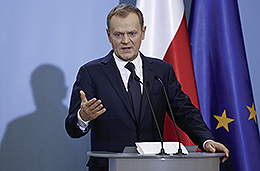
Donald Tusk - President of the European Council
Donald Tusk (31), historian, Polish politician of the Kashubian nationality born in Gdańsk, former member of Solidarity, Prime Minister of Poland since 2014, president of the liberal-conservative party Civic Platform, which was founded in 1957.
The Polish government headed by Tusk has successfully amortized the global economic crisis. He says that during the seven years of his prime ministerial mandate in Poland, GDP growth reached 20 percent, and that financial discipline was established at the same time. This is mainly explained by the fact that Poland has a relatively large domestic market and that it has retained the zloty as its national currency.
Tuska was officially nominated for the presidency of the European Council by the Polish government, only when she failed to push her foreign minister, Radek Sikorski, to the position of high representative for EU foreign policy and security.
Donald Tusk emphasizes that there is no European Union without Great Britain, with which he is ready to make a compromise so that the latter does not leave the Union, so his appointment was supported by British Prime Minister David Cameron.
Tusk complains that he speaks foreign languages poorly, so in the past months he attended an intensive course in English and, according to the Polish press, managed to "somewhat" master it.
Certain media outlets report on the especially cordial relations between Tusk and German Chancellor Angela Merkel: They are of similar age, both have experience from the totalitarian regime, both diligently nurture German-Polish reconciliation.
By ethnic origin, Tusk is a Kashubian. The Kashubs are a small Slavic people living in Polish Pomerania. According to the population census in Poland from 2002, about 5000 people declared themselves to be Kashubian by nationality, while about 51.000 declared themselves to speak the Kashubian language. It is believed that there are about 300.000 people who are of Kashubian origin, but declare themselves Poles in the census. Poles consider the Kashubian language (a West Slavic language with some German loanwords) to be a dialect of Polish.
Tusk was attacked by individuals because his grandfather allegedly volunteered for the Wehrmacht. According to another version, the grandfather was mobilized into the Wehrmacht while he was in a prison camp, since after the partition of Poland, the part in which he lived was treated as part of the Third Reich, and its inhabitants as conscripts.
What is happening in the country and the world, what is in the newspapers and how to pass the time?
Every Wednesday at noon In between arrives by email. It's a pretty solid newsletter, so sign up!
Thousands of people gathered in Tirana for a new anti-government protest. Demonstrators threw stones at police and set fire to the entrance to the Ministry of Agriculture, while law enforcement responded with tear gas, water cannons and rubber bullets.
The French Ministry of the Interior estimated that there were around 410.000 people at the protests, while the CGT union stated that there were close to 800.000. In Paris, the police used tear gas and water cannons
The Israeli human rights organization "Bethlehem" has condemned the plan for the "forced displacement of Palestinian residents" from a settlement in Hebron.
"Now they are talking about the threat from Russia and the beginning of preparations for war with Russia, which, in my opinion, is a kind of political schizophrenia," said Russian President Vladimir Putin
There is, literally, no difference between the one who claims it is day in the middle of the night, or the one who claims to be a giraffe, from the claims we read on billboards: that Vučić is working to unify Serbs and that Serbia is doing better and better day by day.
The pre-election arrests due to the alleged "overthrow of the state" testify to the regime's panic. The bad news for them is - they can't arrest the whole people who decided to defend themselves from progressive beatings and election theft
The ring that tightens around Ćaciland Student list is getting narrower. Because there are more and more spoiled people who see the false prophet for what he is: a street obscener who is fighting Serbia
The archive of the weekly Vreme includes all our digital editions, since the very beginning of our work. All issues can be downloaded in PDF format, by purchasing the digital edition, or you can read all available texts from the selected issue.