The World
New chaos in American aviation: 1.600 flights canceled
Air travel disruptions in the US continued, with 1.600 canceled and nearly 3.600 flights delayed. Donald Trump is asking for more funding for air traffic control
Bearing in mind the burden of the past and the inherited mentality, building a better judiciary according to the measure of liberal democracy will be a huge road. On the way to more credible institutions, the bravest should be precisely those who plead for the citizens to trust them, with the fact that we should never lose sight of the fact that the process of building respectable institutions is a two-way street in which Serbian society must equally participate by changing its idea of the judiciary.

Some time ago, an old friend of mine called me and asked if I could somehow help him with the solution legal problems. He, of course, knew what I was doing, so he counted on the fact that I could certainly find a solution for him. And yet, as our conversation progressed, I realized that I couldn't really help him much since it was a litigation matter, so I discreetly pointed out to him that he had to go to someone to the lawyer who deals with civil law, but he still insisted. Not fully understanding what it was all about, we continued a long conversation in which I explained to him some legal institutes, that is, some general areas of litigation, so that at the end of our conversation he would get angry with me, saying how tired he was of all that, after which he sighed and said: "Let it all go, do you know anyone in that sudu? "
I was taken aback by the question, although it was not the first time that I tried to explain and explain the procedures to my friends, to which they would interrupt me, asking for some other kind of help that I could not provide. At the same time, through conversations with other colleagues, I saw that they were equally faced with seeking this kind of help. All this made me think then and now whether my fellow citizens even understand the role of the judiciary in a society and those of us who work in it, whether we are judges or public prosecutors. Which is why a good part of our country's citizens experience justice through the established narrative that disputes can be resolved through "connection" and that it is enough to know someone there in order to resolve a case. I am of the opinion that this is another one of the many misconceptions that a part of our people suffers from, considering the deep-rooted tradition of not going to doctors and judges without gifts.
Therefore, I asked myself whether we need such or a different judiciary. Should it be a mirror? Serbian society and mentality, that is, is it reflected in other people or in the Constitution and laws? Why do a part of the citizens perceive the holders of judicial functions as "officials of the middle rank of the state", and not as protectors of their rights from all authorities?
MATRICES OF OBEDIENCE AND LOYALTY TO MASTERS
In order to be able to answer these questions, we must reach a little into the past, which will make us think and question whether it is even possible to get out of the legacy of the system of unity of power inherited in a socialist society. At the same time, the collapse of socialist institutions did not disappear the long-cultivated way of thinking according to which the judicial power emanated from the authority of the executive power, even though it was tried "in the name of the people", which was then known as the only sovereign holder of power. Then again, it is unfair to attribute this phenomenon only to the regime established during the period of communist rule, because the problem did not arise then, but that system of undivided power perfectly fit into the already deeply embedded cultural patterns of behavior of the inhabitants of this climate. Namely, nurturing the matrix of obedience and loyalty to the masters extends all the way to the Byzantine and Ottoman periods.
Hence, regardless of the fact that our nation freed itself from the external conqueror over time, it did not manage to fully fight the internal "enemies" of freedom, even though it transferred the won freedoms into its constitutions drawn up in the period from 1835 to 2006, trying to limit the power of its own sizeren, that is, the executive power. Thus, the past constitutional reform in the field of justice reminded us again of the tripartite division of power into legislative, executive and judicial, the relationship of which is based on mutual checks and balances, with an explicit statement that the judiciary is independent.
However, the Serbian soil is such that the sown seeds of the rule of law and the rule of law sprout more slowly, and in reality we see how the legal and political culture gallops behind the legislator. Working in the Public Prosecutor's Office for more than fifteen years, I realized that human nature changes the slowest and that the path from writing to applying the law is much longer and thornier than I could have imagined. That's why I'm not surprised by the story at the beginning of the text, because consciousness formatted like that is difficult to change and it's a process in which everyone should start from themselves, where the impulse to a new way of thinking should undeniably be provided by the political and legal elite of this society, primarily through their behavior in the private and public spheres of life.
However, we are witnessing a time in which some political and social actors are dissatisfied with the decisions of some judges and public prosecutors, commenting on their professional work, attacking their personalities more than the decisions made. On the contrary, the functional division of power rests on the mutual respect of actors who exercise power on behalf of citizens, but since citizens do not punish politicians in elections for attacks on judicial power, we see that there is a lack of responsibility for the publicly spoken word.
Moreover, by occupying a large part of the media space, politicians managed to create an opinion about the holders of judicial positions as corrupt officials. This is also supported by the recent public opinion survey of the European Commission (Eurobarometer), conducted in March and April 2026, from which it follows that the trust of Serbian citizens in the judiciary has fallen by about seven percent compared to the previous report from October/November 2025. This, as well as the OSCE reports, note the growth of the perception of political influence on the courts and the prosecution, dissatisfaction with the efficiency of court procedures and a low level of belief that everyone is equal before the law. At the same time, researches in previous years have shown that less than half of the citizens have confidence in the judiciary, and that the main problems that citizens face are the slowness of proceedings, corruption and the uneven practice of the courts.
But what can judges and public prosecutors do in terms of changing the wrongly anchored awareness and impression of citizens about the judiciary?
ADVANCEMENT AS A COVENANT FOR THE FUTURE
It is clear that they, too, should, by their actions, contribute to changing the deeply held belief about the "incompetent and corrupt" judiciary. In this regard, we should point out an encouraging survey conducted by the World Bank last year, in which it was observed that citizens who had some contact with the judicial authorities have a much better opinion of the work of the judiciary than shown by previous polls in surveys that are more based on perception. This is because I know from personal experience how extremely dedicated most of my colleagues are to their work and that most of them are truly committed to the fundamental values on which the rule of law rests. That's why I think that people who had a close encounter with prosecutor's offices and courts were able to make sure that in those systems there are valuable professionals dedicated to preserving and applying the Constitution and the law.
On the contrary, the perception of the general public remains at an unenviable level due to the fact that many of them are not ready to talk about their work in public, sticking to the position that they tell about their work through their indictments and verdicts. However, in the era of mass media that creates digital noise and when the narration of facts is much more important than the facts themselves, that approach has been overcome because the televised Serbian nation wants to see and hear prosecutors and judges, especially in disturbing cases with high public attention. Then you cannot communicate with it through announcements, but you have to meet the spirit of the curious information society and offer it the voice and stature of the one who acts in the specific case. In this way, the tension would be calmed down, and the most important thing is that the citizens would receive the most credible information.
Therefore, we need a more proactive and transparent judiciary that meets the events, anticipating what the public's reaction might be. The worst option is silence, because this creates the impression that the judiciary is hiding something from its citizens. Therefore, to restore public trust in the judicial system, the first step must be taken by those who create that system. I am of the opinion that a lot has been done in that direction, especially lately due to the frequent attacks of the highest political and social actors on the judiciary. Namely, there are more and more individual appearances of judges and public prosecutors in public discourse, then there are their traditional associations, as well as new modalities of organizing on social networks. Together, these are different types of pointing out the problems of the rule of law, the pillars of which are the separation of powers, the independence of the judiciary, the rule of law and free media.
Let me conclude. Bearing in mind the burden of the past and the inherited mentality, building a better judiciary in line with liberal democracy will be a huge road. On the way to more credible institutions, the bravest should be precisely those who plead for citizens to trust them, with the fact that we should never lose sight of the fact that the process of building respectable institutions is a two-way street in which Serbian society must equally participate in changing its idea of the judiciary. It is especially important to change the awareness of public prosecutors and judges as independent bureaucrats, since their independence was established for the sake of citizens, because they are their shield against the potential arrogance of any government. This kind of obfuscation is a promise for the future and a highway to a truly independent public prosecution and an independent judiciary. Therefore, for a higher quality third branch of government, the formation of an alliance of citizens and their judiciary is necessary.
The author is a member of the Board of Directors of the Association of Prosecutors of Serbia and an elected member of the High Council of Prosecutors from among public prosecutors
Real journalism costs money, and we will not be bought by tycoons and corporations. Support us with a one-time or monthly donation. The time for it is now!
Air travel disruptions in the US continued, with 1.600 canceled and nearly 3.600 flights delayed. Donald Trump is asking for more funding for air traffic control

More than 1,6 million voters will be able to go to the polls today to elect mayors and municipal councilors in all 212 municipalities in Slovenia.

At the consultations before the constitutive session, the Student List announced that the leadership of the Assembly will be decided by the majority, without prior agreement on the distribution of functions. Brnabić assesses this as an interruption of the practice of respecting the opposition

Justice must never again depend on who is in power, because it applies to both "ours" and "theirs". The winners fought for it. Other affairs can wait, even if it is foreign policy - Europe is here, it will not run away

All this is the logical cause of Vučić's hysterical reaction to the mention of regulating the local media space. A mild attack on Prva and Informer televisions led to protests by "loyalists"

Aleksandar Vučić does not constitute reality with his language, but an illusion, the only thing is that now he will no longer be able to impose the illusion on police batons and paid beaters. He showed this at the constitutive session of the National Assembly
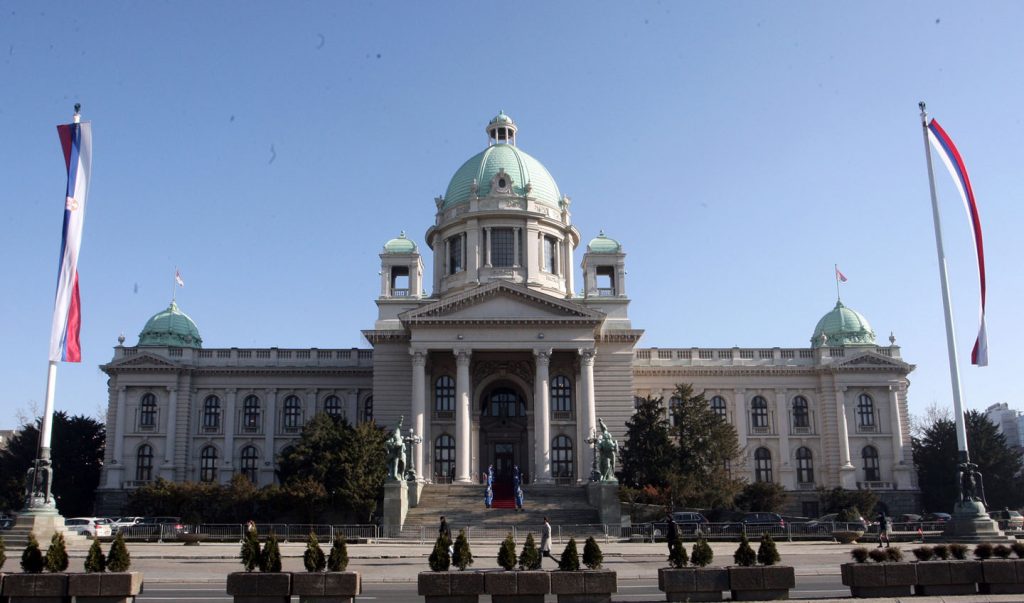
On Tuesday, November 17, the constitution of the National Assembly begins, in which the Student List has an absolute majority. Why is this day historic for Serbia?

Aleksandar Vučić would like Serbia to be grateful to him for not turning the election defeat into violence. Before that, he would have to explain what the preparations for election night were for, first of all in Pionirski Park

Interview: Branko Stamenković, public prosecutor of the Supreme Public Prosecutor's Office
A black picture and the breakdown of the rule of law subscribeThe archive of the weekly Vreme includes all our digital editions, since the very beginning of our work. All issues can be downloaded in PDF format, by purchasing the digital edition, or you can read all available texts from the selected issue.
See all