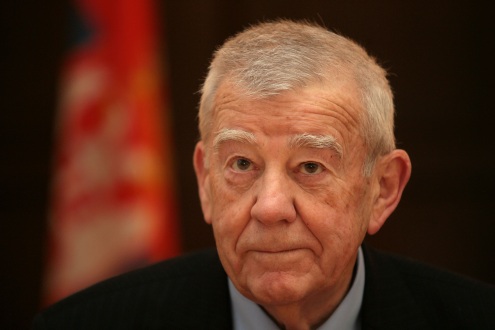
Živorad Kovačević, politician, diplomat and writer, ended his incredibly rich life on the evening of March 23.
He was born on May 30, 1930 in Jagodina. He graduated from the Sixth Male High School in Belgrade and graduated in 1952 from the High School of Journalism and Diplomacy in Belgrade. He received his master's degree in political science in 1961 at the University of Berkeley in California, on the subject of city management, and specialized in international relations in 1963 at Harvard, USA.
In 1948, the High School of Journalism and Diplomacy was founded in Belgrade, where Kovačević studied together with Jugo Grizelja, Aleksandar Nenadović, Vladimir Bulatović Vib, Vasko Ivanović, Dragan Marković... Perhaps this is where his excellent communication with journalists originates. "It was a great school," he later recalled. "We learned several languages each, which was fantastic at the time. Unfortunately, they shut it down after only four years. They liquidated the party organization and that was the end of it. I was responsible before the party committee for, as it is said even today, an editorial mistake. I edited a wall newspaper and wrote for someone, something like: He was born in 1929 as a sign of protest against the monarcho-fascist dictatorship. The end. That led me to the army."
He was the editor-in-chief of the magazine "Komuna" (1954-1962), director of the Republic Institute for Public Administration (1962-1964), undersecretary in the Republic of Serbia's Executive Council (1964-1967), general secretary of the Permanent Conference of Cities and Municipalities of Yugoslavia (1967-1973 ).
From 1974 to 1984, he was the mayor of Belgrade, then a member of the federal government of SFRY.
He was the ambassador of Yugoslavia in Washington from 1987 to 1989, when he was recalled due to disagreement with Slobodan Milošević's policies. During that short ambassadorial mandate, he significantly contributed to the transfer of the legacy of the American scientist of Serbian origin, Nikola Tesla, to Belgrade.
After his dismissal from the Ministry of Foreign Affairs, due to the political risks for the consulting firm "Pro-man", which he founded with friends, he took early retirement in 1991. He was an active member of several non-governmental organizations, from 1994 in the European Movement in Serbia, of which he is the president became in 1999. He was also the co-president of the Igman Initiative, which gathers 140 organizations from the so-called of the Dayton Triangle gathered around the idea of establishing relations similar to those existing in the EU on the territory of Southeast Europe. He was the president of the Foreign Policy Council of the Ministry of Foreign Affairs, which was formed on September 6, 2007 at the initiative of the head of Serbian diplomacy, Vuk Jeremic.
He is the author of the books "Urbanization in the World and in Yugoslavia", "USA and the Yugoslav Crisis", "Serbia and the World: Between Arrogance and Humility", "International Negotiation" and "America and the Disintegration of Yugoslavia", as well as three dictionaries on which he worked 14 year: "Serbian-English dictionary of idioms, expressions and sayings", "English-Serbian phraseological dictionary" and "Serbian-English phraseological dictionary". He spoke English, French and Russian.
The mentioned dictionaries of Živorad Kovačević, which have undergone several updated editions, were evaluated by experts as "by far the largest bilingual dictionary of English idioms that has been published so far in our country, and very likely in the world" (29.000 idioms and 1200 proverbs) and a dictionary that "in all its elements meets the highest standards, and sometimes exceeds them".
He himself once said that he was grateful to Slobodan Milosevic for everything he did to him. "I imagine the time when someone will flip through one of my dictionaries and wonder: imagine, the author of this dictionary was also a mayor, a minister and an ambassador... I hope it will be like that," he said in an interview for "Illustrated Politics" some time ago a year. "Because anyone who has the support of the party can be mayor, minister and ambassador." And this can only be done by a person - alone".
With the book "America and the Disintegration of Yugoslavia", he joined a large number of authors of studies and memoirs dealing with the wars of the 600s on the territory of Yugoslavia (the Library of Congress in Washington has about XNUMX titles on the subject). Živorad Kovačević's study is nevertheless "a significant contribution to the understanding of everything we have been through, stimulating and provocative literature for thinking about whether everything had to be like this".
He collected his diplomatic knowledge and experience in the book "International Negotiation", which is intended primarily for those young people who are studying to be diplomats.
Sam had the privilege of personally meeting six presidents of the United States of America - John F. Kennedy, Richard Nixon, Gerald Ford, Jimmy Carter, Ronald Reagan and George W. Bush. With them, five secretaries of state - Henry Kissinger, Cyrus Vance, George Shultz, James Baker and Lawrence Eagleberger, and three national security advisors: in addition to Henry Kissinger, Zbigniew Brzezinski and Brent Scowcroft.
He valued his student acquaintances equally, considering that they were more important to him than his master's degree.
While specializing in international relations at Harvard, his mentor was Henry Kissinger. "Much later, Henry Kissinger helped me immensely as the ambassador of the SFR Yugoslavia," he said in an interview for "Illustrated Politics". "I just came to Washington, and Henry Kissinger was supposed to give a lecture attended by the entire diplomatic corps. He was a big star, still in a hurry. To my surprise, before he started his presentation, he said: ``I must not start without first greeting my great friend, the ambassador of Yugoslavia.'' I was confused, but with that, he practically opened all the doors for me. Well, on the same day I received polite invitations to dinner from the ambassadors of Germany and the Soviet Union."
He considered it fortunate that he became the mayor of Belgrade at a time of great expansion, but also unfortunate that he replaced Branko Pešić in that position, "an original personality of exceptional abilities and energy, who was truly dedicated to Belgrade like no one before, and I would say, not even after him." ". The mayor's phone number could be found in the public directory, so it happened that citizens would call him in the dark, to complain about the lack of water: "Kovačević? It's me. President? Yes. Well, President, I've had no water for three days, you have to do something! Okay, give me your address and phone number, I'll see what's up, I'll let you know." The story is known, the workers accidentally cut the water pipe, the repair of the defect is in progress. When he heard that the water had been turned on, the mayor answered the phone: "At half past two in the morning, I called the person from last night." After persistent ringing, answer. Hello, this is Živorad. Which Živorad? President of the City Assembly: I am calling you only to inform you that the fault has been fixed. I know, I know, why are you waking me up so late - and slams the phone. They didn't stop teasing me at night, but at least I had that little revenge."
And he looked at the "expulsion" from Washington with a touch of humor. His appointment in 1987 was opposed by Slovenia, which wanted its own man there. By coincidence, two years later, Janez Stanovnik, then President of the Presidency of Slovenia, visited Washington. He used one of the gatherings he participated in to attack the politics of Slobodan Milosevic. Živorad Kovačević reported this to Belgrade in a moderate dispatch, not wanting to add fuel to the fire. "That the chase had started, I found out from the text in 'Ekspres', which was jointly signed by Dragoljub Milanović and Slobodan Jovanović," he remembered later. "It was written, roughly, how our ambassador in Washington organizes gala receptions and swims in Niagara, while the poor people in Kosovo are suffering and bleeding... After that, the inevitable Nikola Ljubičić called, so that the circus would then move to the infamous (' Politikin') rubric "Echoes and Reactions". Although the competent commission of the Ministry of Foreign Affairs positively assessed Kovačević's work, he was recalled in July 1989 under the pressure of Slobodan Milošević.
He survived all that and, fortunately for us, left behind a work by which he will be remembered.