

Nutrition
A craze among young people: Are protein shakes harmful?
Protein shakes, bars and puddings are increasingly popular, yet experts warn that excessive protein intake can be harmful
In the time before and after the first deployment of the future Croatian army, meetings of the presidents of the six Yugoslav republics were held. It was quite clear that the Serbian leadership led by Slobodan Milošević, the Serbian-Montenegrin bloc in the Presidency of the SFRY and the heads of the JNA, Generals Veljko Kadijević and Blagoje Adžić, viewed that act as a unilateral Croatian secession that should be thwarted by the action of the JNA, which would disarm the newly formed paramilitary units in Croatia and Slovenia. The then divided Presidency of the SFRY with Stjepan Mesić at the head, however, did not approve the intervention of the JNA. Croatia and Slovenia continued to illegally arm their military formations and create assumptions for independence, the presidents of BiH and Macedonia, Alija Izetbegović and Kiro Gligorov, unsuccessfully proposed a third path in the form of a "community of Yugoslav republics", the JNA was preparing for a short-term intervention in Slovenia, which ended in debacle, and a good part of the Serbs in Croatia, with the help of the JNA, Serbia and Montenegro, declared SAO Krajina. In September 1991, the Croatian occupation of a large number of JNA barracks on the territory of Croatia followed, and then the serious arming of the newly established units with funds from the occupied barracks.
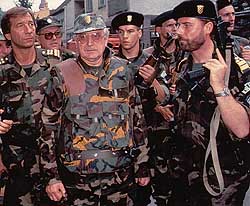
Armed Forces Day in Croatia is May 28, which is also the day of the Croatian Army. The other two branches of the Armed Forces - the Croatian Navy and the Croatian Air Force - celebrate their special celebratory dates along with this date. Navy - September 18: according to the battle that the soldiers of the Croatian prince Branimir fought with the Venetians near Makarska in 887, although serious historical sources and historians such as Neven Budak from the Faculty of Philosophy in Zagreb state that it was a classic land battle that only indirectly had contact with ships. Air Force and Air Defense - December 12, because on that day in 1991, the establishment of HRZ was announced by the decree of the then President Franjo Tuđman. The first combat aircraft were brought in by Croatian pilots who had left the JNA.
On the twenty-eighth of May 1991, at the NK "Zagreb" stadium in Kranjčevićeva Street, the officers of the Croatian Army, which will formally be founded on November 3, 1991, lined up for the first time in front of the then President of the Presidency of the Republic of Croatia Franjo Tuđman and the military and civilian leaders: they were parts of four brigades of the National Guard Corps (which, as we said, will soon be renamed the Croatian Army), and several smaller unit from the active and reserve composition of the MUP of the Republic of Croatia. And the National Guard Corps was formally placed under the organizational wing of the MUP (the minister at the time was Josip Boljkovac), and the reason for this lay in Tuđman's political tactics, which ordered Croatia to prepare for war, but not to manifest visible forms of independence and statehood before making formal decisions on secession from the SFRY, namely, the decision that will follow a few months later. The command of the ZNG units belonged to the Ministry of Defense (the minister was retired JNA Colonel-General Martin Špegelj), until on September 21, 1991, the National Guard Corps Command was formed within the Ministry of Defense, headed by Colonel-General Anton Tus, who left the post of Chief of the Yugoslav Air Force and Air Defense immediately before that appointment. When the Croatian Army was formally established, the ZNG Command became the Main Headquarters of the HV.
CREATION SILE: In Croatia, May 28, 1991 is perceived as the day when the germ of the future armed force was created. On that day, Franjo Tuđman spoke as follows: "You took an oath today and assumed a great and noble obligation. Decisive moments are ahead of us. I hope that through democratic means we will prevent those who want to work on our heads. But, if necessary, we will all defend our freedom and sovereignty to the last. Less than a year after the establishment of the new democratic government, we started our armed forces and under normal conditions this would be quite logical. But we live in abnormal conditions. We have been faced with various threats from the very beginning. We showed dignity and consideration. We are a peaceful nation, but we must create force, because there are those who would want to oppose Croatian freedom and sovereignty. The National Guard has the task of ensuring peace for all citizens of the Republic. That is why you must first of all gain the trust of all citizens. Until recently, people in uniform were hated by the people, because of the government they belonged to. No nation has chosen freedom without sacrifices. Unfortunately, we have already given them. We are for peace and democracy without victims, but we know that all of you and the people will stand up as one if our freedom should be defended. You are the beginning of the future Croatian army. We will not arm ourselves for the sake of conquering other people's territories, we will have as much as we need for the freedom of Croatia and the Croatian people as a whole."
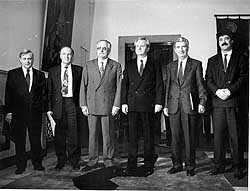
In the time before and after the line-up in Kranjčevićeva street, constant meetings of the presidents of the six Yugoslav republics were held. There was no special reference to the first review of the Croatian police and military units, but it was quite clear that the Serbian leadership with Slobodan Milošević at the head, the Serbian-Montenegrin bloc in the Presidency of the SFRY and the heads of the JNA (generals Kadijević and Adžić) viewed that act as a unilateral the Croatian secession, which should be thwarted by the action of the JNA, which would disarm the newly formed paramilitary units in Croatia and Slovenia. However, the then-divided Presidency of the SFRY led by Stjepan Mesić did not approve the intervention of the JNA. Croatia and Slovenia continued to illegally arm their military formations and create assumptions for independence, the presidents of Bosnia and Herzegovina and Macedonia, Alija Izetbegović and Kiro Gligorov, unsuccessfully proposed a third path in the form of a "community of Yugoslav republics", the JNA was preparing for a short-term intervention in Slovenia, which ended in debacle, and a good part of the Serbs in Croatia, with the help of the JNA, and Serbia and Montenegro, declared SAO Krajina. In September 1991, the Croatian occupation of a large number of JNA barracks on the territory of Croatia followed, and then serious arming of the newly established units with funds from the occupied barracks. At the end of October 1991, an agreement was signed on the withdrawal of the JNA from Croatia, and the agreement enabled the JNA to withdraw a part of its assets to Bosnia and Serbia.
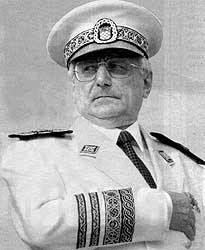
Today, the mentioned date is marked by military parades and state receptions, but during the 28s, for Franjo Tuđman's government, it was not quite like that: Tuđman did not particularly mark May 2000 because, apart from him, at that first line-up Kranjčević's central figures were ministers Martin Špegelj and Josip Boljkovac, whom Tuđman later got rid of, because they did not fit into his Greater Croatian plans in Bosnia and Herzegovina. The celebration of that date was revived after the arrival of the coalition government and the new president of the Republic of Mesić in XNUMX.
Today's leading men of the Main Staff and branches of the Armed Forces of the Republic of Croatia started their military career either in the JNA or in the Croatian military formations that began to be formed in mid-1991. Before the war, the current Chief of the Main Staff, General Josip Lucić, graduated from the Faculty of Physical Education in Zagreb, and at the beginning of the war he was one of the commanders of the MUP's special units. There is not even a day of military education. The Deputy Chief of the Main Staff, Colonel General Slavko Barić, has a pre-war civilian education, a master's degree in social sciences, and entered the army in 1991 as the commander of one of the Slavonian brigades of the HV. He subsequently graduated from the highest Croatian military school. The Commander of the Land Army, Lieutenant General Mladen Kruljac, graduated from the JNA Military Academy, and joined the HV as a lieutenant. Commander of the Navy, Commodore Ante Urlić, started his military career in the JNA, where he graduated from the Naval Military Academy in 1977. He joined the Croatian army as a battleship lieutenant. Commander of the Air Force and Air Defense, Brigadier General Vlado Bagarić, graduated from the Air Force High School and the Air Force Academy of the JNA, and joined the Croatian army in 1991 as a pilot with the rank of lieutenant. The Commander of the Joint Command for Education and Training, Major General Mirko Šundov, who has a pre-war civilian education, started his military career in 1991 as the head of the Department for Operational and Teaching Affairs of the Fourth Guards Brigade in Split. The Commander of the Logistics Command, Brigadier General Pavao Krpan, graduated from the JNA Military Academy, and since 1991 he has held various positions in the logistics and transport sector of the Ministry of Defense.
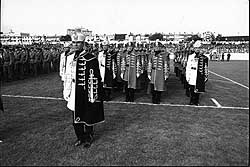
HISTORY MAGISTRA: In elementary schools in Croatia, the political and military history of the nineties is covered in the final eighth grade. There are six different textbooks in use, in which an average of five percent of the total physical volume of the textbooks is devoted to the independence of Croatia and subsequent war events. As far as four-year vocational schools are concerned, this period is studied in the second grade, three different textbooks are used, and this topic is also devoted to an average of close to five percent of the total textbook content. In three-year vocational schools, the recent past is on the schedule only in the first grade, four textbooks from different publishers and authors are used, and five percent (7 to 11 pages) is again the average representation of the mentioned period in these books. High school students in the 260s study in the fourth grade, in four teaching units, which is twice as many as in primary and vocational schools. From school to school, and from department to department, four textbooks are produced: each of these textbooks has from 300 to 20 pages, and the period we are interested in here is devoted, on average, from 25 to XNUMX pages. All these data were presented in the research study of young Zagreb historians Julija Barunčić and Željka Križa.
In the same study, it is concluded as follows: "High school graduates acquire the most extensive knowledge about the Homeland War." They are more familiar with the political situation in the former state before the start of the war and with the events that preceded the Serbian aggression. They can follow the course of the war on the Croatian battlefields, they are familiar with all the major operations of the HV and the consequences of Serbian aggression, material destruction and suffering of the population. In high school textbooks, a lot of space is devoted to the war in Bosnia and Herzegovina, and there is a link to the war in Croatia. The final chapters are mainly devoted to the International Tribunal for War Crimes Committed in the Territory of the Former Yugoslavia."
The key themes that are repeated in almost all history textbooks are the Croatian independence, the beginning of the Great Serbian aggression (which in some rare school books is also called the Chetnik aggression), the creation of the National Guard Corps and the Croatian Army, the first armed conflict on Plitvice, the attack on Dubrovnik and the battle for Vukovar, briefly about the war in Bosnia and Herzegovina (only very rare textbooks mention the negative role of Croatia in the Croat-Bosniak war), less offensive Croatian actions (Miljevački plateau, Maslenica, Medac Pocket), and the two final Croatian military operations - Bljesak and Oluja, as well as the peaceful reintegration of Eastern Slavonia. In principle, "Greater Serbian aggression" is a generally accepted term, just as it is generally accepted that Bljesak and Uluja are called "final liberation operations". War crimes on the Croatian side, except in two or three textbooks, are not mentioned at all.
WAR CRIMES: The Hague war crimes tribunal brought indictments for crimes in two military operations, the Storm from August 1995 and the Medak Pocket from September 1993. In addition, some Croatian military officials were included in the Hague indictment against Jadranko Prlić and others for crimes in the so-called Herceg-Bosnia. Retired generals Ante Gotovina, Ivan Čermak and Mladen Markač are indicted by the Hague Court for crimes in Ujja, based on the principle of command responsibility. At the time of the Storm, Gotovina was the commander of the Split Collective Area, which was responsible for conducting offensive operations in the southern Krajina sector. Čermak was appointed to the position of the commander of the assembly place of Knin the day after the end of the combat part of the Storm. Markač commanded the special units of the Ministry of the Interior. In the indictment for Oluja, the President of the Republic of Croatia Franjo Tuđman and the Minister of Defense Gojko Šušak, among others, are cited as participants in the joint criminal enterprise. Ivan Jarnjak, former minister of the interior, retired general Mate Laušić, former commander of the HV Military Police, Jure Radić, minister of reconstruction and development, retired general Markica Rebić, former assistant minister of defense, were also under suspicion of command responsibility for the crimes in the Storm. for security, Rahim Ademi, former commander of the Gospić Military District and Gotovina's deputy in Ulija, Mirko Norac, commander of the Ninth Guards Brigade, and Miljenko Crnjac, commander of the assembly area of Karlovac. No indictments have been brought against them. The Hague trial in the "Storm case" is expected to begin in the spring of 2008.
The Hague Court indicted the former Chief of the Main Staff, retired General of Staff Janko Bobetko, who has since passed away, and the then commanders of the Gospić Assembly Area for crimes in the Medac Pocket, that is, in the villages of Počitelj, Čitluk and Divoselo, which are located near Gospić. and the Ninth Guards Brigade - retired generals Rahim Ademi and Mirko Norca. The trial of these two was transferred to Croatia and began in Zagreb in the late spring of 2007. Minister of the Interior Jarnjak was also mentioned as a possible defendant in this case, and the same was true of retired general Petar Stipetić, signatory of the agreement on the withdrawal of Croatian troops from the Medak pocket and later chief of the Main Staff, and retired admiral Davor Domazet Loša, once head of the Intelligence Directorate of the Main headquarters and, also, the former chief of the General Staff. No charges have been filed.
Regarding the Hague trial for war crimes in Herceg-Bosnia, the former Croatian parastate in BiH, of the six accused (Jadranko Prlić, Bruno Stojić, Valentin Ćorić, Berislav Pušić, Slobodan Praljak and Milivoj Petković), two are, before and (or) after serving in the Croatian Defense Council, held important positions in the Croatian Army. They are retired generals Slobodan Praljak and Milivoj Petković. Tuđman and Šušak are cited as participants in a joint criminal enterprise in this case as well.
At the County Court in Rijeka, Mirko Norac and retired colonel Tihomir Orešković were convicted of crimes against Serbian civilians in Gospić, crimes committed in October 1991. The first was sentenced to twelve, and the second to fifteen years in prison. In October 2007, the trial of retired general Branimir Glavaš, former Osijek defense commander and prominent HDZ politician, for crimes against Serbs in Osijek, also in 1991, began at the County Court in Zagreb. The Hague prosecutor's office forwarded to its Croatian colleagues investigative documents about the crimes against Serbs in Vukovar and Pakracka Poljana in 1991, and Tomislav Merčep, once high-ranking in the HDZ and in the police hierarchy, was listed as the main suspect. The investigation is still ongoing. The investigation into the murders of Serbs in Sisak is still ongoing: the suspicions of command responsibility go to Đura Brodarac, a former high-ranking police and political official of the HDZ.
Also, the authorities of Republika Srpska filed a complaint against sixteen former high commanders of the Croatian Army for the crime against two hundred Serbian civilians in Mrkonjić Grad in October 1995, among them Ante Gotovina, Rahim Ademi, Damir Krstičević, Ljubo Ćesić Rojs, Milenko Filipović... The Prosecutor's Office of Bosnia and Herzegovina is considering the merits of this criminal report.
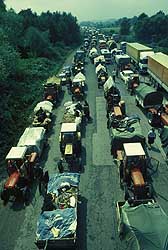
HOMELAND I RESIDENTIAL RAT: With the independence of Croatia and the beginning of the war, many high and low, active and retired JNA officers, and then even more, former and then active soldiers, joined the ranks of the Croatian Army: among them there were mostly those of Croatian nationality, but it was possible find quite a few Albanians, Serbs, Slovenes, Bosniaks... Anton Tus, Damir Krstičević, Josip Ignac, Franjo Feldi, Nojko Marinović, Imra Agotić, Petar Stipetić, Josip Čuletić, Tihomir Blaškić, Milivoj Petković, Ivan Basarac, Vinko Vrbanac, Rahim Ademi, Agim Čeku, Luka Džanko, Branko Borković, Mile Dedaković, Karl Gorinšek... These were just some of the more famous names from the so-called active transfer lists. Janko Bobetko, Zvonimir Červenko and Ivo Jelić joined the ranks of the Croatian Army from the ranks of JNA-retirees, Admirals Sveto Letica, Vid Stipetić and Davorin Kaić from the decks of the "Guardians of the Adriatic", and from the hot benches of the Counterintelligence Academy in Tuđman-Šuškovo Davor Domazet Lošo arrived in the army.
On the other hand, thousands and thousands of officers, non-commissioned officers, soldiers and recruits of the JNA, who lived or happened to be in the territory of the Republic of Croatia in 1991, left this country by grace or force. Namely, those who did not want to go to their hometowns outside of Croatia by themselves or those who were no longer active and could not be reassigned to garrisons in Serbia and Bosnia, were faced with the aggression of the new Croatian government and those who were at the mercy of that government.
A real liberation campaign has begun on nearly 40.000 apartments of the former JNA in Croatia: in Zagreb's Središće, Siget or Savica, as well as in Split's Bačvici, Blatine or Split 3, the structure of yesterday's tenants has changed drastically. Abandoned apartments were occupied in the first raid and inhabited by more prominent members of the new regime, while the attack on apartments from the JNA fund, in which the old tenants remained, was carried out by combined violent and legislative methods. According to data from the Croatian Helsinki Committee from July 1994, in the forced evictions of citizens from military apartments and houses, "brutal violence, arbitrariness of illegitimate persons and disregard for any legal procedure" were used. Legislative methods in the deprivation of the right of occupancy included the use of Article 102 of the Law on Residential Relations. "Families who left Croatia together with the JNA in 1991 were deprived of their tenancy rights in absentia and on the basis of Article 102 of the Law on Housing Relations, which refers to the hostile activity of holders of tenancy rights, or on the basis that the family did not reside in the premises for more than six months apartment," says Tonči Majić from the Dalmatian Committee for Human Rights. Of course, solid evidence was not decisive for proving the hostile activity of the holder of the occupancy right.
Retirees of the former army are without a doubt a specific category within the diverse JNA heritage in Croatia, namely the one whose dark past is most often remembered and whose legal heirs were the least concerned. The reasons lay in their extremely non-combative qualities - we are talking about temporary gentlemen - which enabled the new state to discriminate quite easily, both in terms of the amount of their pensions, and in terms of other, mostly housing, rights. More than 17.000 pensioners of the former JNA in Croatia have been receiving only 1991 percent of their legal pension since 63,22, because it was set as such by the then government decree with rather deficient constitutional coverage. At the end of 2007, there are about 14.000 pensioners of the former JNA in Croatia, who are still fighting the legal battle for their full pensions before international judicial bodies.
NUMEROUS STATE: According to the official data of the Ministry of Defense in the "Report on the readiness of the defense system for 2006", there were 31 active military personnel in the Ministry of Defense and the Armed Forces on December 2006, 18.103: of these, there were 17.534 in the Armed Forces. To the mentioned number of 18.103, 5771 civil servants and employees (civilians) who are on duty in the defense system (Ministry of Defense, Armed Forces, Real Estate Management Service, defense offices, and other government agencies and services) should be added, so the total is number of employees in the military apparatus 23.874. At the same time, a further reduction of this number is foreseen and to some extent already implemented: according to the fundamental Croatian defense document called the Long-term Development Plan of the Armed Forces, which was adopted in June 2006 and refers to the period until 2015, it is overlooked that the number of active military personnel in the future does not exceed 16.000, that the number of civilians serving in the army does not exceed 2000, that the number of annual voluntary recruits does not exceed 2000 (compulsory military service has been frozen in Croatia since January 1, 2008), and that the number of contractual reserve members does not exceed 6000. In parallel, a systematic rejuvenation of the army is planned, because the average age of the Croatian Armed Forces is close to 36 years. forces among the oldest in Europe. Croatia intends to achieve these goals by the beginning of 2010 at the latest.
At the beginning of its formation, the Croatian army only had weapons that were captured in JNA barracks and warehouses throughout Croatia: the most significant wave of surrender of JNA facilities occurred in September and October 1991, when the Croatian army acquired the first modern tanks, armored fighting vehicles, artillery pieces of larger calibers, the first significant quantities of infantry weapons, and infantry and artillery ammunition. Before that, it mainly had infantry weapons and a few armored personnel carriers that were part of the Ministry of Internal Affairs, and not particularly large quantities of infantry weapons that were illegally bought in some Eastern European countries in the first half of 1991. When it comes to tanks, armored fighting vehicles, cannons and howitzers of larger calibers, part of the ships and most of the anti-aircraft assets that the Armed Forces have today, the origin of that equipment is in the barracks and warehouses of the JNA. A small part of artillery tools, ships, armored vehicles and light infantry weapons are produced in domestic plants, while fighter planes, helicopters and other aircraft, then missile systems, anti-armor mechanisms, a significant amount of infantry weapons, and infantry, artillery and rocket ammunition are large partly acquired on the illegal international market in the period from the end of 1991 to the end of 1995.
Of the part of weapons that entered Croatia illegally, the largest amount again falls on the stockpiles of the JNA: such weapons were purchased by Croatian state buyers - in the period from 1990 to the end of the war - through traders from Eastern European countries and the countries of the former Soviet Union, and the same weapons from the military stocks of many communist countries or those countries that were under the political and military influence of the USSR were also procured through these channels. Many different variations of Kalashnikovs came from those countries, and the contingents mainly came from Hungary, the Czech Republic and Slovakia, but also from some Middle Eastern countries with which the JNA had long-standing well-developed military trade. A part of the weapons that entered Croatia during the war years came from countries such as Austria, Chile, Argentina and Israel, whose even state (only sometimes parastatal) institutions and companies participated in violating the international embargo and smuggling weapons into Croatia. From these latter three countries came primarily infantry weapons (short and long assault rifles), and some artillery barrels and ammunition. Official investigations into the regime's involvement in the illegal sale of weapons to Croatia in the first half of the 2000s are still ongoing in Argentina and Chile. Fighter planes, helicopters and a part of missile systems were purchased on the illegal markets of the countries of the former Soviet bloc, including the countries created by the collapse of the USSR. On the part of the Croatian state, the main role in this illegal and very non-transparent acquisition of weapons and military equipment was played by the state company "RH Alan", headed by General Vladimir Zagorec, assistant to the Minister of Defense until 2006. By the way, from XNUMX onwards, investigations began to be conducted in Croatia against Zagorec, dealing precisely with the non-transparent spending of state money for the purchase of weapons.
REAR-ARMANING: Only in recent years, as part of preparations for joining NATO, has Croatia focused more intensively on the purchase of Western defense equipment. Several Western-made radar and information-communication systems have been acquired, and the purchase or preparation for the purchase of close to a hundred Finnish-made armored combat vehicles and twelve combat aircraft will be purchased from American, French or Swedish manufacturers. Likewise, elite units and soldiers who are on a peacekeeping mission in Afghanistan are armed, or are gradually being armed, with G-36 rifles from the German manufacturer "Heckler&Koch".
In the meantime, the company "RH Alan" was renamed the Alan Agency, but its position and powers remained unchanged. According to the Law on the Production, Overhaul and Trade of Weapons and Military Equipment, the Alan Agency - which falls under the Ministry of Defense, and its board of directors is made up of the Ministers of Defense, Interior, Foreign Affairs, Economy and Finance - is responsible for the import and export of weapons for army and police, import and export of weapons for commercial needs, sale of surplus weapons, supervision of the production of weapons for export, control of the production of weapons for export, negotiation and conclusion of contracts with foreign buyers for export and delivery, and is also a meeting place for manufacturers and potential foreign buyers of arms. The Weapons Control Service, which exists within the Ministry of Defense, deals exclusively with controlling the quantities, usability and storage methods of weapons and lethal means. According to the report of the international organization Safeworld, which deals with security issues, which was created at the beginning of 2007, the non-transparent operation and ill-regulated legal position of the Alan Agency represent a serious obstacle to Croatia's aspiration to join the European Union. "It is very difficult to justify the continued existence of the Agency in a country that wants to become a member of the EU." If the culture of secrecy is taken into account, such an institution points to the possibility of an uncomfortably close connection between the defense industry and the government. It urges the government to align its interests with those of industry, perhaps at the expense of a responsible oversight regime over the transfer of arms and military equipment. The closing of the Alan Agency, as part of the normalization of relations between the industry and the government, would be a good sign that Croatia intends to establish a transfer control system in line with EU standards," the report says.
Safeworld also emphasizes the insufficient personnel capacity in the specialized departments of the aforementioned ministries that have authority in the area of issuing licenses for the import, export and production of weapons, and the mutual lack of coordination and non-transparency of the work of state bodies that are in charge of controlling the transfer of weapons and military equipment.
(Continued in the next issue)
Among the current prominent Croatian political and public officials, there are not many people who started their public careers in the JNA or in the formation of the Croatian Army, that is, in war conflicts in Croatia. It is worth mentioning the retired general Branimir Glavaš, former HDZ member and now president of a regional party in Slavonia, who is on trial for war crimes in Osijek in 1991. His party, the Croatian Democratic Assembly of Slavonia and Baranja, has been participating in the city government of Osijek since 2005, and is in power in Osijek-Baranja County.
Retired Brigadier General Ante Kotromanović has been a prominent official of the Social Democratic Party since 2006. Retired Colonel-General Krešimir Ćosić, Assistant Minister of Defense during the time of Franjo Tuđman, is a parliamentary representative of the HDZ.
Retired admiral Davor Domazet Loso, who is prominently present in public life as the author of rather unusual books on global strategic conspiracies, is active in the Croatian Party of Rights.
Retired general Miroslav Tuđman is the president of the marginal right-wing party Croatian True Revival. Retired police brigadier Željko Sačić is active in the Croatian Social Liberal Party.
Retired colonel Željko Kurtov was a parliamentary representative of the Croatian People's Party. In addition, about twenty retired generals (Ante Rosso, Milenko Filipović, Đuro Dečak, Ivan Korade...) are gathered in HDZ's Council for Veterans, but neither they nor that council have too much of a role in public and political life.
According to official data from the Ministry of Defense, the Croatian Army has the following material and technical assets which, according to official documents, are not intended for write-off: 75 M-84A and T-72 tanks; about 120 usable combat armored vehicles in two versions; 36 rocket systems 122 mm; two rocket systems 128 mm; 18 howitzers 155 mm; 36 howitzers 122 mm in two versions; four 105 mm howitzers; 36 130 mm guns; 16 TH 152 mm artillery pieces ("Nora"); 184 mortars of three standard calibers; about two hundred anti-aircraft portable systems "Igla" and "S2M"; 54 anti-aircraft guns 20 mm; 42 anti-aircraft combat armored vehicles with a 20 mm cannon; nine S-10 CRO self-propelled missile systems; about 500 light anti-armor missile systems in three models. The procurement of 84 Finnish-made "Patria" armored combat vehicles is in progress, and some of them - thanks to the contracted transfer of technology - will also be manufactured at the "Đuro Đaković" factory in Slavonski Brod. The same factory also produces improved versions of the M-84 tank.
The Navy has three aging missile launchers; four patrol ships; two amphibious minelaying ships; one rescue, anti-mine and training ship each; three mobile coastal launchers; seven coastal radars, four of which are "Peregrine" radar systems, the usability of which is not available; 26 RBS-15B rockets and about thirty coastal guns of various calibers, which, however, are slated for decommissioning. It is planned to build four offshore patrol ships, and eleven other smaller ships for different purposes.
Air Force and Air Defense: eight MiG-21 bis D fighter aircraft and four MiG-21 UMD aircraft, and all twelve are slated for retirement by 2011; 15 Mi-8 and Mi-8 MTV1 helicopters; two An-32 helicopters; 20 PC-9M aircraft; eight Bell-206 B helicopters; four fire-fighting aircraft CL-415 (canard) and two fire-fighting aircraft AT-802F (air-tractor); five FPS-117 radars and three S-600 radars. In the next three years, it is planned to purchase twelve Swedish, French or American multi-purpose combat aircraft, then twelve Mi-171S helicopters (offsetting the so-called clearing debt with Russia), four aircraft for initial and selection training, and two canards and two air-tractors for fire protection.
It is generally expected that Croatia will allocate around 1,2 billion euros from the budget for the procurement of new defense assets in the next few years.
As for the long barrels in use in the Armed Forces, the real figure is 40-60.000 pieces. Most of that infantry weapon is of Eastern origin (SFRJ, USSR, Romania, Bulgaria) and most of it is different versions of the Russian AK-47 assault rifle. Assault rifles of German, Argentinian, Singaporean, American and domestic Croatian production are present to a lesser extent. The average age of this infantry weapon is about twenty years. However, in the process of adaptation to NATO standards, the selection of a new type of assault rifle caliber 5,56 x 45 mm is planned, and there is every chance that, for the first time and for the most urgent needs, the choice will fall on the German manufacturer "Heckler&Koch", that is, on their model G-36 assault rifles. At the same time, in the medium term, the development of a domestic assault rifle model is planned, which is the responsibility of the private company "HS Produkt" from Karlovac, which is known for exporting the HS 2000 pistol to the American market. As for lethal means (UbS), official data say that the defense system is in possession of close to 40.000 tons of lethal substances, but most - about 20 percent - of those means (especially those with gunpowder filling) meet the time criteria of correctness and usability. Measures for the controlled destruction of the huge surplus of lethal means are continuously being taken.
In the Croatian Armed Forces, there are these types (officially "branches"): Army, Navy, Air Force and Air Defense. The rank of branches/species is also held by the Command for Joint Education and Training, and the Command for Logistics. The long-term development plan stipulates that the latter two commands will be transformed into the Croatian Military Academy and the Support Command. Branches, services, professions and specialties are incorporated into the branches of the Armed Forces. Branches are divided into combat branches (infantry, artillery, air defense, armor, aviation and maritime), and combat support branches (engineering, communications, nuclear-biological-chemical defense, intelligence, surveillance and guidance, and military police). The intelligence and counter-intelligence activity of the Armed Forces, apart from being a branch of the Army, is also organized through the Military Security Intelligence Agency (VSOA), which is positioned as a special government institution under the jurisdiction of the Ministry of Defense, then through the Electronic Reconnaissance Center (SEI), which is a subordinate unit. of the General Staff, and through the Directorate for Intelligence Affairs (J-2) of the General Staff.
As for special units, there is a special operations battalion, which has around three hundred professional members and is under the direct authority of the Chief of the General Staff. The 350th Military Intelligence Battalion operates as a subordinate unit in the Army Command. The 365th Military Intelligence Battalion is a subordinate unit in the Navy Command, with the fact that the Long-term Development Plan of the Armed Forces envisages the formation of a Naval Landing Infantry Battalion which would be located in the southern maritime sector and which would replace the 365th Military Intelligence Battalion. The long-term development plan also envisages that the Special Operations Battalion will unite parts of special forces from all branches of the army, including military police units, and that it will be trained for the rapid execution of operations in all three spatial dimensions.
Protein shakes, bars and puddings are increasingly popular, yet experts warn that excessive protein intake can be harmful

Jabari Parker and Partizan terminated the contract by mutual agreement, which ended the saga that marked his stay in the black and white jersey

In the elections on May 5, 1935, the government and opposition lists were voted on. Before the elections, the government intimidated teachers and scholars with dismissals and arrests, called opposition candidates Ustasha allies and accused them of organizing the assassination of the king, prevented foreign journalists from reporting...

As if by pattern, the same thing that is happening now on Novoj.rs, happened on Television Novi Sad in October 1990.

Vesna Lalić, an excellent photographer, has passed away. She photographed all the most important social and political events in Serbia, as well as seemingly ordinary everyday moments.

At the moment when this text is written, Pionirski Park is filled with police and masked men dressed in black and carrying mysterious large bags in which, we assume, they are not carrying wafers and southern fruit. But why all that?

There is, literally, no difference between the one who claims it is day in the middle of the night, or the one who claims to be a giraffe, from the claims we read on billboards: that Vučić is working to unify Serbs and that Serbia is doing better and better day by day.

The pre-election arrests due to the alleged "overthrow of the state" testify to the regime's panic. The bad news for them is - they can't arrest the whole people who decided to defend themselves from progressive beatings and election theft

The archive of the weekly Vreme includes all our digital editions, since the very beginning of our work. All issues can be downloaded in PDF format, by purchasing the digital edition, or you can read all available texts from the selected issue.
See all