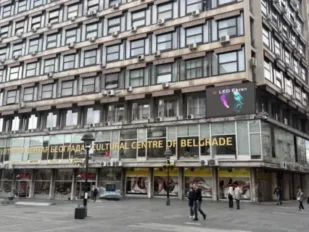
Although Danica Jovanović is considered to be one of our most important painters of the last century, her works have only now been shown for the first time in Belgrade. A hundred of her paintings and drawings are exhibited in the Grand Gallery of the House of the Serbian Army, and will be there until September 20. The exhibition is a joint project of the Pavle Beljanski Memorial Collection, the Matica Srpska Gallery and the Media Center "Defense". The author of the exhibition is Dr. Jasna Jovanov. The reason for this exhibition is the centenary of her death - in September 1914, the Austro-Hungarian authorities arrested her and shot her at the foot of the Petrovaradin fortress.
Before all the questions related to Danica Jovanović's life path, it is inevitable: why was she shot? "The specific reason is not known," Jasna Jovanov tells "Vreme". "Born in Beška in 1886, she was an Austro-Hungarian subject, while studying in Munich she was a member of the Srbadia patriotic association, which gathered Serbian students in Munich and which, after the Balkan wars, expanded its field of activity to include politics. It is possible that she often crossed the border and traveled through Serbia, which had just been liberated from the Turks in the Balkan wars - her works speak of this, but not the documents, it seems that she consciously covered her tracks. Because of all this, she had to arouse the suspicion of the Austrian authorities. There are stories that the police followed her even while she was studying in Munich. When the Serbian army defeated the Austro-Hungarian army on Cer, it seems that several of its units moved to the territory of Austria-Hungary to secure the border fortifications. The Serbs there were happy for them, which the Monarchy did not like. In order to show their strength, they started arresting prominent Serbs in Srem villages. Danica Jovanović was arrested on September 10 while walking with a book under her arm on the main street of Beška with her friend Milan Varićak and her great-granddaughter. She was elegantly dressed, in a costume of English cut and a small hat. Austrian soldiers approached her, arrested her and without a word took her to the Petrovaradin casemate. The next day, she was interrogated, and on September 12, 1914, she was shot, along with five other prominent people from Beška. They were encouraged by their fellow citizens, of German nationality. She was buried in a common grave at the Petrovaradin cemetery. She was 28 years old."
Since then, Danica Jovanović, her life path and her works have rarely been mentioned. Jasna Jovanov says that the efforts of the Belgrade journalist Vuk Dragović (in 1927 he followed the court process initiated by the families of those shot) to collect the artistic legacy of Danica Jovanović and record the memories of her contemporaries are extremely valuable. After 1930, Vladimir Ležimirac exhibited several of her paintings in his bookstore in Novi Sad. The next time she was mentioned was in 1939, on the occasion of the exhibition of painters and sculptors of warriors, participants in the wars of 1912–1918, in the context of her generation. Vuk Dragović found two of her sketchbooks and handed them over to the Matica Srpska Gallery. It was not until 1963 that her work, and that was only one painting, Gypsy woman, shown at the exhibition "Nadežda Petrović and the Beginnings of Serbian Modern Painting". Correspondence discovered in 1982 provided new information about her life. "After that, I, as a young curator of Matica Srpska Gallery, was given the task of researching Danica Jovanović's oeuvre," says Jasna Jovanov. "I showed her paintings for the first time in 1985 as part of the exhibition "Munich School and Serbian Painting" in the Matica Srpska Gallery, and I also showed the first monographic exhibition of paintings and drawings in Matica the following year. And, after that, it kind of took off. The art colony "Danica Jovanović" was founded in Beška in 1995. Then Danica's family, the daughter of her brother Milan, Angelina Nina Grulović and her son Milan, presented Beška with Danica's artistic legacy. They found her pictures somewhere in the house, bent, stained, and they thought it was something unimportant. However, that gift significantly increased the collection of Danica's paintings. After that, Danica Jovanović became an extremely valued painter among collectors."
BEGINNINGS OF PAINTING: She was born in 1886 in Beška, Srem, as the youngest, fifth child of the peasant family of Mileva and Krsta Jovanović. She became infected with paintings and colors as an eight-year-old girl when Dušan and his son Stevan Aleksić, then still a student at the Vienna Academy, hired her to help them while they were renewing their resume in the Vienna church. She intended to enroll in an art school after the Higher Serbian Girls' School in Novi Sad, but suddenly her uncle, who took care of her education, died, so it turned out that her wish would not come true. That's why Danica wrote a letter asking her former drawing teacher Anđelija Sandić, a member of the "Srpkinja Novosatkinja" Charitable Cooperative, to urge the Beščan municipality for a scholarship: "To educate myself academically and professionally and perfect myself in this unusually dear to me and the only subject for which I have a very strong will , and therefore I think I have a gift in painting." He also suggests that she tell the Municipality "that it is a shame for me not to perfect myself in this profession. And to prank them a little more and do it like this: how could there be a High School in N. Sad if there was not such a diligent student in drawing and who draws beautifully like me. Because our paors need pranks. Intelligence is all for me to give me help, but there are these twisted paori, so they don't give it to me, because they look down on drawing, it's nothing to them."
And, she succeeded. In September 1907, she enrolled in the Arts and Crafts School in Belgrade. No work has been preserved from that period, although it is known that she was a diligent student. It is assumed that she was interested in events on the Belgrade art scene, and that neither political events nor the women's protest rally organized by Nadežda Petrović due to the Austro-Hungarian annexation of Bosnia and Herzegovina did not pass her by, regardless of the fact that, as an Austro-Hungarian citizen, she certainly did not participate in it .
She went to study in Munich in 1909 thanks to the help of Danka Jovanović from Velika Kikinda, to whom she was recommended by the director of the Higher Women's School, Arkadije Varađanin. (That is, Danka was found by the Women's Charity Cooperative, whose task was to find a person ready to provide financial assistance, and Danica was recommended to her by a man from Varadža.) It is recorded that before she left for Munich in 1909, she was arranged in Beška a party whose proceeds are intended for Danica's journey. A play was shown Yoguni, which Danica directed and for which she prepared the decor. All her professors from Novi Sad came. She went to Munich with the money collected at the party, with an 800 kroner annual scholarship from the Petrovaradin property municipality and the help of Danka Jovanović. Soon after her arrival in Munich, her benefactor died, but, judging by her letter to Varadjanin, Danica was not worried about how she would continue her studies: "But, believe me, I am happy again that I will be able to use that money to pay school fees and an apartment and school supplies: and for eating, whatever, even if only dry bread. My only desire is to reach the goal and to realize my beautiful ideals." She is also convinced that "when a person makes up his mind about something seriously, and when he strives for his existence, it is not difficult for him to endure even the darkest days." Thanks again to Varadjanin , Danica meets Olga, the wife of Stevan Jovanović, an MP and court advisor from Budapest, one of the founders of the "Serbian Novosatkinja" Charitable Cooperative, whose patronage and friendship will help her finish her studies.
WAR PICTURES: She finished her first year of studies as the best student. He spends the following summer in Beška, slika. Varadjanin writes that she was accepted at the Pinakothek to copy the paintings of the great masters, which is considered a success. "Because whoever applies for copying must already be an expert, he must be completely skilled in order to faithfully make a copy." Otherwise, he will be canceled by the professor and the director of the Pinakothek immediately after a week. They didn't cancel me - moreover, they extended my deadline by a month. So that's a sign that my copy is good." After the third year of studies, in 1913, she was in Paris. There is no information about what she experienced there. It is only remembered that she returned to Beška pensive and sad.
There the books greeted her. The war in Kosovo i Old Serbia, collected reports of the radical Jaša Tomić from the fronts in Kosovo, around Shkodra, and from Macedonia. Both were illustrated with photographs of the cavalry colonel Dragutin J. Andonović taken by the Serbian army along the banks of the Drim, over the Ljum Tower, the Leka Captain's Tower, the Vizier's Bridge, and further across the Albanian mountains. Nadežda Petrović followed the same path in the spring of that year. As Jasna Jovanov says, the fact that some of these motifs also appear in Danica Jovanović's paintings is confusing: "That is the Vizier's Bridge. It is painted as if floating over the swollen waters of a river, whitish and light against the rugged mountains. As with Nadežda Petrović, nothing indicates a war drama. The scene with another legendary point of the Balkan wars, the bridge near Ljuma, is similarly set up in the picture Landscape from Serbia. Both bridges are located on the territory conquered by the Serbian army in the First Balkan War. In the summer of 1913, the border established at the peace conference in London is still porous in hard-to-reach areas; war operations are over, but there is no peace. Still, it is hard to believe that a twenty-eight-year-old girl, no matter how self-aware and determined she was, dared to travel to those parts. However, the motifs in Danica's paintings often point to her travels: perhaps it was during that summer of 1913 that she crossed the Sava and painted peasant women and married women with irises. Nevertheless, the question arises: could she have gone all the way to the south, to Prizren and Ljuma, to regions that were insecure even in peacetime? The answer is searched in vain in the ravaged archives, so that period of her life takes on a somewhat mysterious dimension."
At the end of March 1914, she completed eight semesters at the Women's Academy of Painting in Munich, earned the right to work as a teacher of drawing and painting, and immediately began adding the title "academic painter" to her name. She immediately sent her diploma and a request to the Ministry of Education to provide her with furniture somewhere around Skopje, in the liberated areas, but the request was probably lost, like most of the archival material before the beginning of the First World War.
UNFINISHED CANVAS: Immediately before graduation, on February 6, Danica Jovanović became a member of the patriotic association of Srbadia in Munich, and was soon elected as treasurer. The manager was Stojan Aralica, and the bookseller was Živorad Nastasijević. At the association meeting held on June 13, she was praised for her "energetic work". Stojan Aralica remembered her like this: "Like now I see her sitting in the Munich Pinakothek and copying Rubens' Kidnapping: blonde, small in stature, with an awful lot of freckles. Very intelligent. An extremely cheerful type of man, without a hint of gloom. She wasn't pretty… not sexually attractive… not flirtatious. She didn't try to be liked. She loved the company of men. She was constantly with students, men. But she was by no means the type of so-called suffragette. She was Serbian. And what else could she do? What was he supposed to do? She was Serbian. All. And only that. She was an unconditionally talented girl. However, she was still a student, she had not yet formed. She didn't have her painterly notes yet."
As she wrote in a letter to Varadjanin, her "main profession is portraiture and nudes (head and human body), that profession is the most difficult, but I chose that profession and that profession is sweet and dear to me." Apart from that profession, I also deal with other things privately, such as Stilleben, Landschaft and others. In addition, when I have time, I deal with composition and folk ornamentation." Almost half of the surviving works were created in Munich. Jasna Jovanov assesses that her handwriting varies from detailed school studies to rounded visual entities that define a strong stroke and a refined color with frequent intense accents. Hers Self-portrait, for example, "reveals all the complexity of self-observation and self-analysis in which the painter engaged in the process of presenting her own face. The continuity of self-observation leads from a self-portrait in a sketchbook drawing, where an emphasized individuality is noticeable in the choice of procedure, a decomposed drawing, an emphasized stroke, a volume highlighted by accents, an expression achieved by emphasizing the form." The most exhibited painting by Danica is Woman's head Gypsy woman. "With this painting, Danica Jovanović declares herself as an undoubted colorist, interested only in the conflicts of colored surfaces and the play of light that connects them. With a sonorous and fluid color, the image of a gypsy woman framed in an oval yellow scarf, with a bright red necklace of beads around her neck, is formed on the canvas, as the final chord of a stormy piece of music." had time to focus on herself. She was not tied to a particular artistic milieu, nor did she have time to join a painting circle.
A little more than a month before she was to be executed, Danica Jovanović returned to Beška from Munich. It is known that she traveled to Belgrade during that period - proof is the sketch of the collapsed Zemun bridge mined on the night of July 28, and that she went to Novi Sad, saw her friends and Arkadija Varadjanin. At home, at the time of her death, she left an unfinished canvas on the easel The Abduction of Leucippus' Daughters, after Rubens. She intended to "finish some of her plans - and then, in the name of God, to exhibit" by 1915.