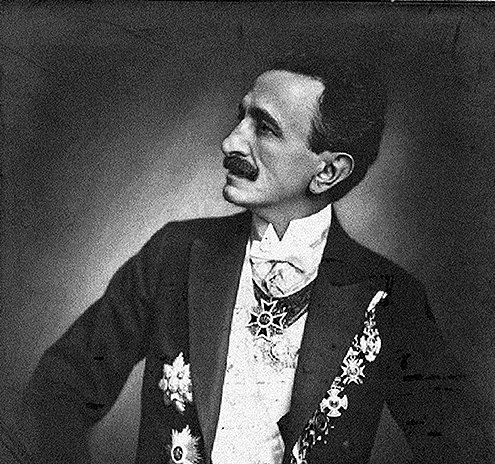
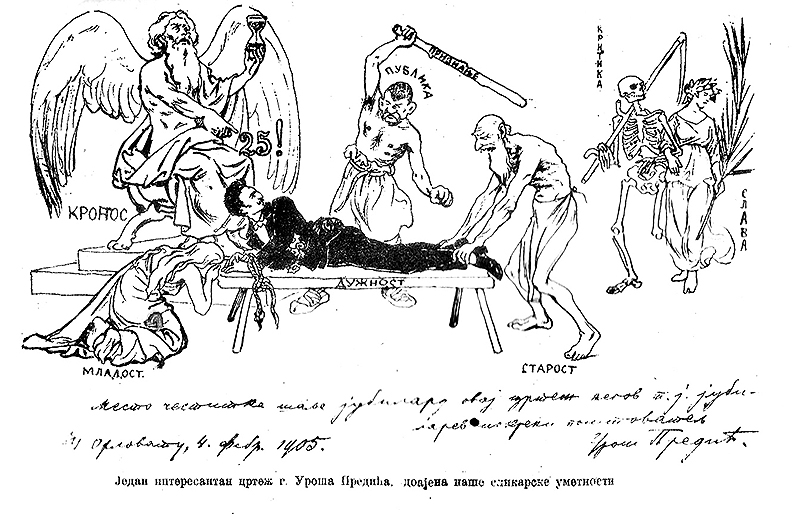
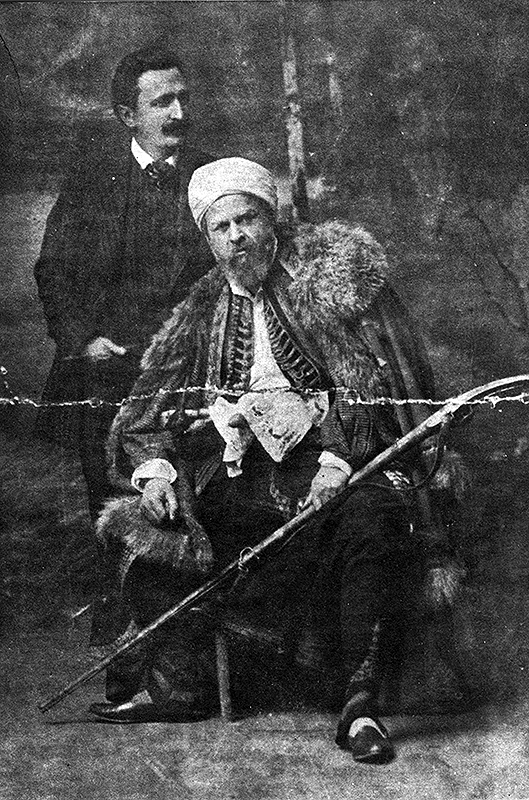
Both by origin and destiny, Nušić is a paradigmatic writer of the Balkans. All his life he lived within the boundaries of one world, his own world, a world that we could call Balkan. It is the Balkans, in the words of Bora Glišić, in which the "integral Mediterranean culture" is synthesized, and the opus of Nušić himself reflects the missed possibility of our unsuspecting renaissance.
It sometimes happens that a single digital innovation in an unusual way, almost literally, realizes the fantasy of a writer. I'm not even thinking here of the more famous examples of Jules Verne or Isaac Asimov, of Verne's submarine and the mighty miracles that Asimov dreamed up before they materialized in reality, but more of some small things. Krleža once compared the position of one book among the millions and tens and hundreds of millions of books that exist parallel to it to the position of a single drop in the Amazon River. Decades later, the biggest online the book store in the world is called Amazon. In one of his most famous fragments, Borges speculated that all the steps a man takes in his life, including the last one, before his death, from some heavenly (divine) perspective, actually draw the image of his face. Those among us, and there are more and more of them, who constantly carry a mobile phone connected to the Internet in their pocket and who are constantly logged in to Google services can today very simply get a map of their movement in a certain time interval.
MY BALKANS: I was thinking in that key about the picture drawn by all the steps that Branislav Nušić made in this world. He lived for less than seventy-four years, and he was born and died in the same city, in Belgrade. He was born on October 1864, 1938 in Cara Lazar Street. He died on the nineteenth of January XNUMX in Shakespeare Street. He was born and died, therefore, in two streets of the same city, two streets whose names ring symbolic for us in the context of his life and work. However, Nušić did not spend his entire life in his hometown. He also lived elsewhere, but again always within the boundaries of one world, his own world, a world that we could call Balkan. Let's take a brief look at the geographical ones stations on the path of life Nušićev. After Belgrade, first downstream down the Danube, to Smederevo, where he attends elementary school and is introduced to the magic of the theater for the first time. Then again Belgrade (realka), then study law in Graz. Some puritans would declare the studies in Graz to be Nušić's short-term departure from the Balkans. From our perspective, however, Graz is one of those peripheral cities that have one foot in Central Europe and the other in the Balkans. After all, the river Mura flows through Graz, and a later poet, actually singing about Nušić's world, will describe (and encircle) that world with a verse from Mura to Morava. Later Belgrade again, then the prison in Požarevac, then Bitola, Serez, Skopje, Pristina (this enumeration seems like a line from a poem about the Balkans). Nušić got married in Bitola. At the end of the nineteenth and the beginning of the twentieth century, he lived in Belgrade, with an interval in Novi Sad. The Balkan wars lead him again to Bitola and Skopje, and the First World War through Albania and to Corfu. Finally, Nušić's two non-Balkan years follow, two years during which he stays in Italy, France and Switzerland. After the war and the creation of Yugoslavia, he returned to Belgrade where he would live until his death, with the exception of a four-year term as director of the National Theater in Sarajevo (1925–1929).
BRČA CONNECTION: Nušić's Cincar origin is well known, the fact that he was born Alkibijad Nuşa (Alchiviadi al Nuşa). Less is known about Nušić's relationship with Brčan. His mother Ljubica (maiden name Kasnar) was from Brčko, and the girl Branislav Nušić would marry, Darinka, was also from Brčko, the daughter of the Brc merchant Božidar Đorđević and the mother of Nušić's three children. This information calls for a long digression for which there is absolutely no space here, a digression in which the history of Brčko and its several symbolic highlights would be encyclopedically summarized. This city, the largest Bosnian port on the Sava, during the SFRY was known to most Yugoslavs exclusively as the birthplace of Fahreta Jahić, known as Lepa Brena ("I was in eternal Rome/ I saw the Greek sea/ But there is no more beautiful land/ Than my Brcko" ), and the war itself will be the site of some of the worst war crimes. The Dayton peace talks were on the brink of failure because of Brčko, so this city was given the status of a district by a compromise solution that does not belong to any of the Dayton Bosnia and Herzegovina. entities, neither the Federation, nor the Republic of Srpska, therefore. This status, which some foreign publicists have already compared with the status of free cities that Gdansk or Trieste had in certain historical periods, made Brčko the city where present-day Bosnia most resembles pre-war Bosnia. One of the rare BiH. cultural manifestations that have achieved continuity that bridges the war and Dayton is also the Brc festival Theater Encounters, at which, two years ago, it was Nušić who triumphed Madam Minister directed by Oliver Frljić. In that Brcko, which reminds post-Yugoslav generations of Eda Maajka more than Lepa Brena, Osman Đikić met his actress Zorka Topalović, the one he would sing to Beautiful girl. This connection from Brc is convenient for me as a key word for the key dimension of Nušić's identity, which is described in a wonderful and precious book. Nušić himself Bora Glišić convincingly and suggestively wrote: "Nušić transcended the literary direction of a certain era." It is a creative synthesis of Mediterranean creativity and the Mediterranean climate. In his childhood, he saw a land that - romantically - exuded the darkness of that Lamartine ocean of Serbian forests; and hajduk and uprisings. But the landscapes that reminded him of Arabia were also engraved in his memory: minarets, stone houses, palaces, khans, gardens, fields..."
A NAIVE AND SENTIMENTAL LOVER: Both by origin and destiny, Nušić is a paradigmatic writer of the Balkans. Bora Glišić gives us the answer again to the question "what Balkans?": "During Nušić's childhood, and especially before the uprising, Serbia was completely identical to Bosnia in terms of 'external circumstances', ethnic composition, and landscape. Even before the liberation, its western nahijas were under the Bosnian vizier. After the surrender of the cities, our Muslim brothers moved to Sandžak, then to Bosnia. (...) Let the Muslims - our tragic brothers - move out. But that emigration, that leaving home, and this sky, and these dear landscapes... is accepted as a necessity - but also with deep sadness. Pečal. And sorry. However, that sorrow is the same as theirs, Eastern Mediterranean, deep, as in Persian poetry; Iphigenian as in Greek tragedy. Then it was felt that (if we leave wars and exterminations aside, and stick to what is human) the arrival of the Turks, and the fact that a part of our people converted to Islam, and living together for centuries, expanded our Mediterraneanization to integral measures. (...) Bosnia and Serbia, on these bases, could become the soil of a new, spontaneous, deeply original, psychological and artistic renaissance of ours, as a synthesis of an integral Mediterranean culture." This is the world that Nušić deeply feels, the world of which he is a poet. . Glišić also says: "In Nušić's oeuvre - as in the case of very few of our writers - that missed possibility of our unsuspecting renaissance is reflected." If we were to look for a counterpart to Nušić in this sense, the first thing that comes to mind is an illogical association at first glance: Ivo Andrić. The two are actually writers from the same world. And also the following contrast is paradoxical only on the right view: when the Bosniak national-romantic intellectual elite declared Andrić an Islamophobe and hater of Muslims, they found a counterpoint to him in Nušić and his Ramadan evenings. From that perspective, of course, it could not be noted that both of them write with love about the same world, only that one of them - in Schiller's and Doctor's terms - naive, while the other sentimental lover. Despite all the poetic differences between Andrić and Nušić, they are - at least since the annexation crisis - politically like-minded. Andrić's metaphysical pessimism contrasts with Nušić's vitality and cheerfulness, but in both cases we are talking about their dominant characteristics. Vitality and cheerfulness persist in the shadow of Andrić's metaphysical pessimism, just as metaphysical pessimism exists in the shadow of Nušić's vitality and cheerfulness. When Nušić autopoetically escapes the label of a satirist because "satire very often dips its pen into mischief", he is actually guided by the same principle that led Andrić to write that "mockers are rarely right".
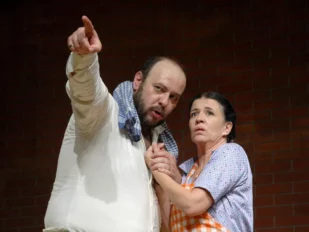
MY PRIVATE NUŠIĆ: In all that was said, there was almost no mention of all that Nušić is remembered for today, about the classic textbook Nušić, Nušić who is a living part of our culture. In this sense he is somewhat similar to Arthur Conan Doyle. Doyle is remembered for the Sherlock Holmes stories, not for the works he wrote with more ambitious intentions. That's how Nušić - without comedic ambitions - is best known today as a comedy writer. My first entry into Nušić's world was a series of television films that were shown in 1989 and 1990: The World, Mister Dollar, Madam Minister, Suspicious face, The deceased, A grieving family, People's representative. I was twelve years old, until then I knew about Nušić through some passages from reading books and articles from Politika zabavnik. The films were broadcast on Sunday evenings, behind the TV news. I remember responding to the humor and I remember being struck by the psychological truth. I also recognized the actors: Petar Kralj, Olivera Marković, Milena Dravić, Milan Strljić, Predrag Ejdus, Miša Janketić, Aleksandar Berček... I will read after Nušić's play and watch different theater productions, but first impressions and first impressions, the rapture of discovery because of the awareness of the stupidity of people work to please others ("for the sake of the world"), the recognition of relative hypocrisies or the tangential consequences of the government's insanity, will remain with me forever tied to those television movies. Those films were shot around the fiftieth anniversary of Nušić's death. A great country paid a fitting tribute to its great writer. It was not too different from when the BBC, for example, makes a series of films based on the works of Dickens. And Nušić's world has narrowed today. In Zagreb, it is played almost as a form of provocation, in Sarajevo, the street that bore his name on Mejtaš is no longer named after him. (Truth be told, another street in suburban Nedžarići bears his name, and Nušić's street in Mejtaš has apparently been given back its old name from pre-Yugoslav times; there is no awareness that tradition can only exist in continuity.) On the other hand, it cannot be said that Nušić has been forgotten in Serbia, nor that this anniversary passes on deaf ears. He is mentioned mostly casually and mostly without awareness of the context that is entirely his, the Balkan context, a context that aspires to the Mediterranean, just as the Herzegovinian peasants aspire to Dubrovnik. Just as Runde's (and Saher's) continental city got a port one night, so Serbian literature got a sea through Nušić, along with vitality, laughter and cheerfulness.
What is happening in the country and the world, what is in the newspapers and how to pass the time?
Every Wednesday at noon In between arrives by email. It's a pretty solid newsletter, so sign up!
More than 20 festivals were not held last year and this year, the FCS has not announced competitions for two years, the Ministry of Culture rejects projects of art associations, the removal of successful directors and the appointment of people who do not promise... all this is evidence that we are living a culture of destruction, according to the research of the Center for Cultural Studies
In the Viennese auction house Doroteum, a painting by the Croatian author Vlaho Bukovac was sold for half a million euros, it will soon be exhibited in Zagreb, and the public there does not know the name of the buyer
The play "Professional" is performed for the 50th time. "It is incredible that in forty years - since writing about the then government and communism, little has changed," says its author, Dušan Kovačević.
The world-famous "Aesthetics of Film", memoirs by Srećko Džamonja, books by Aleksandar Dimitrijević, award-winning novels and other new Clio publications that will not be at the Book Fair
The performance of "Balkan Spy" was canceled last night just before the meeting of the Student List at Slavija - due to the indisposition of the actors. "I am not indisposed," says the director of the play, Tatjana Mandić Rigonat
There is, literally, no difference between the one who claims it is day in the middle of the night, or the one who claims to be a giraffe, from the claims we read on billboards: that Vučić is working to unify Serbs and that Serbia is doing better and better day by day.
The pre-election arrests due to the alleged "overthrow of the state" testify to the regime's panic. The bad news for them is - they can't arrest the whole people who decided to defend themselves from progressive beatings and election theft
The ring that tightens around Ćaciland Student list is getting narrower. Because there are more and more spoiled people who see the false prophet for what he is: a street obscener who is fighting Serbia
The archive of the weekly Vreme includes all our digital editions, since the very beginning of our work. All issues can be downloaded in PDF format, by purchasing the digital edition, or you can read all available texts from the selected issue.