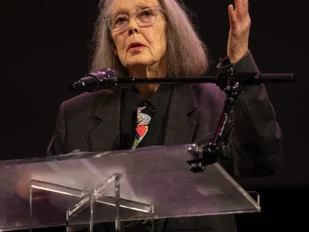
Recently, the Serbian edition of the new novel appeared in bookstores, published by "Booka". Miljenko Jergović 1983. The subtitle of the book is "novel maneuvers", which suggests that this is not a novel, but a form that is and is not at the same time. novel: the chapters are united in time (year 1983), but not by plot and characters. The exception is a character who runs through almost all chapters, he is 17 years old, his name is Miljenko Jergović, he is a kind of emissary to the past of the writer Miljenko Jergović and his guide through 1983. On October 27, 1983, in the "Prosvete" bookstore in Sarajevo (around noon), that seventeen-year-old will steal Encyclopedia of the Dead Danila Kiša. This character and this episode appear in Jergović's other books as well (as, after all, the neighbor of Almas, mother, Nona, father...), but in no other book does he have this role: this "crime", this theft of his, is the pledge of all his passions, past and future, all his pains, disappointments, doubts, breaks and joys, everything that will lead him to the novel over the years 1983. Miljenko Jergović. The year 1983, which the writer will call "documentary fiction", will turn out to be, in many ways, a turning point for that guy, but not only for him. From the darkened parts of our memory, the writer will extract the signs of future catastrophe and interpret them in a way that, we dare say, no one has done before this book.
"WEATHER" What are novel maneuvers??
MILJENKO JERGOVIĆ: First of all, maneuvers are one of those mysterious words from early childhood. It appeared for the first time in 1971. Namely, that year, a unique military exercise called "Freedom 71" took place on the territory of the entire SFRY. At that time, I guess, the words "military exercise" were not strong and impressive enough, so they were military maneuvers, and as our language and speech are characterized by the shortening of phrases and syntagms, in 1971 everyone was talking about maneuvers. I didn't know what that word meant, but I really liked it. And "novelistic maneuvers", from the subtitle of the book 1983, are actually a series of chapters, or chapters within chapters, written with the idea that they might be, in fact they might already be, planned and sketched novels. None of those novels was written as a novel, but each remained at the level of novelistic maneuvers. And all together, like a book 1983, they represent a solid whole that I perceive as a novel, and not a documentary, but a fictional one. Regardless of the fact that everything, or almost everything, in the book is the bare truth, each chapter is constructed as fiction (except, perhaps, a few introductory ones, in which the scenery is set, and the reader is deliberately led on the wrong tracks), but in each chapter there is an element of incompleteness, which further confirms it as a novelistic maneuver, not a novel. I don't know how this explanation of mine sounds to you, maybe I could add to it that this is one of the few books of mine that also implies some kind of pleasure in writing, some almost childish game of writing novels that will not be written and presenting reality as if I had personally invented it. In fact, when I think about it, I may write in two ways: either I invent and subvert an imagined reality, or I present the documentary reality as a fiction. Either way, both are fiction.
One of "junakinja" Yugoslavia is also one of your novelistic menavars...
Yugoslavia is a framework and a context, but it is not a "character". It could be in a different book, but not in this one. In some of my other books, let's say in the novel Srda sings., at dusk, on Pentecost Yugoslavia is a little more than a context, but I did not try to write a novel in which Yugoslavia would play the main role. There are several reasons for that. The first and least important is that such a novel would be offensive to all its readers today. Today, Yugoslavia is another name for curse. Even the nostalgia for that country, that sentimental kitsch regret for the youth of the surviving generations, is only a form of curse and imprisonment in the eternal past. The second, and more important reason why I am not writing a novel about Yugoslavia concerns the fact that, paradoxically, it never even concerned me, until the war. Namely, in the 1980s, and that was my age of initiation, Yugoslavia almost didn't exist for us, just like Great Britain didn't exist for a British kid, or Germany for a German. We were free from the institution of the state, even when it showed strictness towards us. We could have been cynical, ironic, indifferent towards Yugoslavia. We didn't walk around wearing T-shirts with her symbols, nor were we hostile towards her. For us, Yugoslavia was just a context, a framework, a space where our identity cards were valid. Therefore, a novel about Yugoslavia could only be written by someone who experienced the real, pre-Yugoslav era, say from 1945 to the constitution of 1974. And the third reason why I did not write that novel is that a novel about Yugoslavia, disappointment in it, and in some way its disintegration already exists. It was written by Miroslav Krleža, its title is Flags. It is the most powerful monument to Yugoslavia imaginable.
These novelistic maneuvers "they are trying to clarify [events, occurrences, people] in a slightly different way than it has been done so far by the press and the courts"(str. 247). What does it mean "in a slightly different way"?
I'd say it's a self-deprecating phrase. You know how sometimes in old movies, usually from above, you could see the microphone in the frame. I like to introduce that microphone into my prose. In the middle of a story, at its most exciting point, I suddenly start commenting on storytelling techniques and spoil the story for the reader. At the same time, I am my own reader. But there is also something else: in our small and big history there is a huge number of events, sensations and miracles as if they were created for a storyteller, a novelist, a poet. The reality of our lives in the last sixty years has surpassed our imagination and overpowered all our poetic powers, and there are hardly any writers who dealt with it. In the book 1983. I was engaged in writing many unwritten novels, which, well, I would want to read if someone wanted to write them for me. One of the few writers who write such novels for me is Milenko Bodirogić. And I would also warn you about Nada Gašić's new novel, titled Shell box, which was also written for me. But I'll be happy to let you read it too. I'm kidding, but I'm not kidding!
In a maneuver with the title "Accident in Mramor"(str. 477), you write"Language is not just a means of communication. He is, before anything else, story medium, a medium of narrative that is usually wiser than its speakers". Whether, however, language in general is a medium, mediator, or he constitutes the world? Without story, the world would be meaningless...
Language is both! It is important for me that it should be like that at all times. Language is at the same time the medium in which the narrative becomes possible, and even before that, the medium in which each of us becomes possible. In language are our individual consciousnesses, in language is all my (and your!) self. We ourselves do not exist outside of language, or we exist at the level where there are viruses and bacteria. Unfortunately, I am not religious, or not to the extent that would provide me with comfort, but I could, for example, believe that language is God. So, not that the language is from God, but that it is God. And of course, language constitutes the world. There is nothing outside of language. Or what exists exists in complete entropy, to which even physical laws do not create a semblance of order. Quite simply, there is no and cannot be meaning outside of language. The world outside of language is not even meaningless, because even for something to be meaningless, it must exist within the meaningful.

photo: ivan posavec...
For you as a writer, is there any difference between the character of Aleksandar Ranković (for example) and the character of the guy who in 1983. He is seventeen years old and his name is Miljenko Jergović?
Of course it doesn't exist. Or of course it shouldn't exist. It doesn't exist if I'm such a good writer that it could be. For me, for example, those seventeen years of Ranković's life, from 1966 until his death, which he mostly spent in Dubrovnik, are a great novel and film theme. The man who created the communist police in Yugoslavia, and who emerged from the deepest darkness into the summer light of the City, all this time is more or less discreetly followed by those he previously created, but he lives an ordinary retired life, and has his own great inner drama between ultimate and lifelong loyalty to the great leader and the revolution, and the feeling that he has been abandoned and betrayed. At the same time, should I mention that Comrade Marko is not at all a positive figure in the historical sense? Considering the kind of fools and scumbags we are surrounded by, maybe I should mention such things. And it's not bad to say that because of something else: the writer's duty towards the story is not to recognize and sympathize with positive figures, but his duty is to recognize and sympathize with those who never were. Or, let's say, a much more tragic character in the book 1983, former director of "Ina", then a state-owned oil company, now a political emigrant, whose reasons for emigration we will never know, who is trying to save himself in some of the darkest German hellholes by hastily trying to become a literary dissident. It's literally the only way he thinks to save his unfortunate head. From what he writes, we can judge that he has not read very much in his life and that he has absolutely no talent for a story. Let's say, that Đureković is some sad Croatian and communist Scheherazade, to whom God did not give what he gave to the first Scheherazade. Both that Ranković and that Đureković are simply characters that are closer to me than that seventeen-year-old young man who 1983. bore my name. I never have to lie about them, about him sometimes I have to, because it seems to me that I no longer understand him.
Speaking of characters... Dragoslav Mihailović once told me that a writer must love his characters, even if they are scum and criminals. Then he added: Thomas Bernhard doesn't like his characters, that's why I can't read it. How do you understand these words of Mihailović? What kind of relationship do you establish with your characters?, and with that seventeen-year-old thief of Kish's book?
I would say that Mihailović did not read Bernhard well. In fact, Bernhard predictably annoyed him. Isn't it totally logical to you that Thomas Bernhard annoys Dragoslav Mihailović intolerably? On the other hand, I don't really think that a writer should love his characters, or all of his characters, but he should recognize himself in them, he should be able to identify with them. You don't have to love them, for example, just like you don't have to love yourself always and in everything. Let's say, I don't like that seventeen-year-old from 1983. Apart from the fact that he hurt me in my life, I also despise his fears a little bit, I hate his anxiety in me. It's in the book 1983. characters I love much more than him. With which I had to control my affection, because teaching her could ruin the story. Let's say, this is exactly the character of Stjepan Đureković. Not exactly Ranković, but certainly his wife. It's a big scene when he shouts at the policeman who stopped them in the middle of the highway, while Comrade Marko keeps silent. I feel a deep resistance towards the people of Ranković's clan, everything in me revolts against police evil, much more than against the evil of robbers, but at the same time I can recognize that police evil in myself. However, I do not like him, as I like all those characters from the Tuzla mining accident. Or that bride without arms. I don't like metaphor seekers, but that armless bride would be a nice metaphor for Yugoslavia.
"The important meaning of literature, and perhaps the most important in these novelistic maneuvers through 1983. it is in creating the frame and form of what is created in the imagination. The story will replace the body.. Only in the story is there a place to get out of the body"(str. 442). Don't we lose the substance of reality if we give preference to imagination? How do (wave) we defend against arbitrariness? You write a 700-page book, let's say, and my grandmother never in her life believed that the Americans landed on the moon. In this way, she preserved realitysystem. (She believed., however, in everything the Russians did.)
Imagination should be handled carefully. First of all, one should be aware that imagination, or imagination - to use that word from childhood - is primarily a means of deciphering and decoding what we are watching or hearing, and only then is imagination a machine for free and unlimited imaginations. Your grandmother did not believe that the Americans landed on the moon for two reasons. First: it is incredible, and what is incredible is unnecessary even if it happened. Another reason: only the Russians could land on the moon, and they are not liars, so they didn't do it. If we put aside Grandma's Russophilia as something that is antipathetic to us because we grew up on the opposite side of the Moon from Grandma, Grandma was almost right in her judgment. Or, from the point of view of the literary formation of the world, she was completely right. As long as we are talking about literature, that layer of reality within which the grandmother was wrong is completely unimportant. If we stick to that, if we know what we're talking about at all times, we shouldn't have any problems with memory arbitrariness, or with bugs (or bugs-ovimi) in the imagination.
Are you two?, a seventeen-year-old named Miljenko Jergović and you, who have the same name as him "reconciled" in the time of the book, or you still continue on your wayssystem. (If nothing else, now you don't have to steal books from bookstores.)
Today I don't steal books because it doesn't make sense anymore. Not only because today I have the money to buy them painlessly. Only in a rich and blessed time, under the dome of a great and broad culture, in a country mostly unfree, but in which there were people who were searching for their own, very individual freedom, only then did it make sense to steal books. Who should I steal them from today? And we reconciled, my character and I, we did not, nor is reconciliation possible. Our lives flow in different time streams, in different cosmic systems, and they flow in parallel. I often think about what his life is like, that seventeen-year-old from 1983, in the time in which the war did not break out in 1991, and which he lives today, parallel to me who lives in the time of that war. This is a bit complicated, isn't it? But it is human nature to think that way. It's like those conversations we have with our dead, and I think we all have them.
A story about teachers (between 1973. in 1975. years) is a multi-layered story about language that shapes identities, in this case ethnic. In a way, your seventeen-year-old guide to 1983. it was during those years that he began to feel stronger ethnic pressures.
There were three teachers: in the first grade in Drvenik, an old teacher about to retire, Nada Kostanić, always in black, because her husband had died a few months earlier. In the second and up to the third semester, in Sarajevo, at the Silvija Strahimir Kranjčević Elementary School, teacher Aida Alibegović. And from the third semester, a new, wonderful teacher, Sofija Ištuk, wife of the then Bosnian-Herzegovinian party factotum Hrvoj Ištuk. The experience with those three teachers and moving to Sarajevo is probably the most formative and most important political experience of my life. And the moment in which I become the only linguistic criterion for myself. In Drvenik, with teacher Nada, literary Croatian was spoken and written, and the school subject was called Croatian or Serbian language. Although my home language, learned by talking with my neighbors, listening, and to some extent even reading books, was not ideal Croatian, it was well above the language level of a Dalmatian village school, so the teacher was delighted. After arriving in Sarajevo, with teacher Aida, the language was called Serbo-Croatian/Croato-Serbian, but the teacher consistently underlined the wrong words in my homework with a red chemical marker: tomato, apricot, in general... And in that second grade, I had a triple in Serbo-Croatian, a subject that teacher Aida called Serbian for short. That's what the students also called the subject, because it was shorter for them. I haven't, never. I felt miserable, like a victim of some unimaginably terrible injustice, regardless of the fact that tomato, apricot, and in general were normal and everyday words that I myself uttered. In fact, what affected me the most was that my children did not want to argue with the teacher about all this. From my books you will understand some of the reasons why they are not. In a way, I never forgave them. Fortunately, the following year, during the semester, the teacher Aida Alibegović changed schools, so she went somewhere in Novo Sarajevo, to Alipašino polje, I think. She managed to finish the three for me again. I was the favorite student of the next teacher, Sofia Istuk, whose compositions from the third grade she would proudly show around when, many years later, I became famous as a young poet, and when I published my first book. In a way, that woman saved me from a complete social debacle, which I hid only by not wanting to change my words, but stubbornly writing them in my assignments, pretending not to know the others. Then for the first time in my life, I heard that for me terrible sentence, which reads: that's not the way to talk in Sarajevo! And finally, it is not at all unimportant for this story that it is not really a story about nationalism, nor about hard identities, but rather a story about that old and irritating stereotype according to which we in Bosnia before the war did not even know who was who, and a story about that other, even more irritating stereotype, according to which the easiest way not to be a nationalist is to ignore the existence of nations. Namely, the teacher Aida Alibegović was Muslim, she was also Yugoslav, she was certainly not Serbian, but she was a supporter of simpler solutions in life and society. It is easier to say the Serbian language, just as from such a perspective it is somehow easier and more natural to say tomato and apricot, rather than tomato and apricot. And in general and everywhere, don't you think that insisting on it at all is just a form of cursing? For who would it be more natural to say municipality, not municipality, or assembly, not assembly? Again, when I was eight years old, I was not a Croat, but a student who came from Drvenik to Sarajevo. The national question comes with growing up, and in Bosnia at that time it was much more striking than in Serbia and Croatia, because there are many different people in Bosnia. Awareness of one's own diversity comes from two sources: the first concerns various inherited family guilt or suffering, and the second concerns political events in Yugoslavia after Tito's death. I think the former is more formatively important. But very early I began to think that all this was asking for very stupid people. Because only a very stupid person finds one word easier to pronounce than another, and only a very stupid person thinks that in Sarajevo something is said this way and not that way. I was in the second grade of elementary school when I realized that all the words of my language are my words, and that is the difference between me and teacher Aida. And I also realized that it will always be the case that she gives me a three, never the other way around. Until today, nothing has changed there, except that the entire former Yugoslavia has meanwhile become the second grade of the "Sivije Strahimir Kranjčević" Elementary School in Sarajevo.
If it is true that events from Croatia and Serbia necessarily flow from one side to the other, whether what is happening now in Serbia can be reflected, in a way, both Croatia and Bosnia and Herzegovina?
Only bad things tend to overflow. At least that's how it was until now. I have no faith that civic awareness and conscience will change something for the better in Croatia, Bosnia and Herzegovina, and Serbia. Change will occur when a powerful enough political structure is formed to be able to carry out that change. Will it be a change for the better, or for the worse? I think we should be aware of this issue at all times. This awareness should not demoralize us, it should not distract us from the basic mandate of our human dignity according to which we are obliged to be citizens, not subjects, and according to which no state and nation deserves to renounce our human and civil rights. But an unarticulated or weakly articulated rebellion against bad governance will not by some inertia produce good governance. The gravitational pull of evil will always prevail, and this is why it makes no sense to believe in any good that could come from the waste of bad government. Change can only happen in the way that changes happened in Poland and Czechoslovakia at the end of the eighties. Through long and persistent democratic re-education, tolerance and decency, and good literature. I suppose that what I'm saying is irritating, and that the mention of literature in all this seems even more naive, but that's just the way it is. There is no effective or meaningful rebellion without persistent daily re-education. And not of others, but of myself.