Advice from baby boomers and Gen Xers students should have done, with obligatory reminders of their experiences in '68 or the nineties, to these boys and girls today they sound like when Uncle Albert from "Mućki" starts with his - "During the war..."
A part of the older civil society did not understand this when after Vidovdan protest began to distance himself from the student movement. Why? Well, because of the topics and speakers who, as expected, went to the right. But did anyone really think that Kosovo would not be mentioned on Vidovdan? Similarly, after the protest in Novi Sad the other day, the right felt insulted - their speakers were too left-wing, too little nationally organized.
There is a deeper layer to these objections. And that is a misunderstanding that stems from the generation gap. How much do we really understand zoomers? When we look at the previous months, haven't we shown that we are far from knowing how they breathe?
Is nationalism in that key - of which some are so afraid and others are equally proud - just a matter of different glasses?
Horizon of normality
There are many examples where a girl in a hijab is standing next to a young man with a turban and in national costume, and next to them is a colleague wearing dreadlocks and the Jamaican flag. Some fast before Easter, others wait for the sun to set before praying and starting iftar.
This is not about any idealized, Hollywood version of multiculturalism. On the contrary, when they mention Saint Sava, Nikolaj Velimirović or Kosovo and Metohija, it is often not about the exclusive attitude that "Serbs are the oldest people", nor about any need to look down on others.
Namely, the generation that leads this rebellion accepts differences as part of its horizon of normality, something natural and taken for granted. This is probably why the plenum is so powerful: different opinions are heard, no matter how passionate the fights are.
Confiscation of national title deed
It is clear that for a large part of them, national and even religious identity play an important role. This can be seen in the iconography at the protests. If that national identity was not expressed and the awareness of it was absent, in the context of the general senselessness produced by the regime for years, many of them would not try to change this society, but would direct all their energies towards going to some other, more orderly country, where civilized standards and the rule of law function.
In part of the public, this awareness of national affiliation often causes repulsion because it reminds of the poisons of the nineties - hatred for the other and the different, as well as the profits made by those who are still in power today. However, it is a deep misunderstanding of today's youth. It is inclusive and open, they do not function according to the "either-or" matrix, but "and".
Hence pictures from Novi Pazar, hugs in Croatia and understanding with young people from the region; hence the speech of war veteran Goran Samardžić in front of RTS where he admits that their previous steps were a mistake because they allowed themselves to be poisoned in the kitchen of evil and lies, while students - against "us and our failed generations" - illuminate the future.
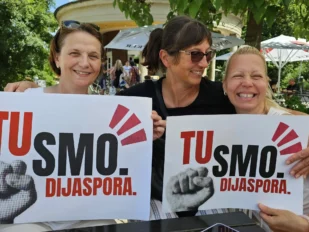
Finally, with the Vidovdan protest, the young people - although it was probably not their conscious intention - broke the narrative that the government is recklessly spreading about traitors and about itself as the only defender of Serbia.
They took over even a part of the "national deed" from professional Serbs and thus gained significant capital for the extraordinary elections that will come anyway.
Maybe faster than we think.