Academician Ljubomir Simović, first and foremost a poet. Author of famous dramas that are still played in theaters all over Serbia and the world, winner of many awards. Raised in Užice, lives and writes in Belgrade. He is currently preparing a book of poetry A fish with two tails (Archipelag), and soon a book of his interviews will be published (Vukotić media), which is unique continuation those of his books - Forge on Čakovina, Gallop on snails, A new gallop on snails, Geese in the fog, The Promised Land, "Titanik" in the aquarium i Frogs in a row in front of the horseshoe - in which he writes about social and political topics. Ljubomir Simović does not want to remain silent about the reality that is happening to us.
That is why, unfortunately, this will not be a conversation about life and creativity, about the power of literature and theater, but about this moment, about the people who lead the country, about ignorance and forgetfulness, about haranguing by the government and the absence of responsibility. Finally, even Laza Kostić's verses that naturally come to mind when listening to the speech of the country's president. We have to deal, as Ljubomir Simović said, with what we are running away from.
"WEATHER": What today's attitude towards words reveals about the society we live in and the people who lead us. When I say "word" I also mean the relationship to the given word, but also the choice of words in the public space, about repeating patterns, about the way of communication, about literacy, about knowledge...
LJUBOMIR SIMOVIĆ: In our political life today, hate speech is simply rampant, and ignorance has never ruled the public scene as much as it does today. I have already pointed out the incredible fact that in our time we elected a man as president of the republic who declared that he would have nothing against Serbia becoming a Russian governorate! How sick are those who pretend to manage the destiny of this country is also shown by the announcement of the organization "Healthy Serbia", which says that "there is nothing against organizing a referendum with the question of whether the citizens of Serbia agree that Kosovo should be temporarily handed over to Russia for management!" You can Can you imagine the brain behind such a statement? What kind of relationship can we have towards words and their meaning, and how much can we be bound by what we say, if our thought and knowledge are at this level?
Listening to our speakers, I can't help but think of Günther Grass's line: "He speaks steadfastly about nothing."
In our country, there seems to be an organized forgetting of everything. And maybe we are talking about some kind of compromise, to which a good part of people agree?
In our country, many things are based on thoroughly forgetting everything that happened yesterday. If we remembered what some politicians said, represented, did, during the nineties, would any of them be in the top of the government today? The painter Dušan Otašević did not accidentally create his object, the "Amnesiator", a machine that erases memory, that erases the connections between cause and effect, and which I mention today for the umpteenth time.
You mention a compromise "to which a good portion of people agree". Many people are blackmailed and intimidated, and in that fear they agree to anything. Look at the harangue that is being waged against Professor Dana Popović and Judge Majić, and you will see how those who oppose them fare. Neither words nor means are chosen in that harangue. Following all that, I can't help but remember the lines of Česlav Miloš:
We were free to advertise ourselves with the screeching of dwarves and demons,
But pure and worthy words were forbidden
Under threat of such a severe punishment, that who dared to utter one of them,
Sam already considered himself lost.
Otherwise, people from the top of the government protect their interests with the most unexpected compromises. Vučić, for example, took over the party founded by Toma Nikolić. But Toma did not come out of it without compensation either: he was appointed, probably as an expert, as the head of an office for economic cooperation with China and Russia. His reconciliation continued, so he was allowed to stay in the president's residence, even though he has not been the president of the republic for a long time. Thus, the residence of the President of Serbia was turned into "Uncle Tom's Cabin". And recently I read in some newspapers that the former president intends to build a small hydroelectric power plant himself on a mountain river.
I am no longer surprised by anything for a long time. Everything is possible with us. And that the day of the liberation of Belgrade, October 20, is sometimes the sixteenth, sometimes the nineteenth, and maybe we will see it dawn sometime in November. Depending on the schedule of obligations of a high-ranking person who comes to visit us.

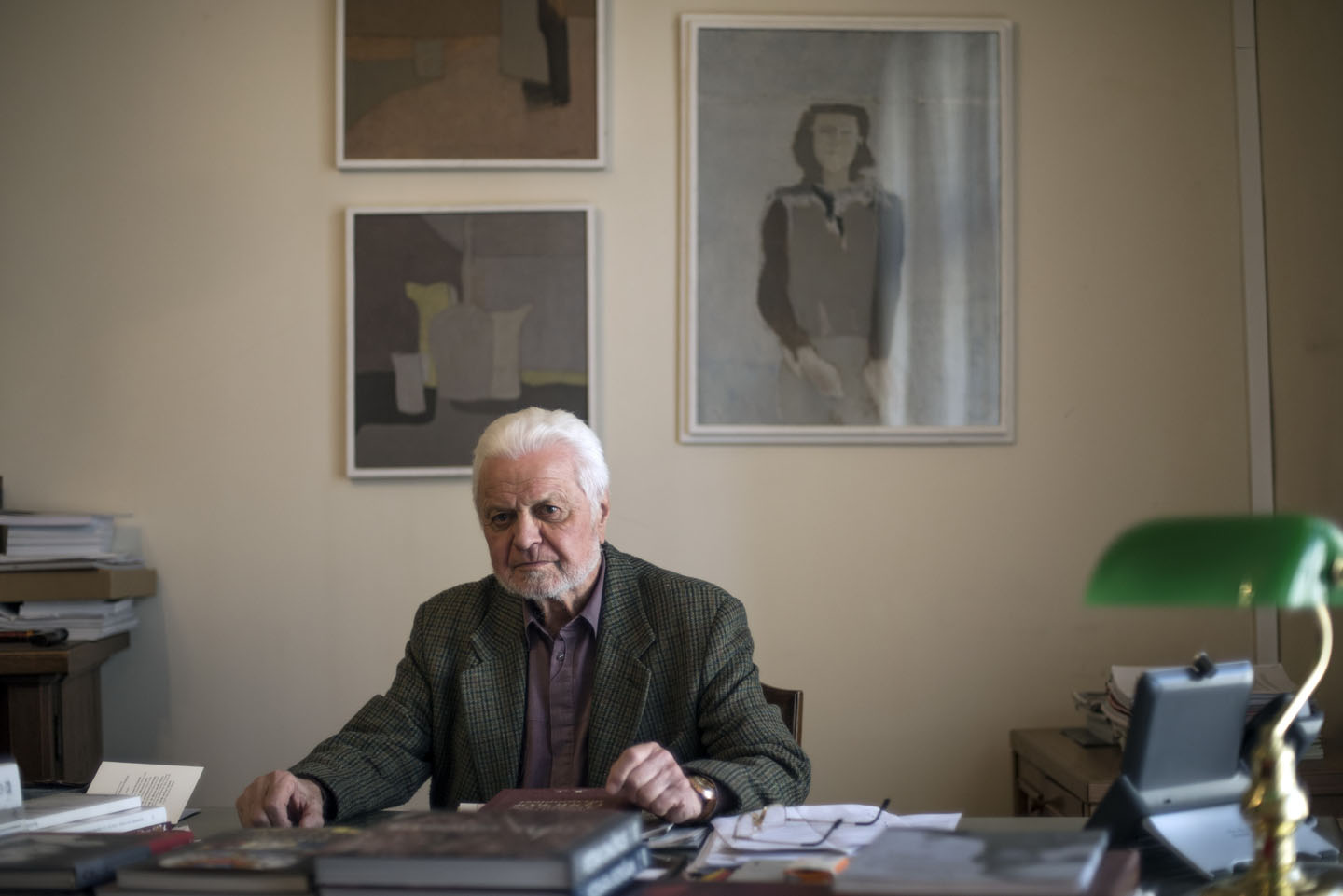
Ljubomir Simovic, poet, academician. 29.10.2019. Belgrade. Photo by Marija JankovicPhoto Marija Jankovic
What about the question of responsibility? How is it, for example, it is possible for the president of the state to say something and promise and he says and promises a lot without all that he promised coming to nothing, and he will not be held accountable in any way for that?
And who should call him to account? The president, as far as I can hear, stated that he goes to sleep three hours after everyone else and wakes up four hours before everyone else. He wants to emphasize that he is constantly awake, and I would rather say that, if what he says is true, he is constantly sleepless. Which is to say, constantly distracted. His numerous and endless monologues are sometimes difficult to follow. Not only to journalists, he often interrupts himself. But I would like to keep your attention, if you allow, on one text in which his concentration is undeniable. It is about the author's text "Elite and Plebs". The definition "Style is a man" has not seemed to me as accurate and convincing for a long time as when I read that work. He practically did not say anything about the "elite" and the "plebs", and their relationship, but he did, unintentionally, about himself, his nature, his mentality and character.
said a lot. In fact, his style said about him what he might not even want to say about himself.
But back to your question about responsibility. Staying in power for a long time, politicians gain so much power that they lose their sense of reality. They believe that this absolute power naturally belongs to them, and they perceive any resistance to their authoritarian behavior as an attack on their natural right, as an invasion of their private property. In that feeling of unlimited power feeling in charge and competent for everything. And you know what it's called and where it leads.
When you look around you, when you look at where we are, do you feel defeated?
When a man whose name rhymes with "diploma" was elected president of the country, I thought we had reached the bottom, that we couldn't go any lower. I soon realized that I was mistaken. The decline continues. Does that make me feel defeated? If I felt defeated, I would be silent in some mouse hole. And I wouldn't say all that I'm saying. And I am speaking because I think that it is necessary to speak, in order for us to rise from this bottom that opens up under our feet.
You are a witness of different times. How Aleksandar Vučić and Aleksandar Vulin happened to us again, how Siniša Mali and Goran Vesić happened to us? How did this return to the past and turn our backs on the future happen to us?? I don't mean just specific people, but also to return and regress as a phenomenon.
If all value systems had not been abolished, would one of the people you mention become, no less, than the Minister of Defense? When I see generals and officers calmly saluting that minister, I wonder how they feel. And I wonder how the newly elected bishop Nikodim of Dalmatia must have felt when his enthronement in the church in Šibenik, as Vučić's official envoy, was banned by the Minister of Defense. Alexander. Vulin. By sending the Minister of Defense, as his emissary, to a church ceremony, Vučić reminded Croats of his role in the wars of the 1990s. I don't believe he did it by accident. And you see if it was smart.
Speaking of doing or not doing smart, no one bothers to ask what the profession has to say about what they do. Petitions are not read or taken into account by anyone. Recently, Department of Language and Literature SANU, of which you are a member, supported the initiative of the Department of Historical Sciences to return the question of the appearance of the Belgrade Fortress and Belgrade to the competence of experts. At the time, you wrote about the destruction of the capital city's identity with projects like Belgrade on the Water. Did you expect that the only reaction to that would be that the deputy mayor accused academician Matija Bećković of wanting to return Serbia to the Middle Ages?? Were you expecting something a little more constructive??
Hand on heart, seeing that to the volumes of texts written about Belgrade on the water by architects, urban planners, lawyers, economists, and many others, there is no reaction, no "constructive reaction", as you say, I did not expect this announcement either. The deputy mayor tried to downplay the importance of that announcement, claiming that it was not the Academy that was behind it, but Matia. Vesić, with reason, felt affected by that announcement and defended himself from it as best he knows how. I will take the liberty of reminding you of the sentences with which that announcement ends:
"With his determination to build a cable car with a gondola on the Belgrade Fortress, despite all the arguments and warnings, Vesić threatens to call into question the cultural and historical authenticity of this monument." Such his reaction to the judgments and warnings of experts - whose arguments he qualifies as 'hysteria' - instructs us to most resolutely oppose leaving the fate of historical and cultural monuments, and the identity of our cities, to people whose ambitions and power are clearly disproportionate to their education."
In an interview from 1998. year you stated: "When I came to Belgrade definitely, 1. September 1955, it was a city sir. And today it is a city beggar, degree garbage dump. He is lost and neglected, as this whole of our wasted country is lost and neglected, which is falling apart. And yet, and in such a Belgrade I breathe easier. " Do you still breathe easier in Belgrade?? Starting with the specific one; today as we speak, Belgrade is the most polluted city in the world.
I do not ignore the problem of air pollution, nor the consequences of that type of pollution. But I have something else in mind.
After the liberation of Užice, at the very end of the Second World War, a rally was held on the Wheat Market - now Partizan Square. I remember that on the roof of the market scale, where participants and speakers performed, music professor Dragoljub Jovašević sang:
He branched out, evo, but also May Day,
Russians in Berlin are drinking tea now.
At that rally, as a third grader, I recited a satirical poem about occupied Belgrade. I forgot, a long time ago, that song and who its author was. But, looking at what has been happening in Belgrade in recent years - from Slavija and Savamala, through Belgrade on the water, through the abolition of the Main Railway Station, to the excavated boulevards, to Republic Square, to the moving of the living Old Sava bridge from the river to the meadow, to the mast, and to the cable car and the gondola on the Kalemegdan fortress, after so many years, I remembered the opening lines of that satire:
Belgrade, the famous old town,
what the hell are they doing out of you!
If we turn back and look, can we find anything in Serbia that was spared??
General robbery is legalized. For someone's personal benefit, they steal rivers and streams from mountain villages and, building small private hydroelectric plants, close them in pipes. We will have rivers and fish in the pipes. For one's personal gain, the survival of the remaining villages is being questioned.
I have to ask you something... I don't know if you will agree, but i will try. Could you write us a few sentences about your eventual Secret Plan of the City of Belgrade?, the way you did when writing the Secret Plan of the city of Užice? What would be the names of ordinary citizens, which make up the spirit of the city, gave to the streets of Belgrade?
I can't describe to you how much pleasure I had working on that Secret Plan of the city of Užice! I gave the streets the names of artisans, barbers, drivers, coppersmiths, postmen, professors, football players, actors, midwives, municipal drummers, bums... An unusual friend of the snake, Desimir Gujar, and Pipelja the driver, and goal scorer Keblo, and Jevdjo also got a street. baker, and photo Lazić, and Stevo Kinez, and to the famous Zora Čučkuša, who cooked for the refugees on Varda in a large cauldron beans, I assigned one avenue. In that secret plan, all the power of the people who gave tone and character to the Užice of my childhood came to life. Belgrade's secret plan, however, would have to be made by someone else, someone who, in childhood, experienced Belgrade the way I experienced, remembered and revived Užice.
You mentioned, when I called you to arrange this interview, to keep writing the diary, that is, notes. I know you are a diary from the time of the 1999 bombing. published under the title Geese in the fog. If it's polite to ask someone, what's in those notes today, and it concerns all of us?
I have never been tempted to write a diary. I even found it too pretentious. But when the bombing began on March 24, 1999, I felt a kind of moral obligation to write down everything I see and hear, everything that happens. I acted, if I may say so, like a microphone and a camera. I wanted to leave an authentic testimony about those days. The diary ends on June 14, in the red salon of the Patriarchate, with a conversation to which Patriarch Pavle invited us... The next day, a note was added about how Milosevic lavishly distributes promotions and ranks.
I never kept a diary again. But a man who is engaged in my business must have a notebook in which he writes down something that seems important to him, and that should not be forgotten. And even if I hadn't written it down, I certainly could never forget what I heard from a woman one Saturday at the beginning of August, while waiting for the bus at Byloni's market. Three elderly ladies were sitting at the bus stop and talking. One of them said:
"We should all go to the polls, and we should all vote." If only this one - I'm leaving out the epithet she used - if only this one would leave, even if someone came and burned!"
You heard that Aleksandar Vučić, at the ceremony on the occasion of the eleventh anniversary of the founding of the Serbian Progressive Party, promised to young people "Serbian dream"?
Yes, I heard. And I remembered Laza Kostić's lyrics:
After those bright dreams,
those wonderful knights,
those pictures, those glories
this java!
(Published in issue 1504, October 31, 2019)
Read daily news, analysis, commentary and interviews at www.vreme.com