I met him more than seventy years ago when I published the first verses and an essay on the occasion of the centenary of the Hungarian Revolution and Sándor Pétefi, and the head of Agitprop Dobrica Cosic (December 29, 12 - May 1921, 8) wanted to meet the "young poet from Vojvodina". However, I never belonged to his circle of close friends. Later, I disagreed with him on many things, but he helped me several times in my life, and I hope that I have repaid him to some extent.
I remember our last conversation ten years ago, which started unpleasantly through my fault. I was walking with my wife, Knez Mihailova, when he hurried past us, and I joyfully shouted: "Gedzo!" He turned, stopped, waited for us to approach him. I could see that he was uncomfortable, he didn't like his old nickname. I knew that, so I apologized to him and said that it was unintentional, he politely said that it doesn't matter. And so we spoke a few words about the Academy of Sciences and Arts, which he was about to enter.
I met him as "Comrade Geju". As a native of Vojvodina, I didn't know what that word originally meant, especially I didn't think it sounded disparaging, nor did anyone think so at the time. For me, it was just like when someone is called "comrade Tempo", "comrade Crni", "comrade Gido" or "comrade Tito".
Dobrica then recommended me to the editorial office of the youth newspaper "Mladi Borac". I was very proud when I first entered the, for my then concepts, solemn building in International Brigade Street. Thanks to that, I later got a job in the newspaper "Omladina".
In Novi Sad, in 1948, I graduated from the Civil Engineering Secondary Technical School, with a diploma that only allowed me to enroll in the Faculty of Civil Engineering, which I did, but later I wanted to switch to German Studies, which was not legally possible. I complained to Dobrica. He phoned someone, so it became possible for me to become a Germanist. Of course, it is not his fault that I did not finish those studies either.
I did not agree with the politics that arose from his national convictions. Ali somehow went along with him. Dobrica, born in Velika Drenova, a village in Western Morava, the heart of original Serbia, was a Serb in body and soul. He had shaken off the mantle of false internationalism, but it should also be emphasized that he always rejected the Chetniks.
Dobrica spoke in a direct, friendly voice. It seems the same to me when we talked when he was a member of the Central Committee or later, when we met by chance or agreed on certain topics, for example about Hungary, or when he was a "renegade". There was an honest immediacy in him. He never emphasized authority, neither as a leading politician in Tito's Yugoslavia, nor later as the "father of the nation".
Milutin Doroslovac - in the world, but also in our country, better known as Milo Dor - visited him once in the building we call today the Palace of Serbia, when he was sitting there as president in the cabinet equipped for Tito. He told him that he felt uncomfortable there, but that it would not be right for him to choose something now and ask for some changes.
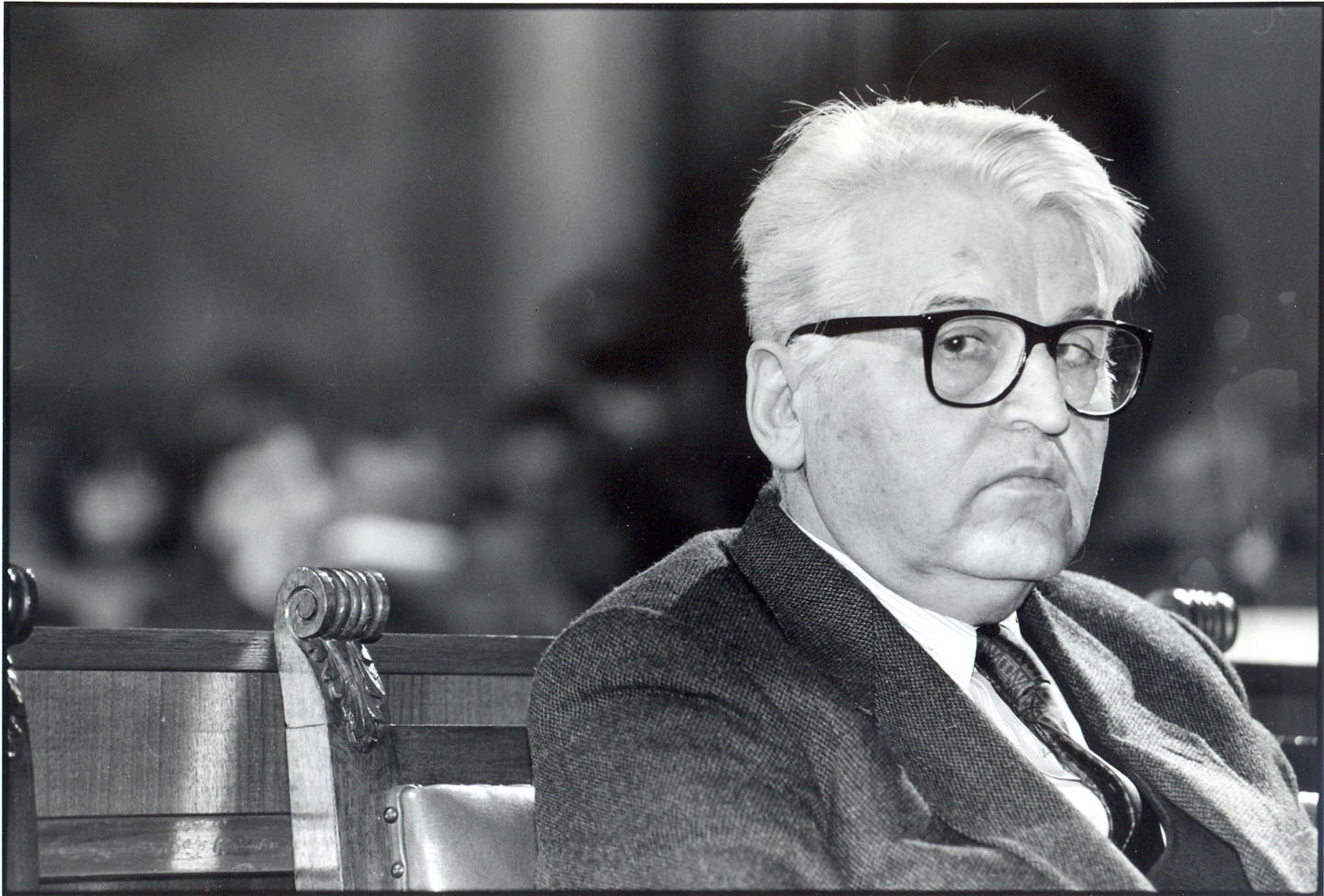
Even in his old age, he still had that naughty tuft of hair and it looked good on him. With someone else, one might think that he carefully cares for that detail, stands in front of the mirror and fixes his hair, but I can't imagine that with him. On Dobrica, everything seemed natural, which, for example, could not be said about Tito - Tito's dyed hair and neat hairstyle always seemed artificial.
We were in Budapest at the same time Hungarian Revolution of 1956. After I published my novel "One Hungarian Autumn", Dobrica called me on the phone: "Why do you write that I behaved like a coward?" ?'
When it is Alexander Solzhenitsyn published the novel "August 1914", I wrote in a German magazine that Dobrica Ćosić is a greater writer than the Russian Nobel laureate. As an adviser to the Yugoslav Embassy in Bonn, I said in a lecture on literature at the University of Cologne that Dobrica Ćosić, despite having problems with Tito's party, is one of the greatest Yugoslav writers. A party investigation was then launched against me.
And when, as the secretary of the Presidency of the Union of Writers of Yugoslavia, I organized an international meeting of writers in Budva, I invited Dobrica Ćosić, of course, and personally begged him to definitely come, even though the government was against it.
I once wrote that he “the greatest Serbian novelist of the nineteenth century". It wasn't a mistake, I meant to say that I think it's old-fashioned writing. I think he read that too and just smiled.
Now, when he has been gone for a long time, and some remember one or another of his virtues, others his shortcomings and mistakes, my feeling is: I loved that man.
Read daily news, analysis, commentary and interviews at www.vreme.com